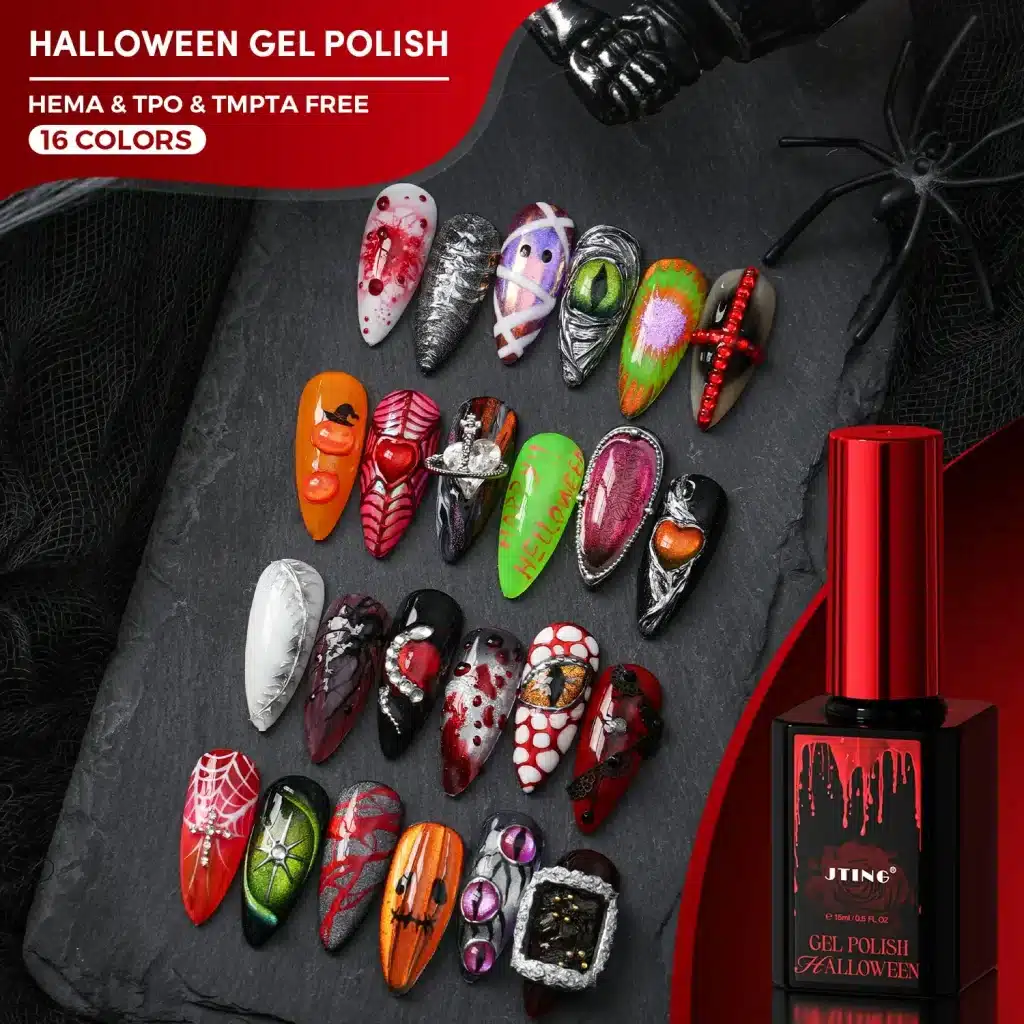
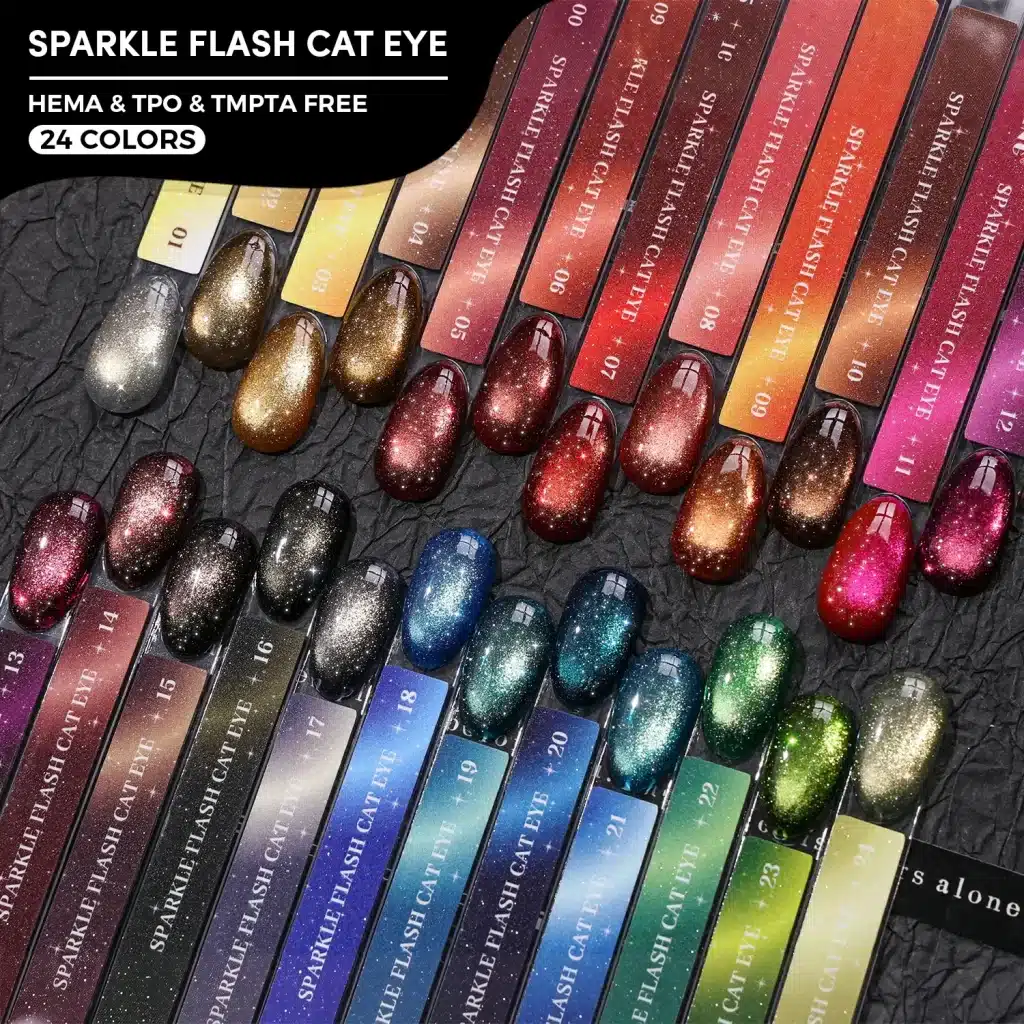
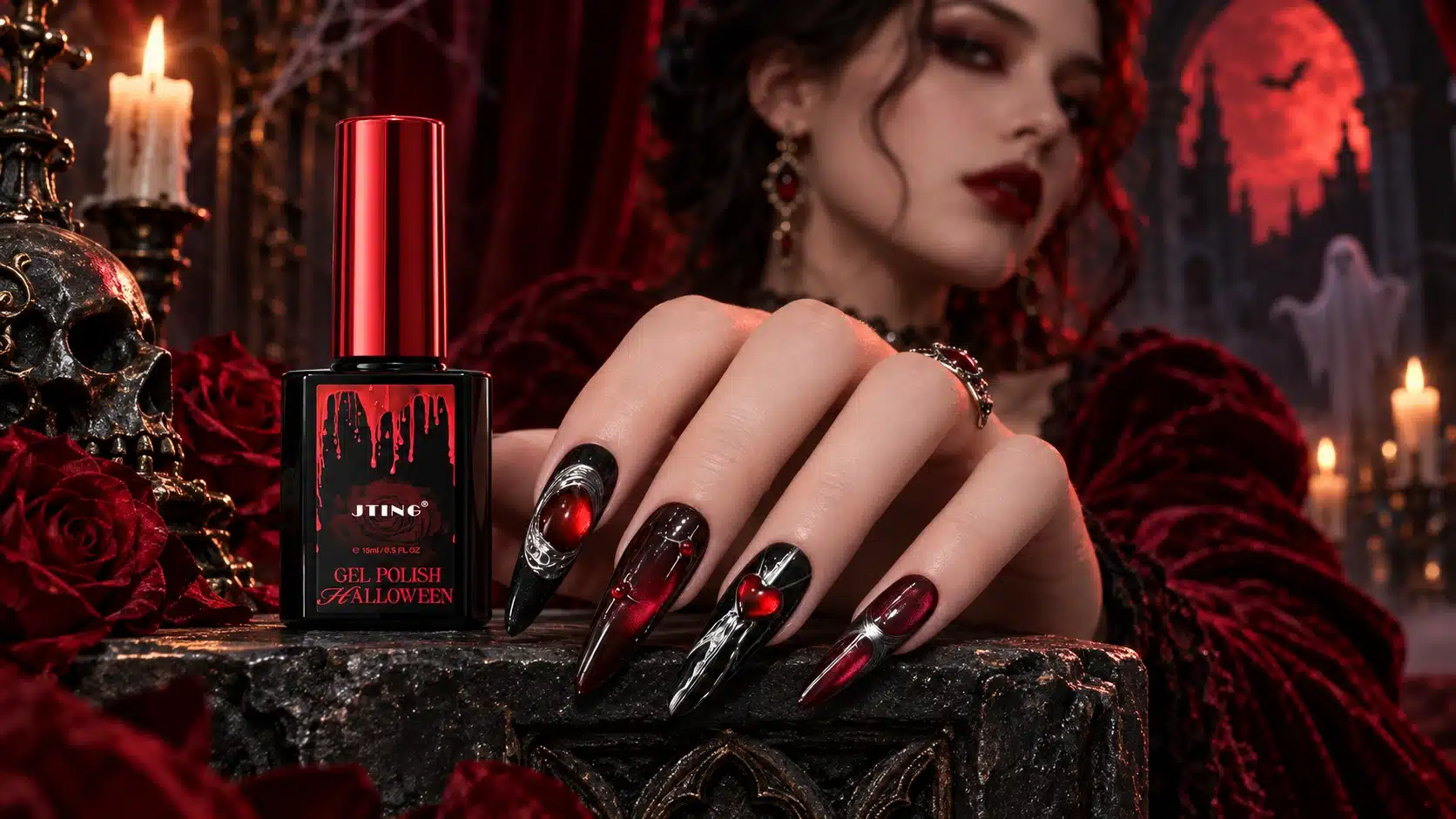
JTING introduces Halloween Gel Polish, a seasonal collection that brings several different nail art effects into one coordinated product story. The range combines solid colors, black and white detailing options, a glow-in-the-dark gel, magnetic cat-eye shades, and a Dark Red and Drip Top Coat pairing. For nail brands, distributors, and salon suppliers, the opportunity is to build an understandable seasonal offer around those different roles.
A collection can look convincing in a campaign image and still leave a buyer with practical questions. Which products need a magnet? Which two belong together? What is created by the gel itself, and what comes from additional decoration? How should a brand evaluate samples, explain the range to professional customers, and organize a launch without treating every bottle as interchangeable?
This guide answers those questions through the JTING Halloween Gel Polish collection, model K07. It connects the product's numbered range with professional application planning, design combinations, sample review, private label decisions, and downstream sales. The commercial examples are planning suggestions for your business, rather than reports of customer sales results.
If you already know the collection, visit the JTING 16-Color Halloween Gel Polish product page for the product overview and inquiry options. If you are evaluating it for the first time, start with the product roles below. Understanding those roles makes the later decisions about samples, training, and assortment much easier.
1. A New Halloween Collection with Several Product Roles
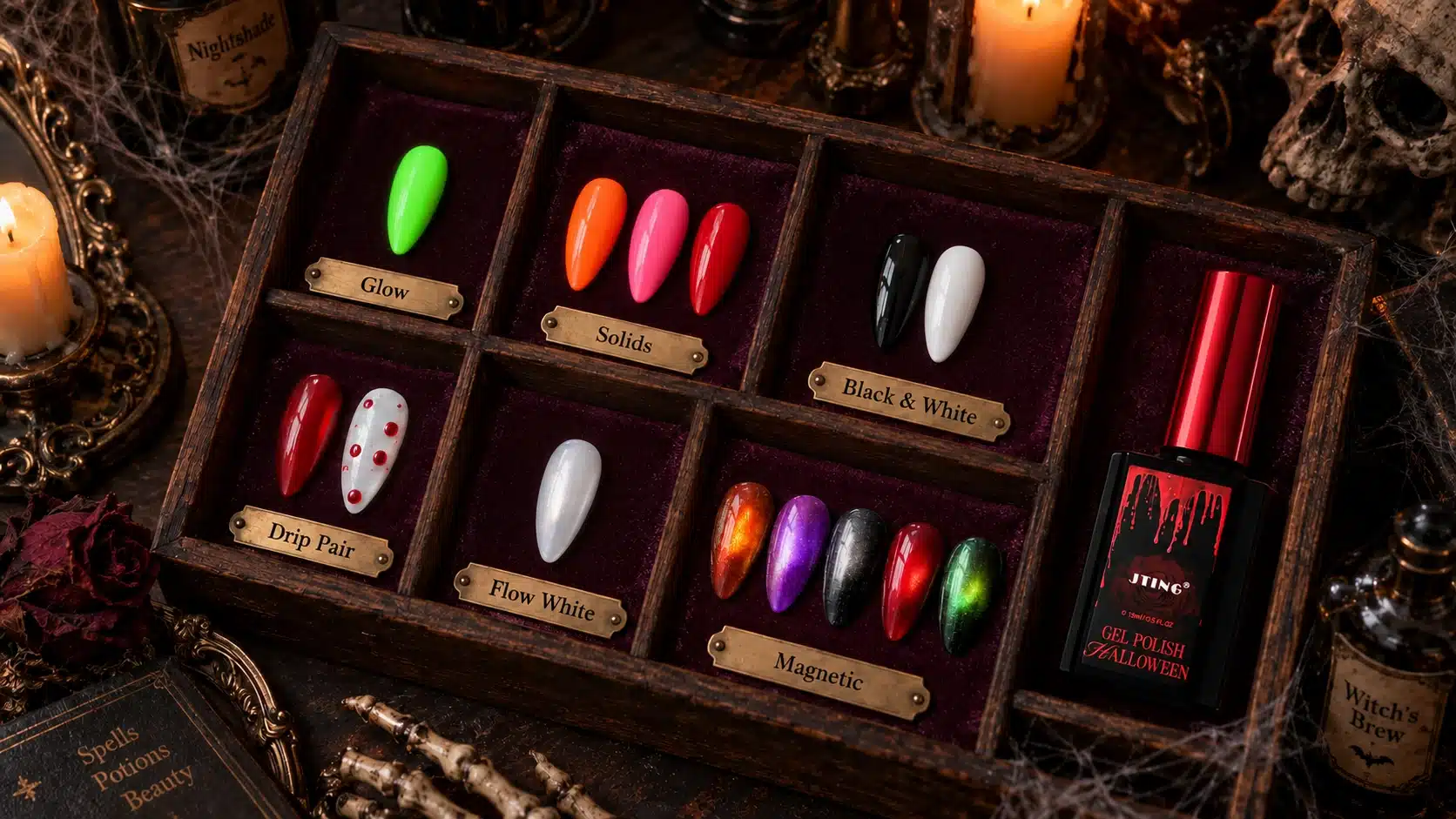
The collection is presented as 16 numbered shades and effect products in 15 ml bottles. That description matters: a range of 16 numbered products is not automatically a fixed retail box containing 16 identical types of gel. Bottle quantities, chosen assortment, display materials, and accessories belong in the agreed supply configuration.
The new-product story is the combination of functions within a recognizable Halloween presentation. Solid colors establish the palette. Black and white support contrasting details. Magnetic finishes introduce moving highlights. The glow product provides a separate change in viewing conditions, while the paired drip products create another distinct decorative direction. A buyer can evaluate how these roles fit a seasonal release without assuming every customer needs every effect.
| Product Reference | Role in the Collection | What a Professional Buyer Should Notice |
|---|---|---|
| No. 01 | Glow-in-the-Dark Gel | Its normal-light appearance and its appearance in darkness need separate explanation. |
| Nos. 02–04 | Seasonal Solid Colors | Orange, pink, and red provide color options alongside the special effects. |
| Nos. 05–06 | Super Black and Super White | These support contrasting backgrounds and painted details. |
| No. 07 with No. 08 | Dark Red and Drip Top Coat | The products form a pair for the beaded drip effect; evaluate and explain them together. |
| No. 09 | Flow White Cat Eye | A light magnetic direction within the range. |
| Nos. 10–16 | Seven Additional Cat-Eye Shades | These extend the magnetic selection and need a compatible magnet for effect shaping. |
Use the original numbered chart and approved samples when choosing products. Decorative artwork, lighting, display shape, and background styling can make a collection attractive, but they are not acceptance standards for color or magnetic performance. A sales team should be able to move from a styled image to the corresponding sample reference without guessing.
One clear introductory statement is more useful than several exaggerated claims: this is a mixed-effect Halloween gel polish collection. Calling it a sixteen-color cat-eye set would misdescribe the nonmagnetic products. Calling the complete range glow-in-the-dark would also create the wrong expectation. Accurate category language helps buyers explain the launch to their own customers and prevents avoidable confusion when the first order arrives.
2. Plan the Complete Application System before Demonstrating the Collection
Professional use begins with a system, not a bottle alone. The selected color or effect needs an appropriate substrate, preparation method, base and finishing products where specified, suitable tools, and the prescribed curing process. The details can differ between effects. A general gel routine should therefore provide the working framework, while the selected product instructions determine the actual sequence.
For staff training, prepare a demonstration sheet that identifies the Halloween product by name and shade reference. Record the base, any background color, finishing product, lamp model, and accessories used. Keep this sheet with the sample rather than relying on the technician's memory. A distributor can then send the same information with a demonstration video, and a brand can use it when answering application questions later.
The practical preparation sequence is to identify the intended result, assemble the confirmed compatible system, prepare a practice sample, demonstrate the effect according to its instructions, complete the specified cure and finish, and record the outcome. This is a demonstration-planning sequence, not a substitute for product-specific instructions. In particular, it does not establish the intermediate curing steps for the drip pairing.
Separate Tools, Effect Products, and Decorative Additions
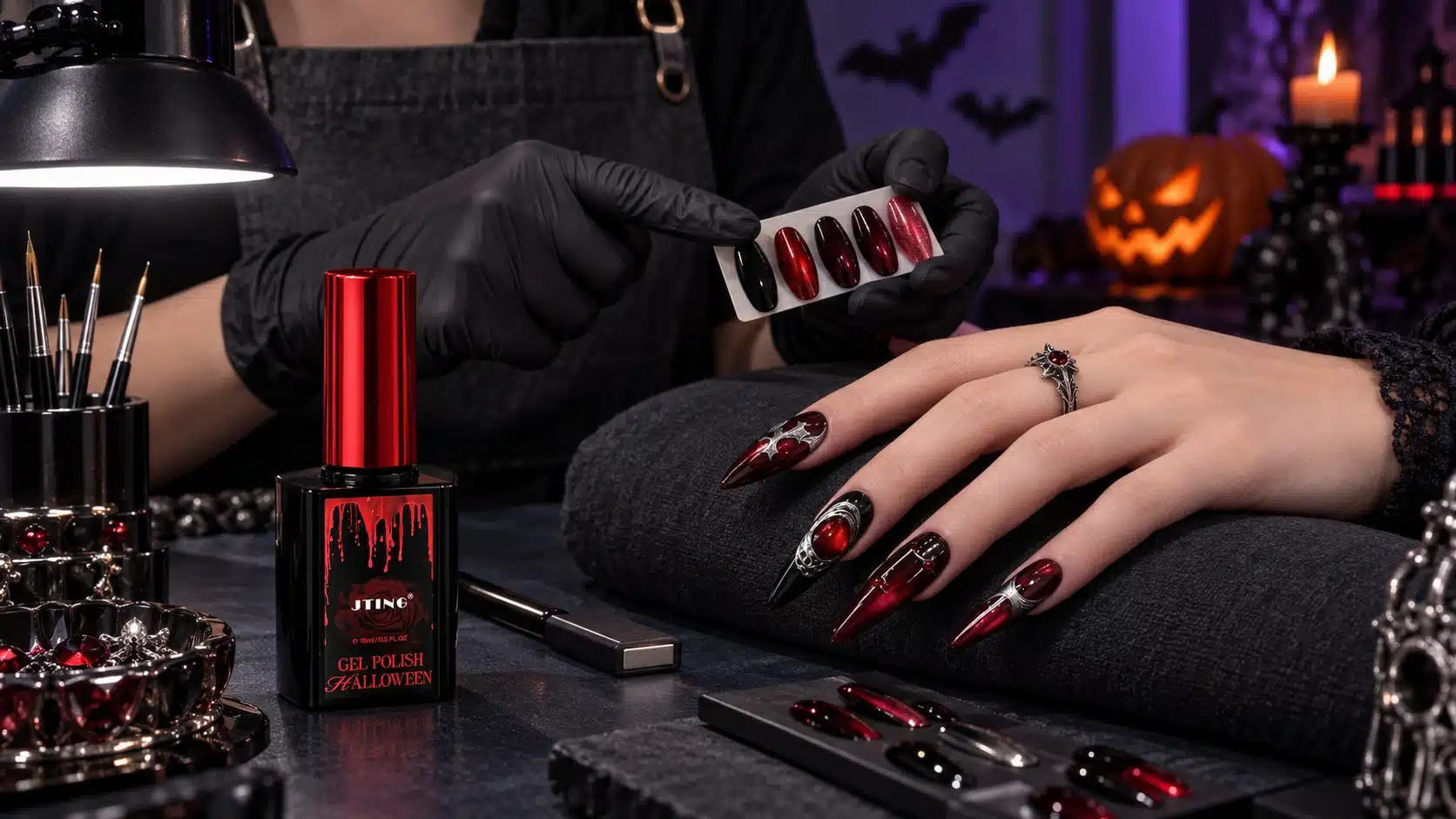
A magnet changes the appearance of a magnetic gel; it does not replace the curing lamp. A drip-effect product has a specific pairing role; its name does not establish that it is a universal finishing coat for the whole collection. A silver ornament, crystal, or raised frame shown on a decorated nail is an additional material, not proof that the color gel creates that structure by itself.
Organize the working materials into three groups. The first contains the Halloween products being demonstrated. The second contains the compatible preparation, base, finishing, and equipment system. The third contains optional art materials. This grouping makes a purchase discussion more precise because the buyer can distinguish the color order from the resources needed to reproduce a particular promotional design.
| System Element | Question to Resolve | Information to Keep with the Demonstration |
|---|---|---|
| Selected Halloween product | Which effect and numbered reference are being shown? | Product name, reference, and batch identification where available. |
| Base and background | What approved surface and background were used? | Product identities and preparation instructions. |
| Effect tool or paired product | Is a magnet or the Dark Red and Drip Top Coat pair required? | Tool identity or both product references. |
| Curing and finishing | Which instructions apply to this exact combination? | Lamp identity, prescribed sequence, and applicable finishing guidance. |
| Optional decoration | Which elements are separate from the gel effect? | An itemized list for the artist, sales team, and buyer. |
Keep Curing Guidance Specific to the Product
The collection's source information identifies UV lamp curing. It does not establish a universal curing time for every effect, every layer, or every lamp. Light exposure that activates a glow is also a different requirement from curing gel. A successful-looking photograph cannot settle either question.
Before using samples on clients or issuing your own instructions, obtain the applicable curing and removal guidance from JTING for the selected products and system. Your technical request should identify the products, base, lamp, intended layers, finishing materials, and removal method to be assessed. Ask for a sequence that addresses that combination. A timing recommendation from another brand or a single remembered number cannot supply the missing product-specific information.
For a B2B buyer, this information is part of a usable supply package. It gives the educator a consistent reference, helps customer service ask useful questions, and prevents a reseller from improvising different guidance in each market.
3. Demonstrating the Glow Product Clearly
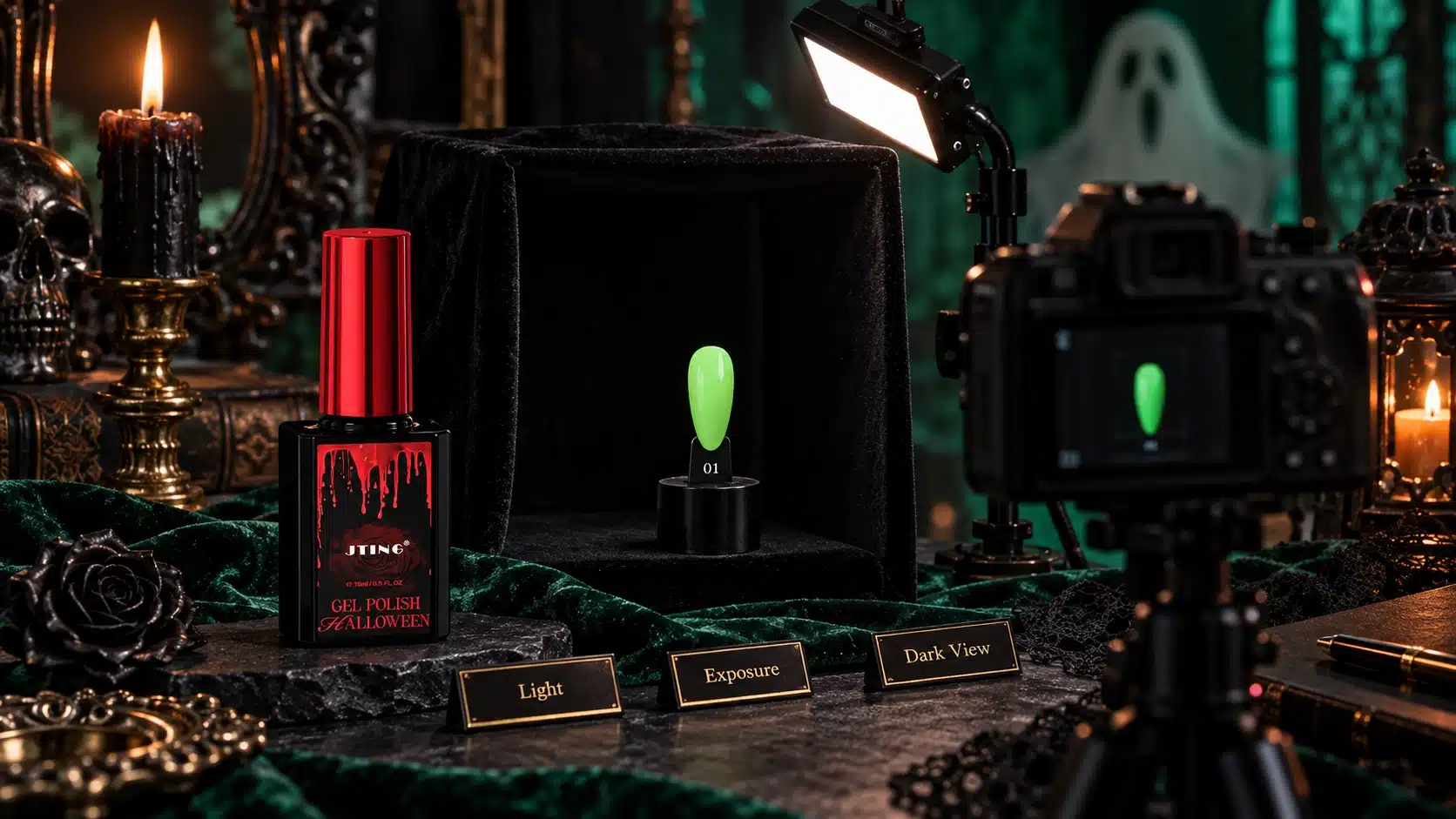
No. 01 is the glow-in-the-dark product within the Halloween collection. Its normal-light appearance and its glow after light exposure are two different observations. A buyer needs to see both to understand what professional customers will receive and how they can present it.
Use the same finished sample for a normal-light view and a dark view. Record the light source and exposure conditions used before the second image. Where practical, keep framing consistent and record any changes to camera settings. A brighter photograph can result from different photography choices; it should not be treated as proof of a stronger or longer-lasting product effect.
For an internal review, decide what question the demonstration should answer. It might be whether the effect is understandable in a short sales video, whether staff can reproduce the demonstration, or whether the sample matches the intended seasonal presentation. Those are useful, specific questions. They are different from claiming a measured glow duration, which needs an actual test method and supporting observations.
Build a Useful Glow Demonstration Record
A short record can include the product reference, preparation system, light source, exposure conditions, viewing environment, and elapsed time when each image was captured. If the objective is a time comparison, use a planned sequence with timestamps. If the objective is simply to explain the effect, label the two viewing conditions clearly and avoid duration claims.
For a simple buyer-facing sequence, photograph the numbered finished sample under ordinary viewing light, record the light exposure used for activation, and then photograph that same sample in darkness. Keep the sample reference visible in the accompanying record. Use an actual elapsed-time label only when it was recorded during the shoot. This sequence explains the product without borrowing a brightness or duration claim from an unrelated glow gel.
A catalog should not promise all-night brightness, a fixed number of hours, or the same appearance in every environment without supporting test evidence. It can accurately identify the glow product and show the conditions under which the actual demonstration was made.
For distributors, keep the demonstration available alongside the order reference. A customer who has only seen a bright promotional picture may need a concise explanation of light exposure and viewing conditions. For brands, make sure the creative team and customer service team use the same approved description. This creates a more useful presentation than allowing each channel to invent its own glow claims.
4. Using Magnetic Cat-Eye Effects as a Professional Demonstration
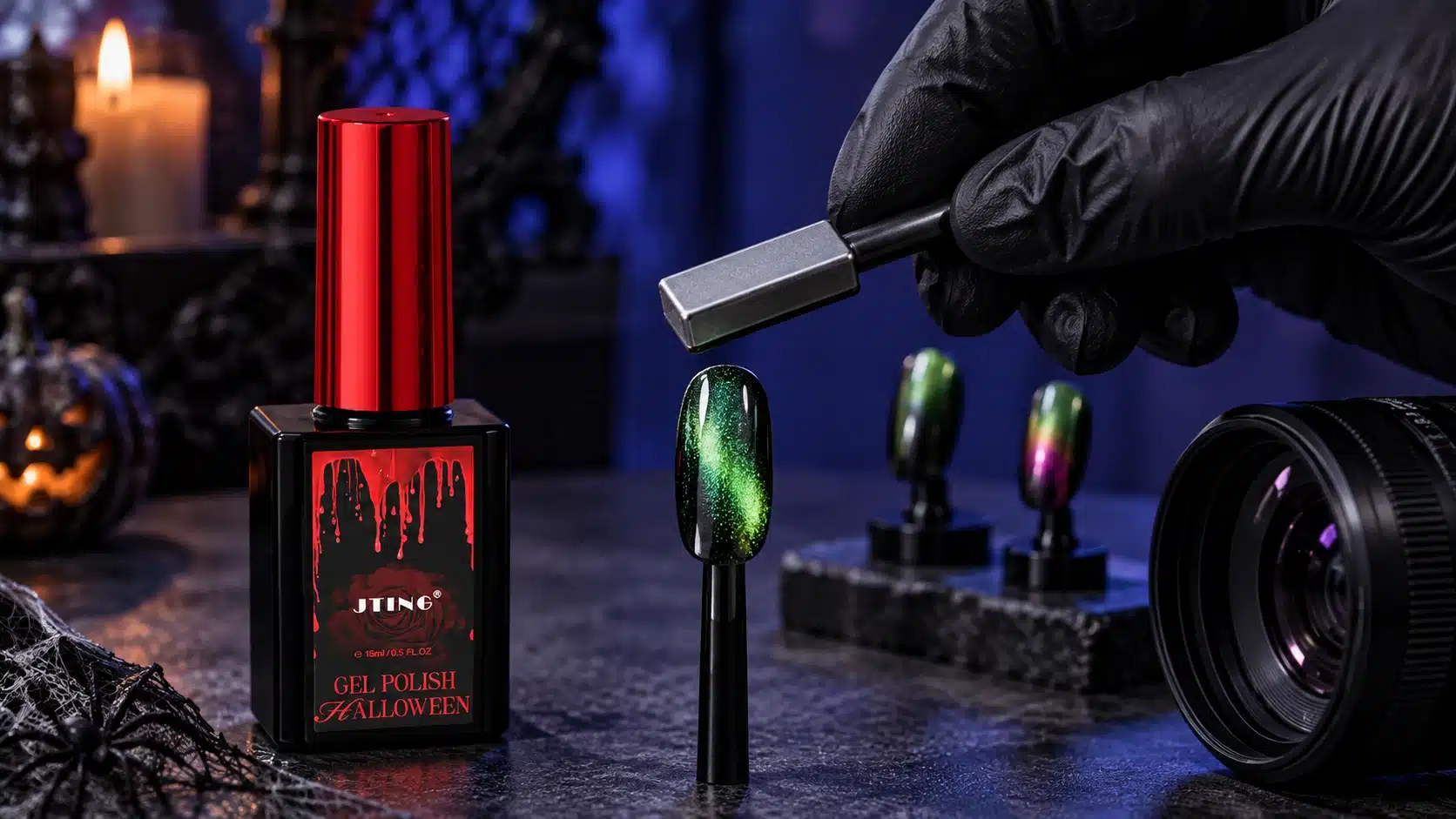
Nos. 09–16 form the magnetic portion of the collection. A compatible magnet is used over the uncured magnetic gel to position the visible effect before the prescribed cure. Magnet placement and angle influence the appearance, so training and product presentation need to show the manipulation as well as the finished nail.
The useful distinction for the buyer is between creating the optical pattern and completing the prescribed cure. The magnetic manipulation occurs while the gel is uncured; the product instructions determine the compatible tool and subsequent procedure. Teach those as separate parts of the demonstration so staff do not describe the magnet as a curing device.
Make the Comparison Useful to a Buyer
Start with the same approved preparation and background when comparing shades. Select one magnetic placement for a baseline demonstration, record the tool used, and film the same sample from more than one viewing angle. Then test an alternative placement on a separate sample if you want to demonstrate versatility. Changing the shade, base, magnet, and lighting together makes it difficult to understand which change produced the difference.
A narrow highlight and a broader luminous appearance can support different creative directions, but a buyer should approve the actual sample rather than rely on a generic effect name. No. 09 also deserves its own sample view: the lighter Flow White Cat Eye direction should not be represented only by photographs of deeper shades elsewhere in the range.
Explain the Effect without Promising Every Design
For a salon supplier, a concise before-and-after demonstration can show what the magnetic tool contributes. For a distributor, a short angle-changing clip can help a retailer explain the finish. For a private label brand, a consistent set of product images helps distinguish the available shades without exaggerating differences through unrelated photography.
Do not imply that one tool position guarantees every popular cat-eye pattern. The selected magnet, application conditions, and technician's technique matter. When planning training, first establish a repeatable result with the approved system, then document the variations that have actually been demonstrated.
If a trial does not resemble the approved example, gather the shade reference, base, tool, lamp, sequence, and a short process video. This evidence supports a practical review. A text message saying that the gel is “not magnetic enough” provides much less information and can obscure a mismatch in the demonstration method.
5. Understanding the Dark Red and Drip Top Coat Pair
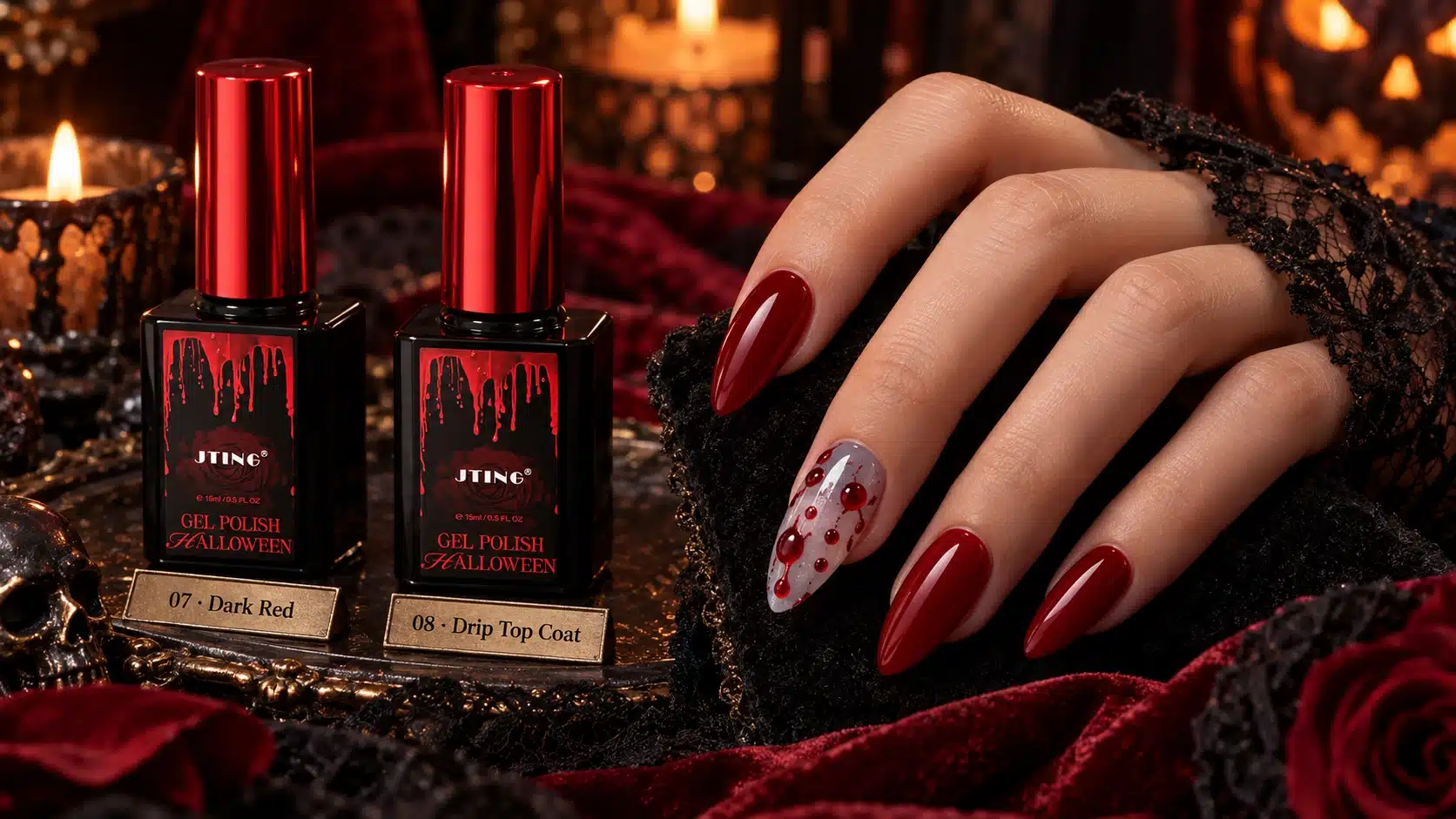
The beaded drip effect is associated with Dark Red No. 07 and Drip Top Coat No. 08. Treat them as a relationship within the collection, not as two unrelated colors. The pair should remain visible in sample requests, demonstration records, and downstream product explanations.
The source description places the drip top coat underneath the Dark Red application and describes allowing the bead effect to form. However, the available material does not establish every preparation and intermediate curing step. Before publishing a complete operating procedure, obtain the confirmed sequence from JTING. A diagram may explain that the two products work together, but it should not invent a layer-by-layer cure schedule.
Review the Finished Effect as a Complete Sample
Ask a professional demonstrator to produce the approved result, then record the application system and finished appearance. Useful visual review points include where beads form, how the decorative area is arranged, and how the result fits the intended design. Inspect the completed sample from the side as well as from above, particularly when a styled image includes additional raised decoration.
A beaded red design and an applied red ornament may look related in a small photograph while involving different materials. Keep those distinctions clear in your product descriptions. If an art sample includes a metal frame, a crystal, or another embellishment, list it separately and use the relevant attachment instructions for that material.
For commercial planning, the pair introduces a dependency: the downstream customer needs the correct products to reproduce the effect. That does not prove the two bottles will be consumed at the same rate. Start by keeping the relationship clear in ordering and training; use actual customer usage and reorder information to refine stock planning later.
The appropriate sales message is therefore specific: the collection includes a Dark Red and Drip Top Coat pairing for this decorative direction. Avoid extending that statement into an unverified promise that an ordinary top coat can replace the paired product, or that the effect requires no technique, preparation, or curing.
6. Three Application Directions for a Professional Halloween Offer
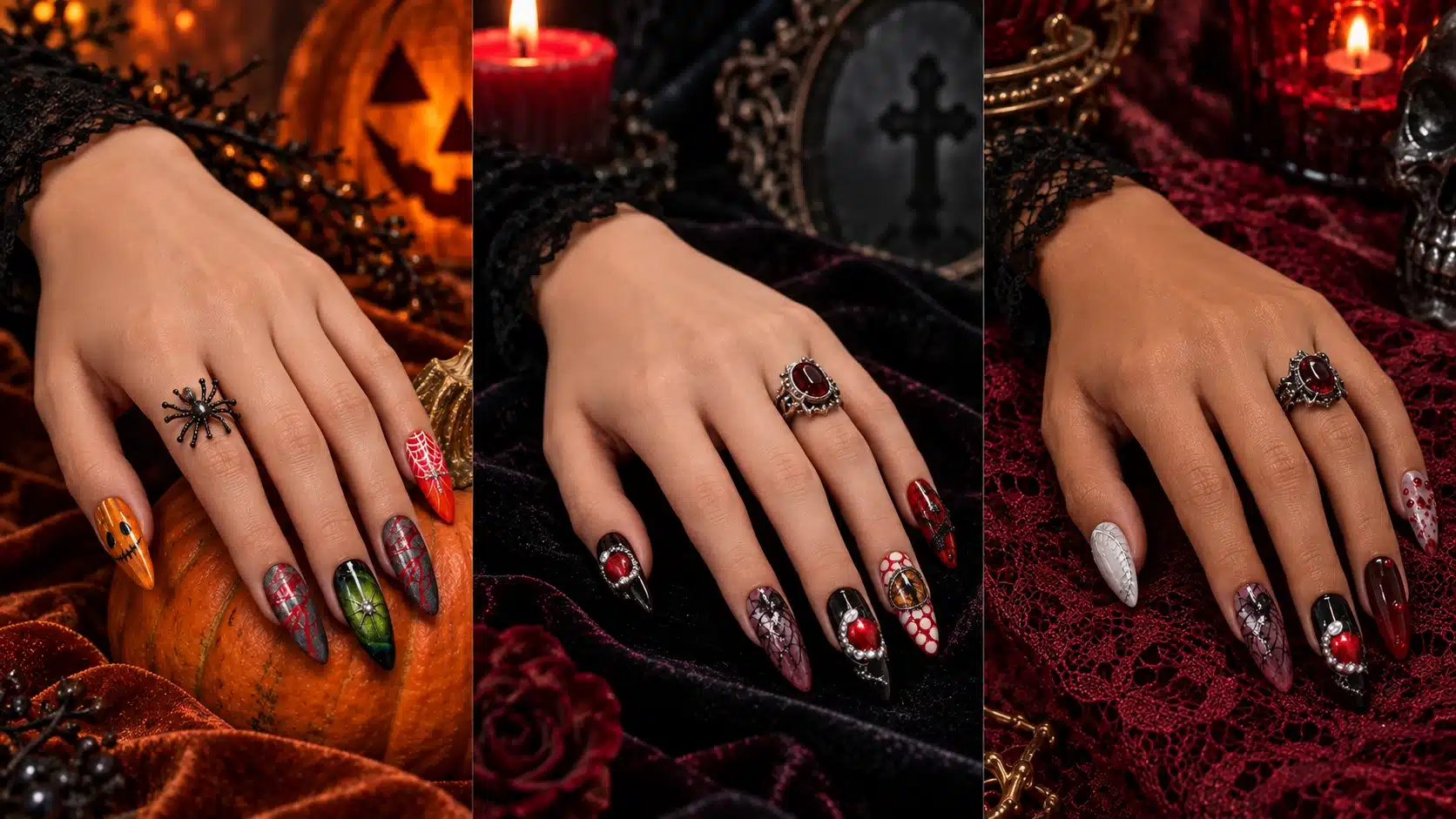
Design examples become commercially useful when they help a buyer organize a range and explain it to professional customers. The following directions are proposed ways to present the collection. They are not fixed kits, verified service times, or claims that every decorative element is supplied with the gel.
Graphic Halloween Color and Detail
A graphic direction can use seasonal solid colors with contrasting black and white details. Orange, pink, and red give the presentation different moods, while the black and white products support backgrounds and line-based motifs. A buyer can use this direction to show customers that a Halloween range does not have to rely entirely on dark magnetic finishes.
Prepare a small set of actual demonstration nails that keeps the color story easy to read. A professional artist might explore a contrasting motif, a negative-space arrangement, or a simple accent composition after checking the selected system. Record the actual products used, including brushes and any other art materials. The photographed design should determine the product list, rather than guessing shade numbers from an edited image.
For a salon supplier, the useful question is whether the demonstration matches the skills and services of its customers. For a brand, it is whether the new presentation adds a recognizable seasonal message to colors it already sells. If the same client base already holds similar colors, the introduction should explain the value of the coordinated release instead of pretending familiar shades are a technical invention.
Gothic Magnetic Depth with Controlled Accents
A darker magnetic direction can focus attention on the moving light band and use other elements selectively. The collection's existing styled artwork includes red-and-black looks and additional silver-colored decoration. Those images establish a visual direction; they do not identify every material or demonstrate the performance of every shade.
For your own launch, choose an approved magnetic sample and show it without elaborate decoration first. Follow with a finished professional design using the same recorded product. This gives the buyer a clear view of the gel's contribution before seeing how an artist develops the final look. If the second image includes a frame or charm, identify it in the design description.
Commercially, this two-stage presentation can support both a straightforward magnetic offering and a more elaborate showcase concept. The two should have separate material and training descriptions. Do not build a service-cost estimate from a simple color sample when the advertised result includes extensive artwork and accessories.
Glow and Drip as Distinct Feature Demonstrations
Glow and drip effects can each serve as a focal point within a collection presentation, but they need different explanatory material. The glow product benefits from a comparison of viewing conditions. The drip pair benefits from a clear product relationship and a verified demonstration. Combining both under a single “special effects” label would lose the information that helps a professional customer use them properly.
Show each effect independently before presenting it within a broader seasonal story. This does not mean layering the products together. A display can place different completed samples side by side without establishing chemical compatibility between their application systems. Any proposed combination on the same nail needs its own confirmed method.
For a distributor, these separate demonstrations can become product cards within one launch presentation. For a private label brand, they can become distinct educational posts linked to the collection. The connecting theme is Halloween; the instructions remain specific to the product. This approach allows expressive creative work while keeping the technical message precise.
Build a Trial Board with Specific Product Choices
Use a trial board to turn these directions into a buying discussion. The combinations below describe suggested presentation groups, not instructions to layer every listed product on the same nail. A professional demonstrator should establish any layered application using the confirmed system. Keep separate, clearly labeled samples wherever the purpose is simply to compare products.
| Suggested Trial Group | Products to Evaluate | Tools or Additional Materials | What the Buyer Can Decide |
|---|---|---|---|
| Orange with Graphic Contrast | No. 02 orange with No. 05 Super Black and No. 06 Super White as separately identified design materials. | Suitable art brushes and the confirmed preparation and finishing system. | Whether a graphic seasonal presentation adds value beyond the buyer's existing orange, black, and white products. |
| Pink or Red Alternative | No. 03 pink or No. 04 red as an alternative color direction beside the graphic samples. | The tools needed for the approved design, rather than an assumed new accessory kit. | Whether the buyer's customers need a brighter variation on the same theme. |
| Light and Deeper Magnetic Options | No. 09 Flow White Cat Eye and a chosen entry from Nos. 10–16, shown on separate samples. | A compatible magnet, recorded background, and consistent viewing setup. | Whether the lighter and deeper presentations serve different positions in the buyer's range. |
| Beaded Accent Direction | No. 07 Dark Red with No. 08 Drip Top Coat, using the confirmed pairing method. | Approved preparation and finishing materials; any ornaments listed separately. | Whether staff can explain and demonstrate the paired effect clearly enough to support the proposed offer. |
| Glow Feature | No. 01 on its own documented finished sample. | The confirmed application system and a recorded light-exposure and photography setup. | Whether the effect is understandable through the buyer's actual sales channel. |
When choosing between the first two groups, begin with the buyer's existing customer preference and product gaps. The point is not to predict that orange will outsell pink or red. It is to compare how each option supports the proposed launch and whether a familiar color needs a new story, a different presentation, or no additional stock at all.
For the magnetic group, place the lighter and deeper samples beside each other under the same viewing conditions. Ask the sales team to describe the difference without using broad adjectives such as “better” or “stronger.” A useful description names the background appearance, visible highlight, and intended presentation. If the distinction cannot be explained clearly, examine the physical samples before adding both to a narrow assortment.
Finally, keep the finished board connected to an actual material list. An account should be able to point to a sample and learn which product references, tools, and separate decorations produced it. That relationship turns attractive nail art into a practical sales and training resource, while the order proposal separately defines which items JTING will supply.
7. Turn Sample Evaluation into a Decision Record
A useful sample review ends with a purchasing decision and a record of why it was made. “Looks good” is not enough information for a later reorder, a packaging approval, or a customer-service discussion. Use the review to connect the intended business use with a specific product, application system, and acceptance reference.
Begin by writing the intended result. For a magnetic shade, that might be a clearly demonstrable highlight under the intended retail lighting. For the glow product, it might be a repeatable educational demonstration. For the drip pair, it might be a completed sample that can be explained accurately to a professional customer. These are review objectives; they are not pre-existing performance claims for the collection.
Review the Same Question under Consistent Conditions
Keep the selected base, tool, application record, and photography conditions consistent when comparing samples. Where you deliberately change a condition, label the change. A second technician can repeat an approved method to assess how clearly the instructions transfer, but that exercise should be recorded as your evaluation rather than presented as universal proof of performance.
| Review Record | What to Capture | Decision It Supports |
|---|---|---|
| Product identity | Halloween Gel Polish name, shade reference, and available batch information. | Accurate approval and future order matching. |
| Intended use | The channel, demonstration, or professional application being evaluated. | Whether the sample addresses the actual business need. |
| Application system | Preparation, base, effect tool or pairing, curing, and finishing instructions used. | Whether another professional can reproduce the approved demonstration. |
| Visual reference | Actual sample images, viewing conditions, and relevant close-ups. | Consistency between product, training, and catalog imagery. |
| Outcome | Approve, adjust the proposal, repeat a defined check, or exclude from the planned assortment. | A clear next action rather than an open-ended trial. |
Resolve Problems with Evidence, Not Immediate Substitution
If a trial is disappointing, first compare its conditions with the approved method. For glow, record the exposure and viewing setup. For magnetic effects, identify the tool and show the manipulation before cure. For the drip pair, document both products and the sequence supplied for them. For color differences, compare physical samples under consistent lighting before treating a screen image as the reference.
These records help JTING and the buyer discuss the same observation. They do not establish a diagnosis from a photograph or justify an improvised change to curing. Keep unresolved samples out of customer-facing demonstrations until the method or product selection has been clarified.
Once approved, retain the reference information alongside the order configuration. The product page remains the place for the current commercial specification, while your approval record connects that specification with the assortment, imagery, and training your business has selected.
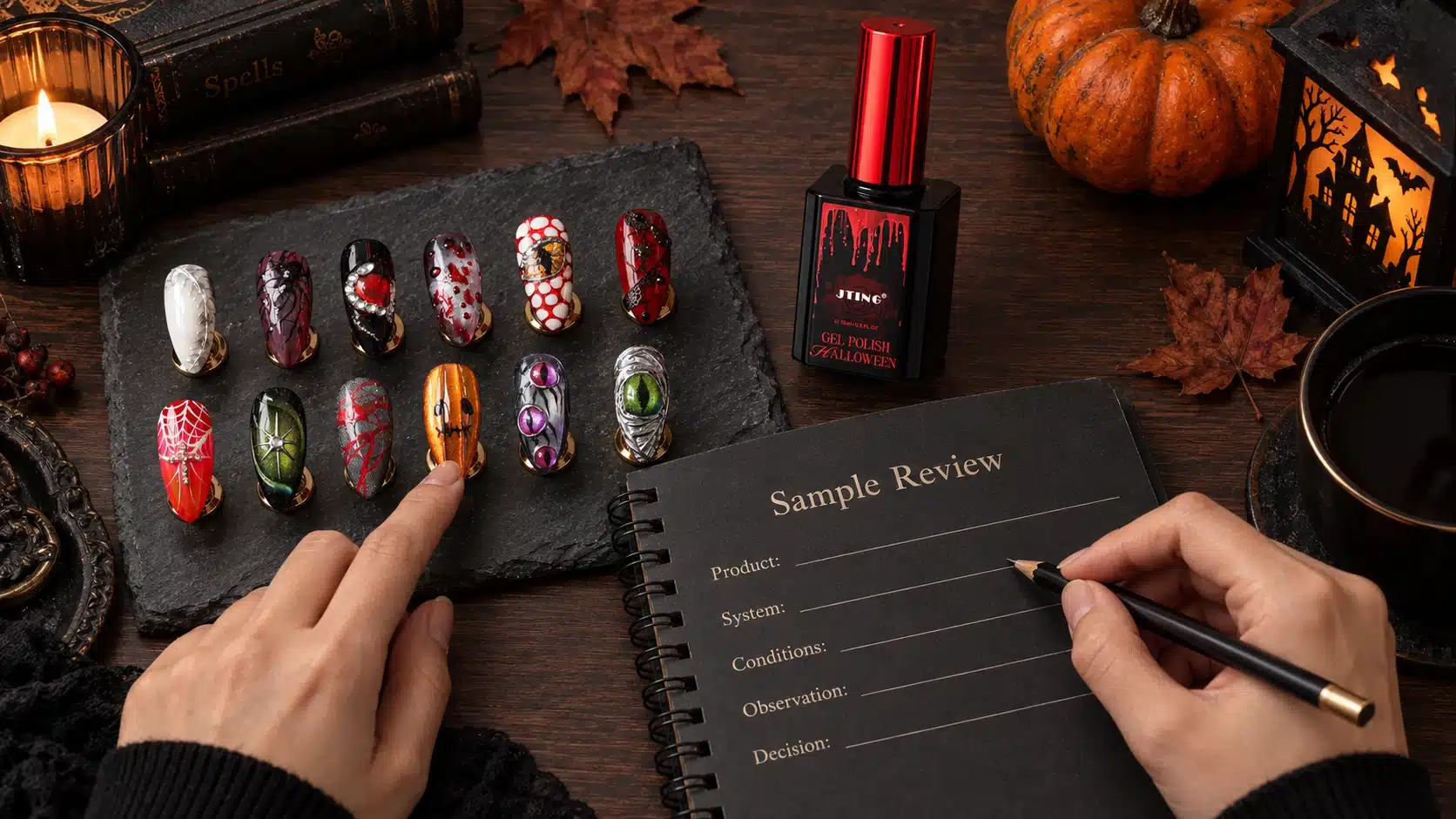
8. Keep Formula, Documentation, and Customer Claims Aligned
JTING's Halloween Gel Polish product information lists HEMA, TPO, and TMPTA exclusions. Those are ingredient-related statements. They should not be expanded into claims that the products are allergy-free, suitable for every individual, or automatically authorized for every destination market. Ask for the ingredient and safety information applicable to the actual products in your order, especially when the assortment contains different effect formulations.
Professional handling information belongs with the product. The FDA's nail-care guidance advises reading labels, following warnings, and avoiding skin contact with relevant nail-product ingredients. For your staff and downstream customers, use the supplied product directions and appropriate professional procedures. A social-media demonstration should not become an alternative set of safety instructions.
Organize documentation by purpose. Ingredient information identifies the formulation being reviewed. Application instructions describe the intended working system. An SDS supplies safety-related information. Other market or product documents need to be assessed for their actual scope. The existence of one document should not be used as a blanket statement that every commercial requirement has been satisfied.
JTING can discuss documentation support according to the product and destination market. The practical first step is to name that market, identify the selected products, and tell the team which documents your importing or compliance process needs. This keeps the discussion specific without turning the article into an unverified legal checklist.
Before approving packaging or sales copy, compare the ingredient claims, instructions, product references, and images across the materials. Check that a glow claim remains attached to the glow product, that magnetic descriptions apply to the magnetic range, and that the drip effect identifies its pair. This final consistency review protects the usefulness of your own launch materials and gives professional customers a clearer basis for choosing.
9. Fit the Halloween Gel Polish Collection into an Existing Product Line
A seasonal launch is easier to evaluate when each addition has a defined job. Use the collection’s product roles to find a real gap in your existing line before choosing quantities, packaging, or a display format. The objective is a useful addition that your team can explain and your customers can reorder.
Start with the assortment customers already buy. Place the current Halloween products, core black and white gels, dark reds, magnetic gels, and nail-art effects in one sheet. For each existing item, note its role, visual result, buying unit, and selling context. Then compare roles rather than names. A brand that already carries a black gel may still need a clear seasonal reason to include 05 Black; a distributor with several cat-eye products may find more value in a coordinated Halloween presentation than in adding another complete magnetic lineup. The question is what a buyer can demonstrate or combine that the present catalog cannot explain as clearly.
| Existing Line Situation | Potential Role in JTING Halloween Gel Polish | Decision Before Adding It |
|---|---|---|
| Few Halloween base colors | 02–04 solids and 05/06 black and white can provide a coordinated color and contrast group | Compare actual shades and current stock to avoid duplicating near-identical basics |
| Dark red already sells | 07 Dark Red has a specific pairing with 08 Drip Top Coat | Assess the two together; do not assume an existing red creates the same paired presentation |
| Cat-eye range is broad | 09 Flow White Cat Eye and 10–16 supply magnetic options within the seasonal range | Select the magnetic shades that add a distinct color role to the current offer |
| Seasonal effects are limited | 01 glow can give the assortment a separate effect category | Review the actual sample under appropriate viewing conditions before defining the sales claim |
| Nail-art accessories are already stocked | Color and effect products can sit beside a separate accessory offer | List accessories separately; ornaments visible in imagery are not gel polish features or included components |
This matrix is a planning tool, not a recommendation to buy every row. A compact offer might lead with the products that solve the largest gap and add supporting shades only where they strengthen a coherent story. Conversely, a full-range presentation can make sense when a buyer needs breadth for its own channel, provided the proposal identifies each numbered product and its order quantity. Ask for a line sheet that distinguishes the collection reference, individual numbered entries, and any proposed bundle or display. That distinction lets you ask whether individual replenishment is available under the proposed supply arrangement.
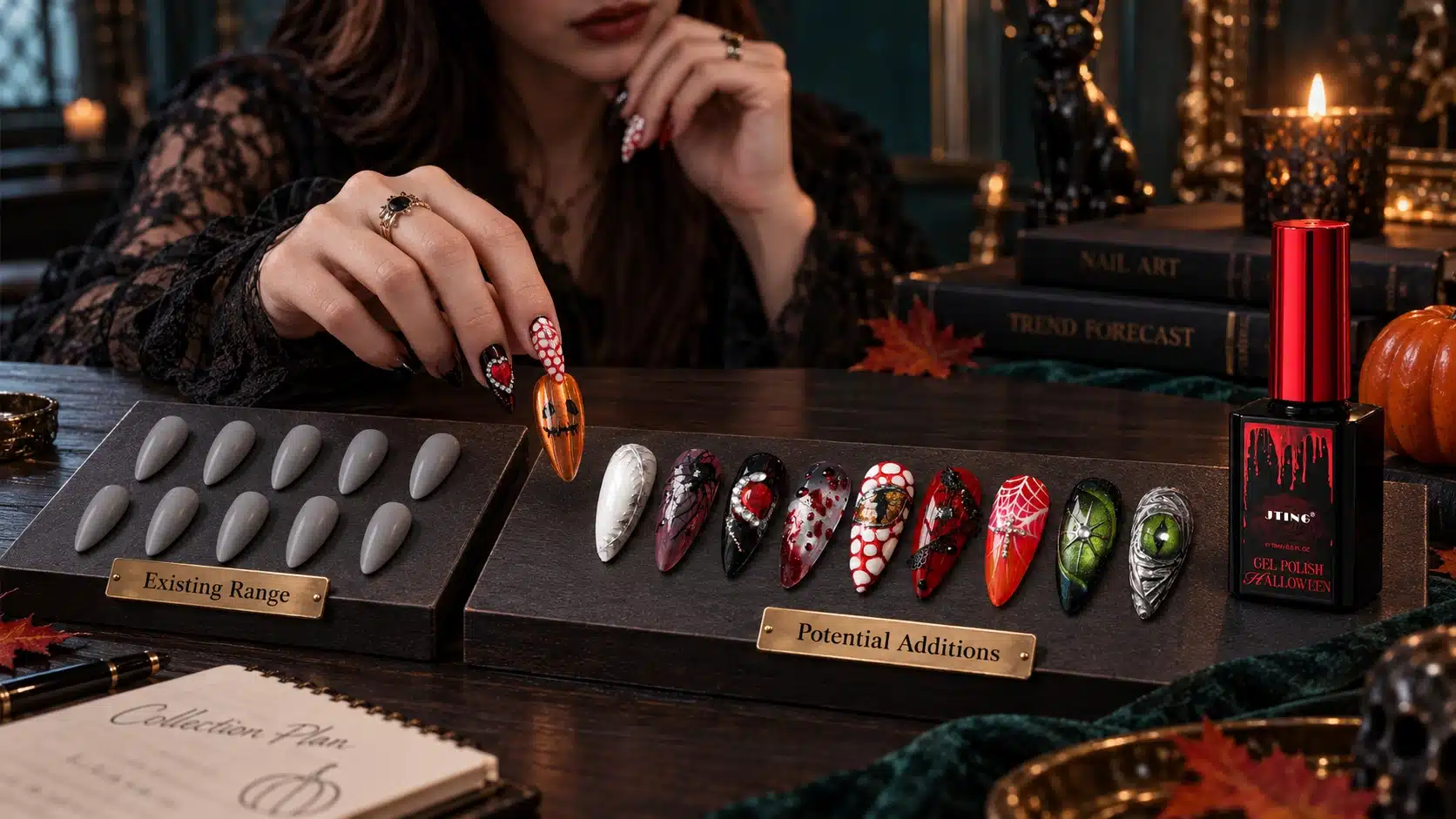
10. Three Channel Launch Plans for Halloween Gel Polish
The following plans are illustrative recommendations for how different buyers could introduce JTING Halloween Gel Polish. They are not customer cases, sales results, or evidence that a particular configuration is in stock. Each plan begins with a channel's selling task and ends with a request that can be translated into an actual assortment and quotation.
Nail Brands: Make the Collection Legible at First Glance
A brand can frame the range as a sequence of distinct looks: a solid-color base group, contrast colors, a paired drip concept, glow, and magnetic light. Its first decision is whether the campaign presents a selected edit or all 16 numbered products. Either approach needs an explicit product list. A visual campaign can group products by effect, while the product detail page and order form identify each item separately. That prevents a customer from reading “16-color collection” as a promise that every bottle glows or responds to a magnet.
For a selected edit, choose an anchor that matches the brand's existing audience. If that audience buys nail-art looks, build the creative around 07 Dark Red with 08 Drip Top Coat and show the products as a pair. If it favors magnetic finishes, select specific entries from 09–16 after sample evaluation, while keeping 01 glow clearly separate. Let the sample results determine the final claims and imagery. Packaging can then carry the same hierarchy: collection name, shade number, product role, and brand identity. The brand brief should list the bottle and label direction, any collection packaging, the artwork owner, and the exact contents of a proposed set. A set is a new commercial configuration to quote, not an assumed standard format.
Distributors: Sell Clear Choices to Different Accounts
A distributor needs a range that representatives can explain quickly across many accounts. Create a short sales card for each role, then a master numbered sheet for purchasing. The card should state what the account can add to its own range, which products are paired, and which effect requires a distinct demonstration. The master sheet should carry individual quantities, bottle size, packaging choice, and reorder references. This allows the distributor to offer a narrow salon-facing edit and a wider retailer-facing edit without implying that either is JTING's mandatory kit.
An illustrative distributor rollout could start with three account questions: Does the account already stock seasonal solids? Does it have a magnetic selection? Can staff demonstrate the 07/08 pairing accurately? Use the answers to form a proposed mix. A customer rich in cat-eye gels may need only a few selected magnetic entries alongside the pairing and 01 glow. A customer with no seasonal program may prefer a broader selection. In both cases, show the numbers and product roles on the quote. During sell-in, provide approved sample imagery and language for the actual selected products. A picture of a decorated manicure may be inspiring, but it cannot serve as a contents list.
Salon Suppliers: Teach the Assortment Through a Few Clear Looks
A salon supplier sells to professionals who need to know what to select for a service menu and what to replenish after use. A practical starting edit can combine a few solids, contrast products, the 07/08 pair, and selected magnetic entries, with 01 glow offered when the supplier can show its effect under the right viewing conditions. This is a planning example; actual selection follows sample approval and local customer demand. It should never imply that every salon needs the same shade mix.
Give the salon-facing team one page that maps each selected bottle to a visual role and identifies materials that are separate from the gel polish. For the paired drip look, keep 07 and 08 adjacent in the visual and on the sales sheet. For magnetic entries, use clear sample references rather than a generic “cat eye” label for the entire collection. If the supplier offers education, focus it on recognizing effect categories and correctly describing the supplied products, while product-specific application details follow the approved product information. The supplier's reorder sheet should retain the numbered references, so the supplier can assess an individual-shade replenishment request against the agreed configuration.
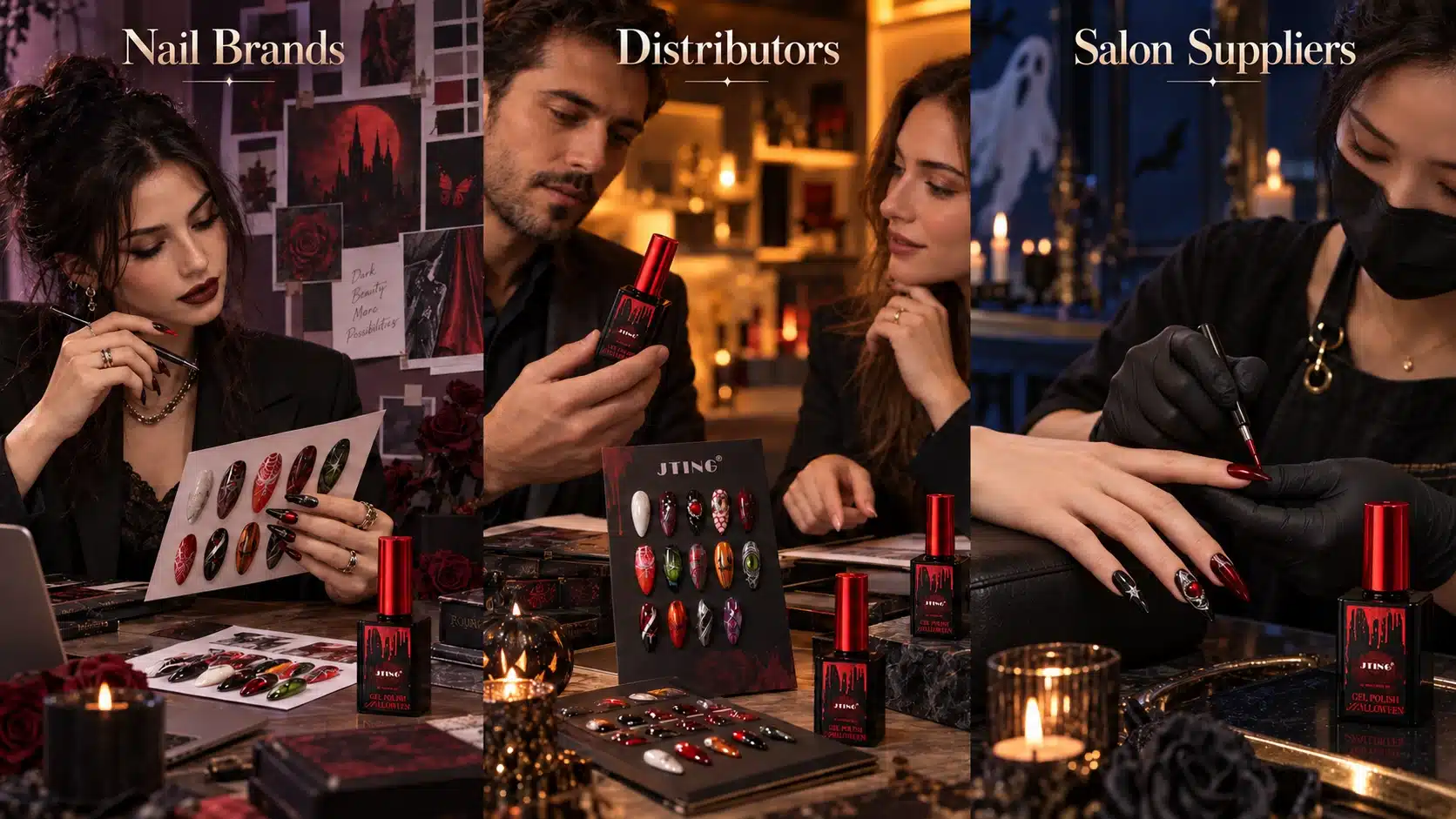
11. Build a Downstream Sales Proposal Buyers Can Use
The first objection may be, “We already sell Halloween gel.” That is an invitation to compare assortment roles, not to dismiss the current line. Ask what the account already offers: base colors, magnetic looks, glow, or a paired art effect. Then place the proposed JTING Halloween Gel Polish products beside that list. If the current range already covers black and white, the opening proposal might emphasize the 07/08 pairing or a specific magnetic color gap. If the customer already has many magnetic gels, a pitch based on “more cat eye” adds little. Explain the distinct role of each suggested addition, and leave out entries with no clear purpose. This is a more credible way to build incremental shelf space.
The next objection may be, “We only want a few shades.” The 16 numbered products describe the collection structure. Ask whether your preferred selection can be supplied under the proposed order configuration, rather than assuming either mandatory full sets or unrestricted individual selection. Build a shortlist with the customer, identify each numbered product, and request a quote for that exact selection and quantities. Keep 07 Dark Red and 08 Drip Top Coat together when the proposed selling idea depends on the drip pairing. A buyer can still inquire about individual units, but a commercial proposal should not quietly show the paired effect while quoting only one component. Similarly, if a selected offer includes only one magnetic entry, do not market it as an eight-shade magnetic range.
A third objection may be operational: “Our team will not know how to explain this.” Give them a one-page inclusion and effect guide. It should have three columns: what the customer receives, what the product is meant to show, and what appears only in example photography. For this collection, the guide must distinguish 01 glow, 02–04 solids, 05/06 black and white, the 07/08 pair, and 09–16 magnetic products. It should state whether a quoted package contains a display chart, magnet, decorative accents, or outer box only after those items are specified in the offer. Pictures can show styling possibilities; the signed item list defines supply.
Train the sales team on repeatable language: identify the numbered products supplied, describe each effect group accurately, and separate added decorations from gel effects. An approved script should avoid unsupported performance claims and detailed technique promises.
Finally, prepare a quote-ready request instead of a broad “send price” message. Include the intended sales channel, selected numbers, quantities by number, 15 ml bottle reference, desired branding, proposed packaging, destination, and the materials expected in the offer. Ask for the exact composition of any bundle or display. The resulting proposal can be reviewed by purchasing, marketing, and the downstream seller without asking each team to reinterpret an attractive campaign image. JTING can then discuss the product and customization options against a defined brief.
12. Compare Supply Proposals and Plan Private Label
Two Halloween Gel Polish proposals can display the same product photo and still represent very different purchases. One may quote individual 15 ml bottles; another may include labels or an outer box; a third may propose an assortment with a display element. Compare the commercial unit before comparing the total. “One unit” might mean one bottle, one selected group, one boxed set, or one display carton. If the unit is unclear, the price cannot be evaluated fairly, and the buyer cannot know how replenishment will work.
Compare the Cost of the Same Deliverable
Build a cost worksheet that separates the quoted goods from branding setup, sample or display materials, freight, and destination charges relevant to the agreed shipping terms. Use the actual proposal for each amount. A low bottle price may exclude a component that another proposal includes, so comparing totals is useful only after the contents and responsibilities are aligned.
For your internal review, divide the applicable total by the actual sellable units received. Define that denominator carefully. If you sell bottles individually, sample bottles and display items should not silently become saleable stock. If you sell a selected set, use the complete set definition and identify any components purchased separately. Keep one-time development or artwork costs visible so repeat-order comparisons do not accidentally reuse the first-order cost structure.
This worksheet is a comparison method, not a suggested retail price or a margin promise. Your own selling price, tax treatment, fulfillment costs, customer terms, and returns arrangements determine the commercial outcome. The immediate purpose is to understand exactly what the Halloween launch proposal buys.
Approve the Product and the Presentation Separately
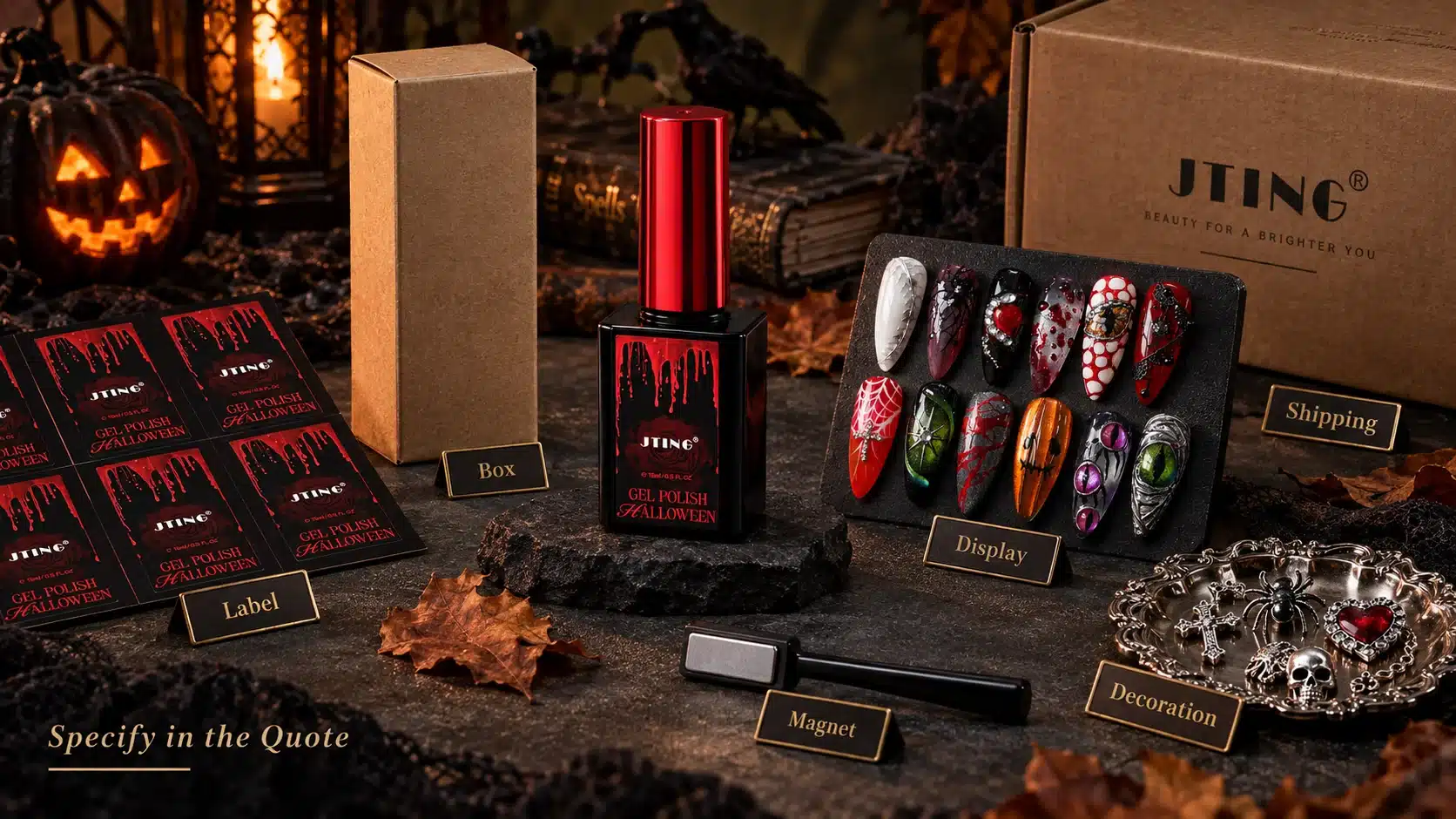
Private label planning begins with a product map, then moves to artwork and packaging. Identify which numbered products need the buyer's brand, which label information must appear, and whether the bottle and cap direction follows the existing visual or requires a new selection. For an assortment, decide whether every bottle has its own shade number and whether the outer pack describes the contents accurately. The black bottle and red cap shown in JTING's product imagery are a visible presentation reference, not proof that every custom order includes that exact combination. Likewise, a coffin-shaped shade chart seen in product materials is a display direction to discuss, not an automatic part of every shipment.
Use a like-for-like comparison sheet before approving artwork or paying for the wrong configuration:
| Comparison Point | What to Put on Each Quote | Why It Matters |
|---|---|---|
| Buying unit | Bottle, selected assortment, boxed set, or display; units per case if relevant | Establishes what quantity and price refer to |
| Product selection | Exact numbers and quantities by number, including separate lines for 07 and 08 | Prevents a campaign concept from replacing the actual SKU list |
| Formula and effect | Product identity for each line; agreed sample reference and approved claims | Keeps solids, glow, drip, and magnetic entries distinct |
| Branding | Label artwork, logo treatment, approval stage, and who supplies final files | Avoids assuming a visual mockup is production approval |
| Components | Bottle, cap, brush, label, outer box, insert, chart, magnet, and decorative items if requested | Makes included and optional items visible |
| Logistics and documents | Packing method, destination, shipping term, and product or market documents requested | Keeps product cost, transit, and documentation scope separate |
| Reorder basis | Whether individual numbers can be reordered under the chosen configuration | Protects the buyer from rebuilding a whole set to replace one role |
JTING's current general starting point for private label gel nail polish is 10 pieces per shade. House-brand mixed-color orders can start from 100 pieces. These are company-level reference quantities, not an unconditional Halloween Gel Polish quote or a promise that every possible packaging, formula request, component, or SKU mix qualifies. Final MOQ depends on product type, packaging style, formula request, and customization level. A buyer should therefore submit the proposed shade mix and packaging for a project-specific MOQ and quote. Avoid using the 100-piece figure as if it were a confirmed fixed 16-product kit requirement, or the 10-piece figure as an automatic MOQ for a complex custom display.
When evaluating private label options, separate the product decision from the presentation decision. First approve the actual selected products and effects. Next approve bottle, cap, label, and any outer packaging. Only then compare the complete landed commercial proposal under a stated shipping term. No price can be inferred from the collection image, the general MOQ, or a sample of an unrelated configuration. An accurate component list also helps marketing: it can photograph the supplied bottle and shade chart as supplied, while treating styled nail-art accessories as creative elements unless separately purchased.
13. Work Backward from the Halloween Gel Polish Launch
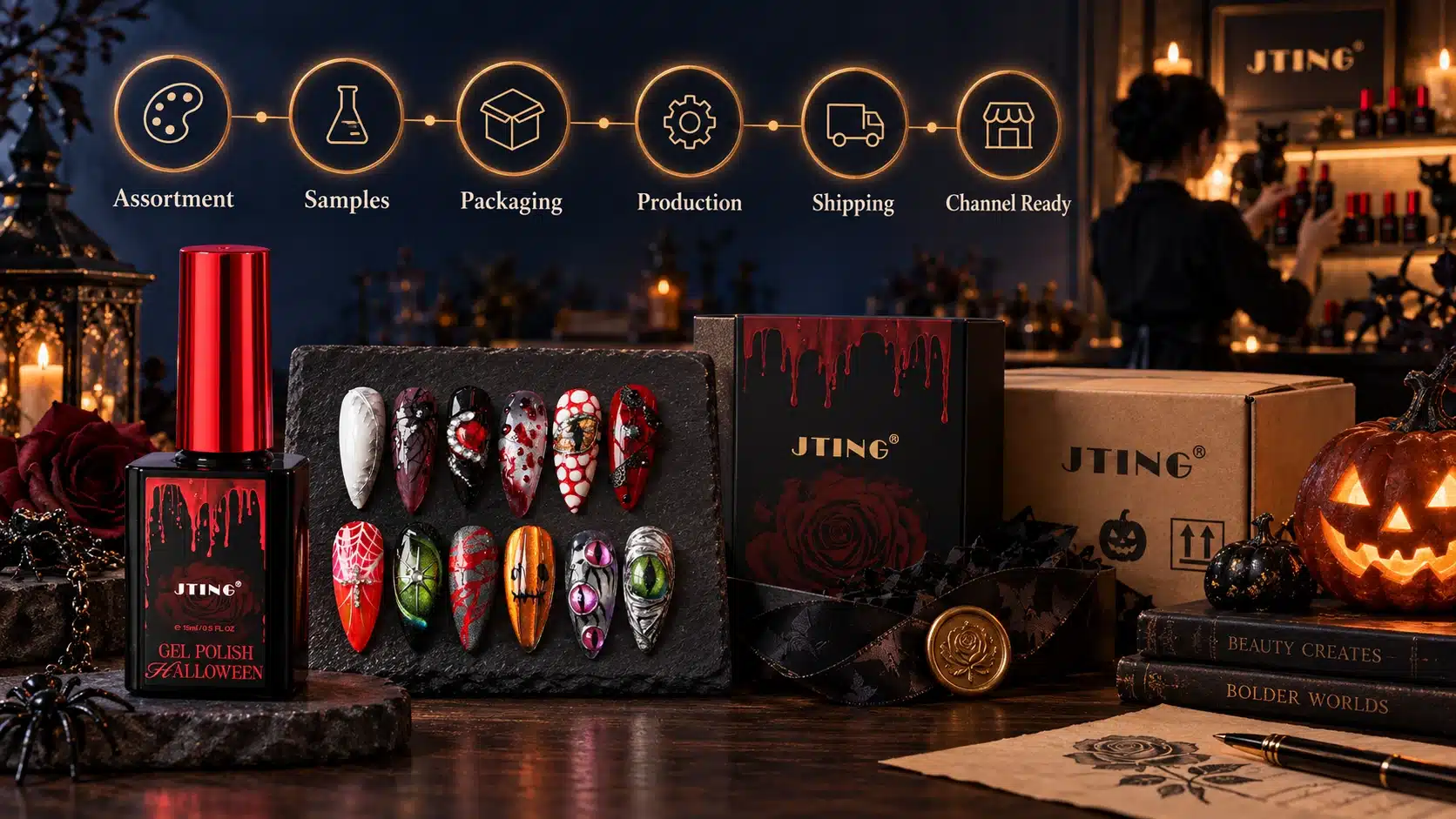
Start with the date by which stock must reach the buyer's selling channel, then work backward through transit, production, approvals, samples, and assortment decisions. Avoid building the plan around a calendar date selected for this article. A brand needs stock before its campaign begins; a distributor needs time to circulate sales materials to accounts; a salon supplier needs time to prepare a clear product guide. Each channel may therefore have a different internal ready date even when the underlying products are the same.
The first milestone is a final assortment brief: selected product numbers, quantities, channel, branding direction, packaging components, and destination. The second is sample review. Check the actual products and the visual references that will support the offer, especially 01 glow, the 07/08 pair, and the magnetic entries. The third is written approval of product, artwork, packaging, and the precise item list. Bulk production planning follows those approvals. Transit, import handling, local distribution, photography, and campaign setup are distinct steps after or alongside the relevant supply work; they should appear as separate lines in the launch plan rather than being silently absorbed into a factory production estimate.
As general JTING company guidance, standard samples typically take 7–10 business days; custom color or exclusive formula development typically takes 2–4 weeks; and bulk production after sample and packaging approval typically takes 15–20 days. These ranges depend on the product, sample quantity, revisions, development work, number of colors, packaging complexity, order size, and required documents. They are useful for building an initial sequence, but the actual timing for a Halloween Gel Polish order needs confirmation from the agreed configuration. Do not add the general ranges together and present the result as a guaranteed delivery date. Calendar days, business days, approvals, and freight do not share one clock.
A simple milestone tracker should name an owner and exit condition for each stage. “Assortment locked” means the numbered product list and quantities are approved. “Samples approved” means the selected products and claims match the reviewed samples. “Artwork approved” means the final printable files and placements are approved. “Production released” means the complete commercial configuration is signed off. “Shipment booked” means the agreed shipping plan is known. “Channel ready” means staff, listing, and product images match the delivered goods. If any one changes, update the downstream milestone rather than keeping a fictional launch date on the calendar.
Match the Sales Conversation to the Launch Stage
Run the customer communication plan alongside the supply plan. Early interest can help refine an offer, but each stage needs a different message and a different next step. Sending the same announcement repeatedly gives an account little reason to respond again.
| Communication Stage | Material to Share | Response to Record |
|---|---|---|
| Preview | A short introduction to the collection and the proposed role in the account's range. | Which product direction interests the buyer, and why. |
| Interest Review | A numbered shortlist with actual sample images and unresolved questions clearly identified. | Preferred references, possible quantities, destination, and target timing. |
| Proposal Confirmation | The agreed selection, sample references, component list, and project-specific commercial offer. | Approval, requested changes, or a specific reason for deferring. |
| Formal Introduction | Approved product cards, demonstrations, ordering details, and the confirmed supply position. | Orders or qualified requests tied to specific products. |
| Follow-Up | Answers to application questions and a review of product-level demand. | Training needs, reorder requests, and feedback for the next buying decision. |
For example, an account that responds to the drip presentation should next receive the paired product explanation and sample discussion. An account interested in magnetic colors needs its selected shade references and viewing examples. This keeps follow-up relevant to the buyer's response and connects the announcement to a concrete purchase discussion.
14. Replenishment and Post-Season Decisions
Seasonal stock should be monitored by product role and actual orders, not by an assumption that all 16 numbered products move together. Track demand by number, channel, and customer type. Record whether a sale used a solid as a stand-alone color, selected a magnetic entry, or drew interest from the 07/08 pairing. Add inquiry data: which products are repeatedly requested, which sample images generate qualified inquiries, and which proposed combinations are rejected because a customer already stocks a similar shade. These observations make the next purchase more precise than a simple total-bottle count.
Watch the paired products carefully, but do not assume one-to-one consumption. A customer may already own one component, use the pair at different rates, or sell them in a different configuration. Compare reorder requests for 07 Dark Red and 08 Drip Top Coat with the way the pair was actually sold and demonstrated. If one line begins to run low, check whether replenishing it alone preserves the stated product concept and whether the chosen packaging permits an individual reorder. The same logic applies to magnetic products: one popular color does not prove that the whole 09–16 group should be increased equally.
Build a small review rhythm during the selling window. Separate a true stockout from weak presentation: a product that customers never saw in a clear sample may need better explanation, while a product with repeated requests and low remaining inventory may warrant a replenishment quote. Review aged stock before buying more. Seasonal packaging can constrain use after the event, so compare the economics of a Halloween-specific outer pack with a more flexible branded bottle and removable seasonal campaign materials when planning the next cycle. That is a design choice to quote, not a claim that every existing pack can be repurposed.
After the season, preserve the numbered product map, approved effect images, component list, sales objections, and shade-level order history. Reuse the decision framework and creative structure, then refresh product selection and factual content for the next campaign.
15. Questions Professional Buyers Ask before Introducing the Collection
Can I Introduce This Collection without Replacing My Existing Colors?
Yes, you can evaluate it as an addition to an existing line rather than assume a complete replacement is needed. Map the roles you already cover, then identify the Halloween products that add a useful effect, presentation, or seasonal message. A proposed selected assortment is a commercial configuration to discuss with JTING; the existence of sixteen numbered products does not establish a universal minimum assortment. Your comparison should include the training and demonstration resources needed to support the additions, not just the number of new colors.
How Should I Handle Different Application Setups across My Customer Base?
Establish a reference demonstration using the product instructions and a documented system. Share that reference with professional customers instead of claiming every lamp, base, magnet, or finishing product is interchangeable. When a customer reports a different result, collect the actual setup and sequence before comparing it with the reference. This gives your support team a structured starting point and helps identify which compatibility questions need JTING's input. It also keeps a reseller's informal advice from becoming an unsupported universal instruction.
Can I Turn the Promotional Nail Art into an Exact Shopping List?
Only when the products and additional materials used in that particular design have been identified. A styled photograph may show charms, frames, crystals, or other decoration alongside the gel. It may also use creative lighting. Ask for an itemized material list or commission a documented professional demonstration before presenting a design as a reproducible package. If exact material identification is unavailable, label the image as design inspiration and provide a separate, accurate list of the products included in your offer.
Should I Publish Application Instructions before Finishing Sample Review?
Draft the layout and list the questions your customers will need answered, but approve the actual instructions against the selected product guidance and demonstrated system. This is particularly important for the Dark Red and Drip Top Coat pair, where a partial description does not supply every intermediate curing step. Your published guide should match the samples, product references, and configuration you intend to sell. Keep an approved version for staff so that packaging, training, and customer service do not use conflicting instructions.
How Can I Test Interest without Promising Unconfirmed Stock or Delivery?
Use a clearly described preview or expression-of-interest campaign. Show the collection, identify the proposed offer, and ask accounts about the products, quantities, and timing they would consider. Explain that the final assortment and supply schedule will be confirmed through the commercial proposal. Record interest separately from accepted orders. A customer liking a campaign image is a different signal from an account requesting a specific quantity with a target arrival date. Those distinctions help you turn early feedback into a more grounded initial order.
What Information Makes a Reorder More Reliable?
Provide the product name and numbered references, the previous order or approved sample reference, quantities, branding version, and any packaging changes. For the drip concept, check the customer's requirements for both paired products without assuming equal consumption. For a selected magnetic assortment, name the actual entries rather than requesting “the Halloween cat-eye set.” Retaining these details makes it easier to compare the new proposal with what your customers already know and to identify any change before updated materials or stock are released.
16. Send JTING a Brief That Can Become a Quote
The most useful next step is a short project brief: your channel and destination; the JTING Halloween Gel Polish product numbers you want to evaluate; estimated quantities by number; whether you want house-brand supply or private label; the bottle, label, and outer packaging direction; any proposed set or display contents; and the date stock must be ready for your channel. Include the effect images or sample questions your team needs answered. If 07 Dark Red and 08 Drip Top Coat are central to the offer, identify both. If you plan to show magnetic or glow effects, identify the corresponding products and the visual proof your team needs for its own sales materials.
JTING can use that brief to discuss samples, configuration, MOQ, documentation needs, and a project-specific timeline. Explore the JTING Halloween Gel Polish product page to identify the range, then contact JTING with the selected numbers and intended sales channel. A clear request turns a seasonal idea into a proposal that purchasing can compare, marketing can describe accurately, and customers can reorder by the products they actually need.