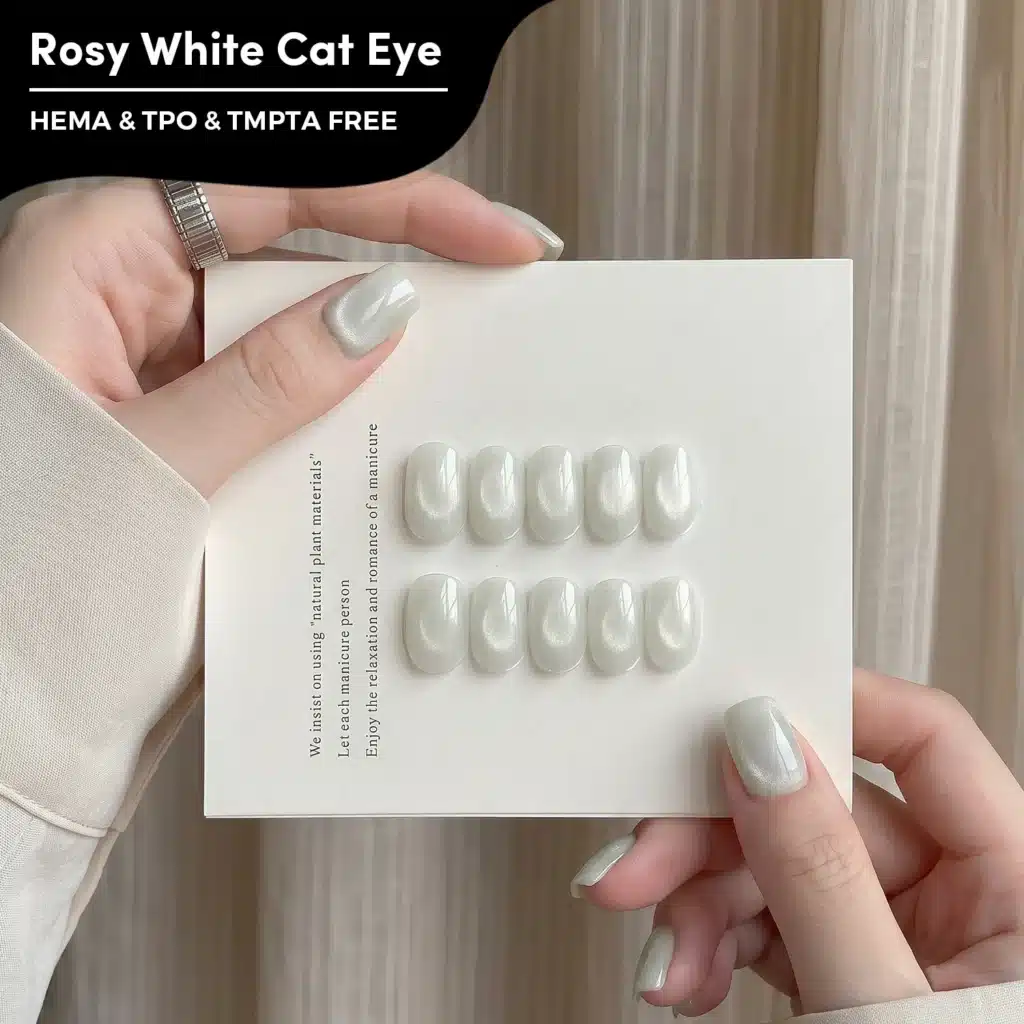
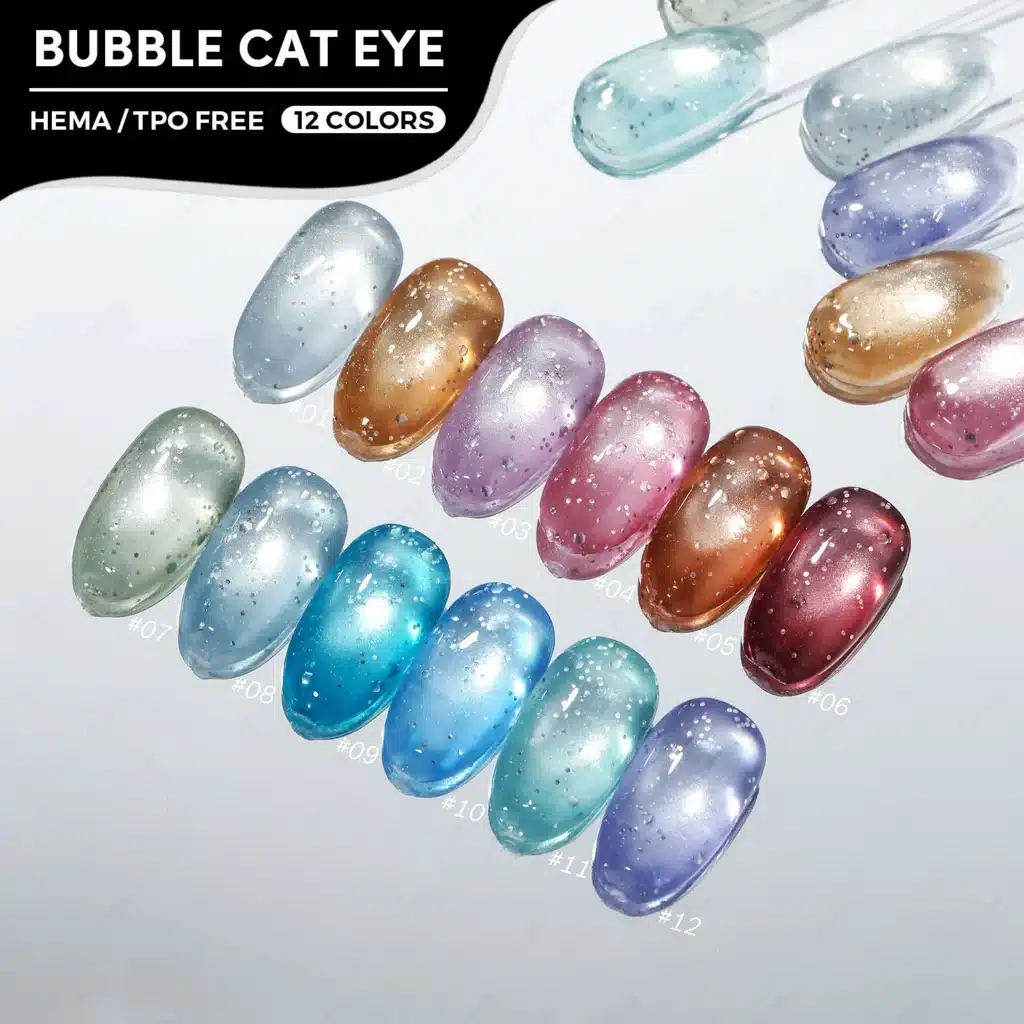
Chrome nails can mean a silver mirror manicure, a soft glazed finish, an aurora shift, a brushed-metal surface or a raised metallic detail. That range is commercially useful, but it also creates confusion: chrome nails, chrome powder and chrome gel polish are related terms, not interchangeable product names.
This guide separates the finished effect from the materials used to create it. It explains the powder and gel routes, shows why base color and surface preparation change the result, diagnoses common failures, and gives salons and private label buyers a practical framework for evaluating a chrome nail system.
Short answer: Chrome nails are the finished look. Chrome powder is a loose effect pigment rubbed onto a compatible cured surface. Chrome gel polish is a UV/LED-curable gel containing reflective, metallic or magnetic effect pigment. Chrome cat eye gel is one magnetic subtype of chrome gel polish, not chrome powder. A product called “chrome gel” may also be a clear or colored no-wipe transfer layer for powder, so the application instructions matter more than the marketing name.
1. Quick Answer: Are Chrome Nails, Chrome Powder and Chrome Gel Polish the Same?
No. They sit at different levels of the system:
- Chrome nails describe a visible finish or nail-art style.
- Chrome powder is a loose pigment product used to create that finish.
- Chrome gel polish is a brush-on, UV/LED-curable gel intended to create a metallic or chrome-like appearance.
- Chrome cat eye gel polish is a brush-on magnetic gel whose reflective particles are shaped with a magnet before curing.
- Chrome effect gel or chrome base gel may be clear, black, white or another color and is designed to receive chrome powder rather than replace the powder.
The distinction matters because the products do not use the same workflow. A loose powder does not cure by itself. It depends on a prepared nail, a compatible receiving surface, controlled rubbing and a final seal. A pigmented chrome gel is applied and cured as directed. A magnetic chrome cat eye gel must also be shaped with a magnet before curing. A chrome base gel is neither the powder nor automatically the final sealing layer unless its manufacturer explicitly approves that use.
The most reliable question is therefore not “Is this chrome?” It is:
What is the product’s role: color, magnetic effect gel, loose pigment, transfer surface, art gel or final seal?
2. Chrome Powder vs Chrome Gel Polish vs Chrome Effect Gel
| System | Product form | How the effect is created | Main strengths | Main limitations | Best suited to |
|---|---|---|---|---|---|
| Chrome powder | Loose fine pigment | Powder is rubbed over a compatible cured surface and sealed | Highest mirror potential; base color can transform one powder into many looks | More steps; loose dust; sensitive to surface and cure timing | Mirror, glazed, pearl, aurora and full-cover chrome |
| Chrome gel polish | Brush-on colored gel | Reflective or metallic pigment is dispersed in a curable gel | Fast, clean and repeatable; familiar bottle application | Some formulas look metallic or brushed rather than truly mirror-like | Full-color metallic manicures and efficient salon services |
| Magnetic chrome cat eye gel | Brush-on magnetic colored gel | A magnet concentrates and redirects reflective particles before curing | Multi-dimensional light bands without loose powder; broad color storytelling | Requires magnet technique; the result is cat eye rather than a flat mirror | Magnetic chrome, velvet, glass and dimensional salon looks |
| Chrome gel paint | Pot or bottle art gel | Dense metallic gel is painted in controlled areas | Precise lines, French tips, frames and small details | May show brush texture; not always ideal for a full smooth nail | Nail art, liner work and liquid-metal details |
| Chrome effect/base gel | Clear or colored no-wipe gel | Creates the receiving surface for a separate powder and may establish the background color | Helps powder adhere and lets clear, black or white bases create different directions | Still requires powder; may not be the final sealing layer | Full-cover powder transfer, mirror chrome and controlled base-color effects |
| Chrome topper or glaze | Sheer polish or gel with pearl/effect pigment | A translucent layer shifts the base shade | Easy soft-glaze effect; forgiving application | Usually lower reflection than rubbed powder | Glazed, pearl and subtle retail looks |
These names are not governed by one universal technical naming standard. Brands may use “chrome gel” for a colored metallic gel, a clear powder-transfer gel or a nail-art gel. For that reason, product pages and buyer specifications should always state the actual format and workflow.
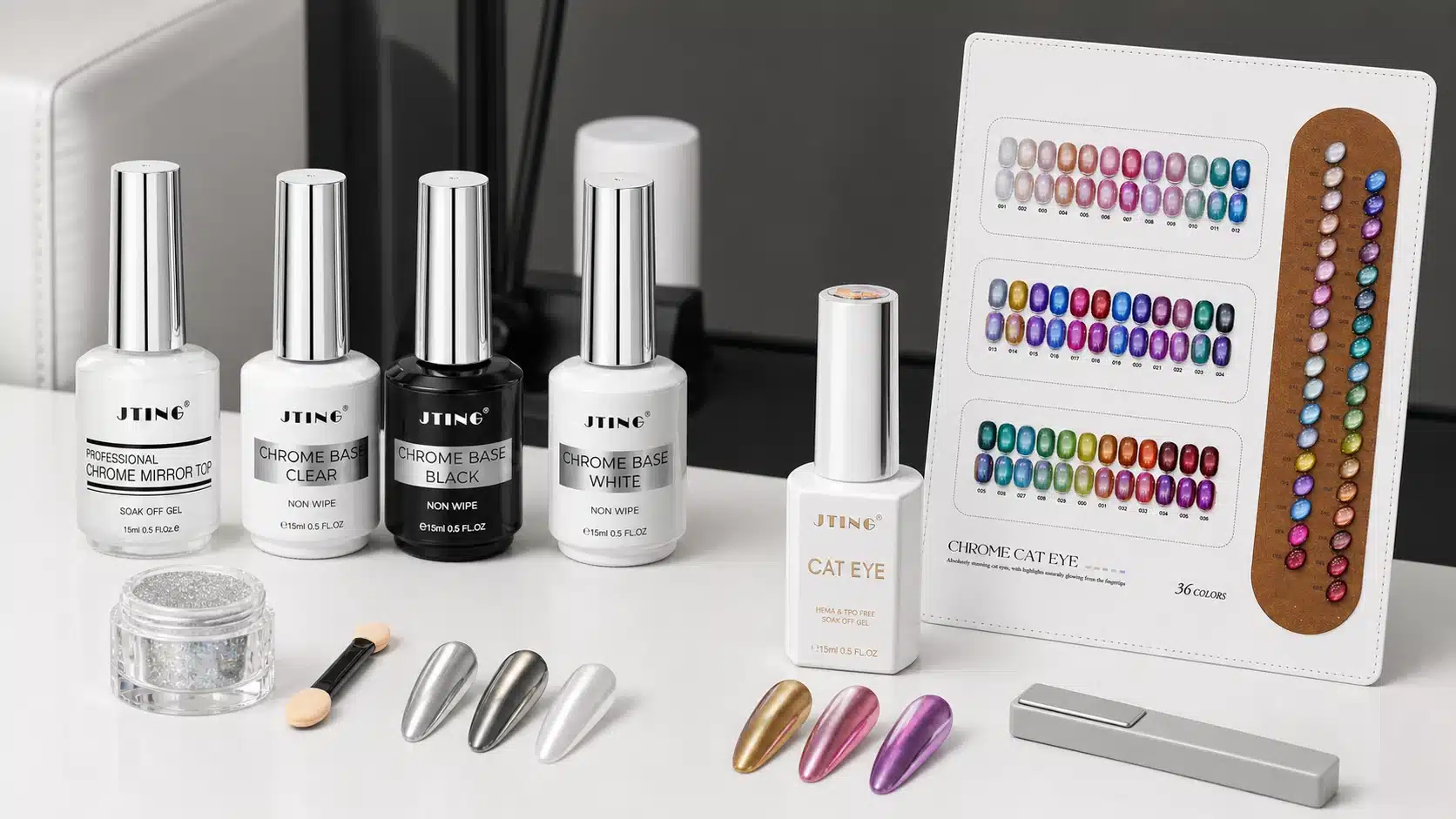
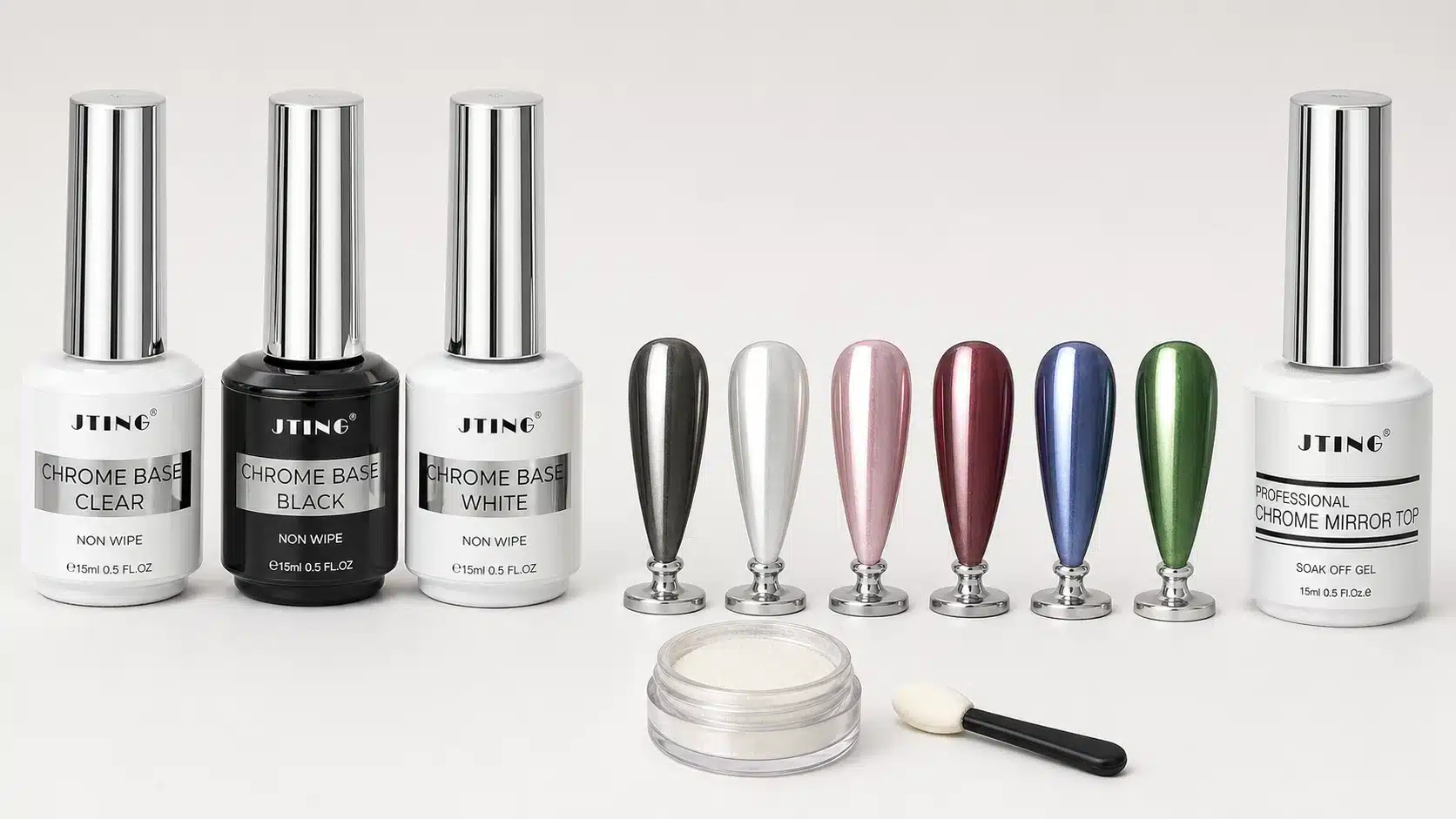
JTING’s verified product range illustrates the distinction. The Chrome Powder route can use FG128 Clear Chrome Base Coat when the underlying color should remain visible, or FG123 Black and FG124 White Chrome Base Gel when the receiving layer should also establish a black or white background. JTING Chrome Magic Top Coat is designed for the chrome-powder rubbing stage. The separate gel route is represented by JTING 36-Color Chrome Cat Eye, a magnetic chrome-effect gel polish.
3. What Are Chrome Nails?
Chrome nails are manicures designed to reflect light with a metallic, mirror, pearl or color-shifting appearance. The term refers to the visual result, not one chemistry or application method.
A classic silver mirror nail tries to produce a smooth, continuous reflection. A glazed nail uses a more translucent pearl effect over a pale or nude base. Aurora and multichrome looks shift color as the viewing angle changes. Brushed chrome and liquid-metal art deliberately keep more directional texture. All belong to the broader chrome nail family, but they should not be sold as visually identical.
The word “chrome” also does not prove that a powder contains elemental chromium. Effect-pigment ingredient lists vary. For example, OPI lists calcium aluminum borosilicate, tin oxide and optional titanium dioxide for one of its chrome powders. Buyers should review the actual ingredient declaration and supporting documents rather than infer composition from the effect name.
This distinction is particularly important for private label projects. A buyer may say “silver chrome” while expecting one of several different results:
- a sharp mirror that reflects surrounding objects;
- a fine metallic silver with uniform coverage;
- a translucent white pearl over nude;
- a cool silver powder over black;
- a raised molten-metal line;
- or a brushed satin-metal finish.
A reference image and an agreed physical sample communicate that target more accurately than the word “chrome” alone.
4. How the Chrome Effect Is Created
Chrome effects depend on how reflective particles interact with light and how evenly they sit at the nail surface. A smooth, aligned effect layer returns light more directionally and can appear mirror-like. A rough surface, uneven powder coverage or particles suspended at different angles scatter more light and look sparkly, grainy or brushed.
This explains why several variables influence the result:
- smoothness of the underlying nail architecture;
- smoothness of the color and top layer;
- type and size distribution of the effect pigment;
- compatibility between the receiving surface and powder;
- cure state of that surface;
- rubbing pressure and coverage;
- dust removal;
- and the final sealing method.
With chrome gel polish, pigment dispersion, gel viscosity, brush control and self-leveling also influence how flat and reflective the cured surface appears. In magnetic chrome cat eye gel, magnet position and timing additionally determine the light band and depth. A product can be highly reflective without behaving like a flat mirror. That is not necessarily a defect; it may be the intended finish.
5. What Is Chrome Nail Powder?
Chrome nail powder is a loose effect pigment applied to a compatible nail surface with a sponge, silicone tool or other approved applicator. It is normally used as one component in a gel manicure rather than as a complete system by itself.
The usual architecture is:
- prepared nail or approved enhancement;
- base coat;
- chosen gel color;
- compatible receiving layer, often a no-wipe product;
- chrome powder;
- final sealing layer.
Professional systems differ. Some powders perform best after a partial or “soft” cure of a specified no-wipe top coat. Others are designed for a fully cured surface or a dedicated chrome base gel. The GelBottle’s published chrome-pigment instructions, for example, use its own color, top coat, lamp and surface-preparation sequence, while OPI specifies a short soft cure before rubbing its powder. These examples demonstrate why one brand’s cure time should not be copied into another system.
5.1 Why chrome powder can look more mirror-like
Powder can be rubbed into a thin, concentrated effect layer at the surface. When the receiving layer is smooth and the particles spread evenly, the result may deliver stronger reflection than a brush-on gel in which reflective material remains dispersed throughout a thicker resin layer.
5.2 Why one powder looks different over different colors
Many chrome powders are not completely opaque. Light interacts with both the effect layer and the color underneath it. A black base can intensify contrast and create a deeper metallic result. White or milky bases can create pearl and glazed effects. Pink, blue, green, red or nude bases can shift the perceived tone without changing the powder.
5.3 Chrome powder is not dip powder
“Chrome powder” and “dip powder” are not automatically the same product. Chrome powder is generally an effect pigment rubbed onto the surface. A dip manicure uses a different powder-and-resin application system to build color or structure. Chrome can sometimes be applied over a completed dip enhancement if the selected products are compatible, but that does not turn chrome powder into dip powder.
6. What Is Chrome Gel Polish?
Chrome gel polish is generally a UV/LED-curable gel containing metallic, reflective or pearl effect pigment. It is applied with a brush, allowed to level when required, cured under the approved lamp and usually sealed with a compatible top coat.
The category can include several performance directions:
- metallic gel polish: uniform metallic color, often with fine visible texture;
- brushed chrome gel: directional satin-metal appearance;
- liquid metal gel: dense, flowing metallic look;
- mirror gel paint: concentrated art gel for small areas or full coverage;
- chrome topper gel: translucent pearl or glaze over another color;
- magnetic chrome cat eye gel: reflective magnetic gel shaped with a magnet before curing;
- metallic liner gel: controlled lines and French-tip details.
The key advantage is operational simplicity. The technician does not need to manage loose powder across every nail. This can improve speed and reduce cleanup, especially for full-color salon services or repeated designs across a team.
The tradeoff is finish. Some gels provide an impressive reflective metallic surface, but a liquid gel does not automatically equal a powder-rubbed mirror. The GelBottle explicitly distinguishes its brushed chrome metallic gel polish from a higher-shine finish created with chrome pigment. Buyers should approve the actual finish rather than depend on “mirror,” “metallic” or “chrome” in a product title.
6.1 Do all products called “chrome gel” contain chrome color?
No. A chrome effect gel may be clear and designed only to receive powder. Daily Charme, for example, describes its Chrome Effect No-Wipe Gel as a clear base for chrome powder and states that it is not recommended as the final top coat. This is why a supplier specification must include product role, appearance before use and full application instructions.
6.2 Is chrome cat eye gel a chrome gel polish?
Yes, when the formula is a curable magnetic gel designed to create a chrome-like reflective result. It is still important to describe it as magnetic chrome cat eye gel polish because its application and appearance differ from a non-magnetic mirror gel and from loose chrome powder.
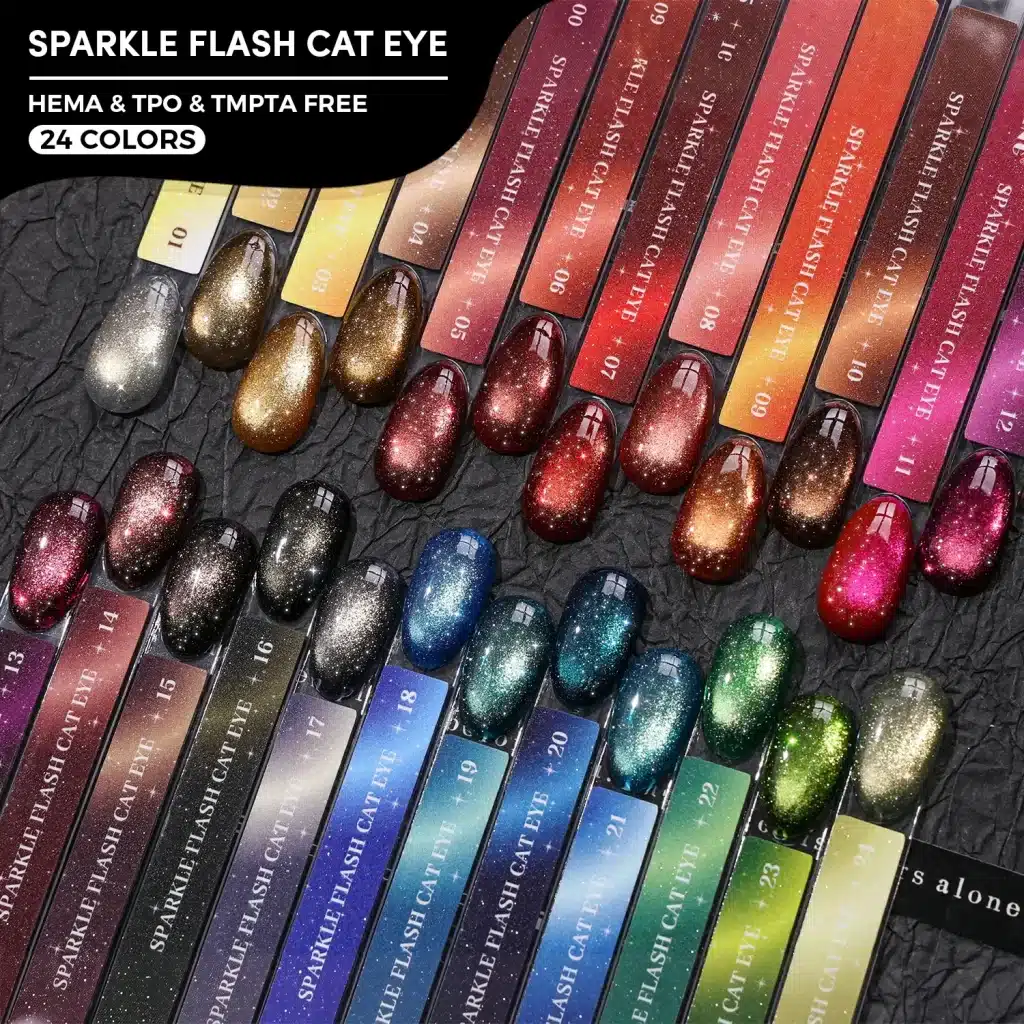
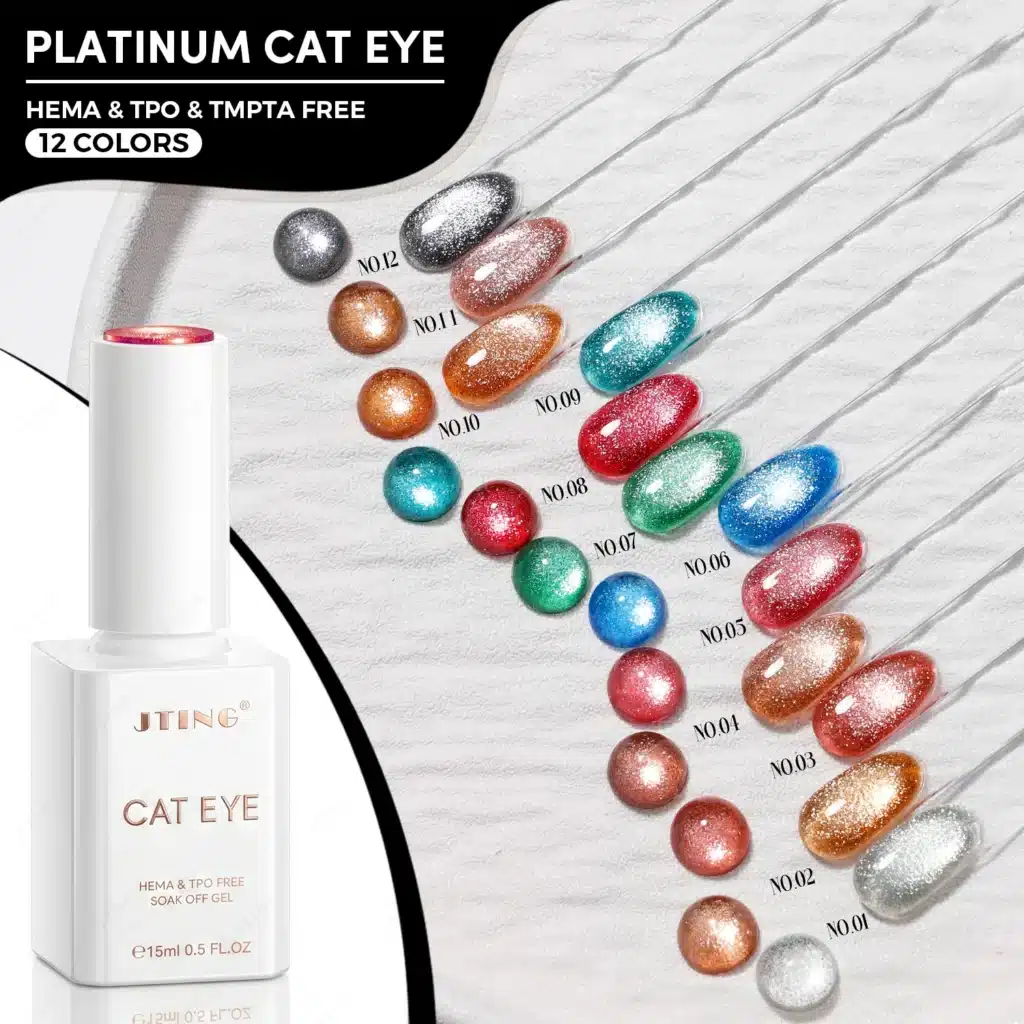
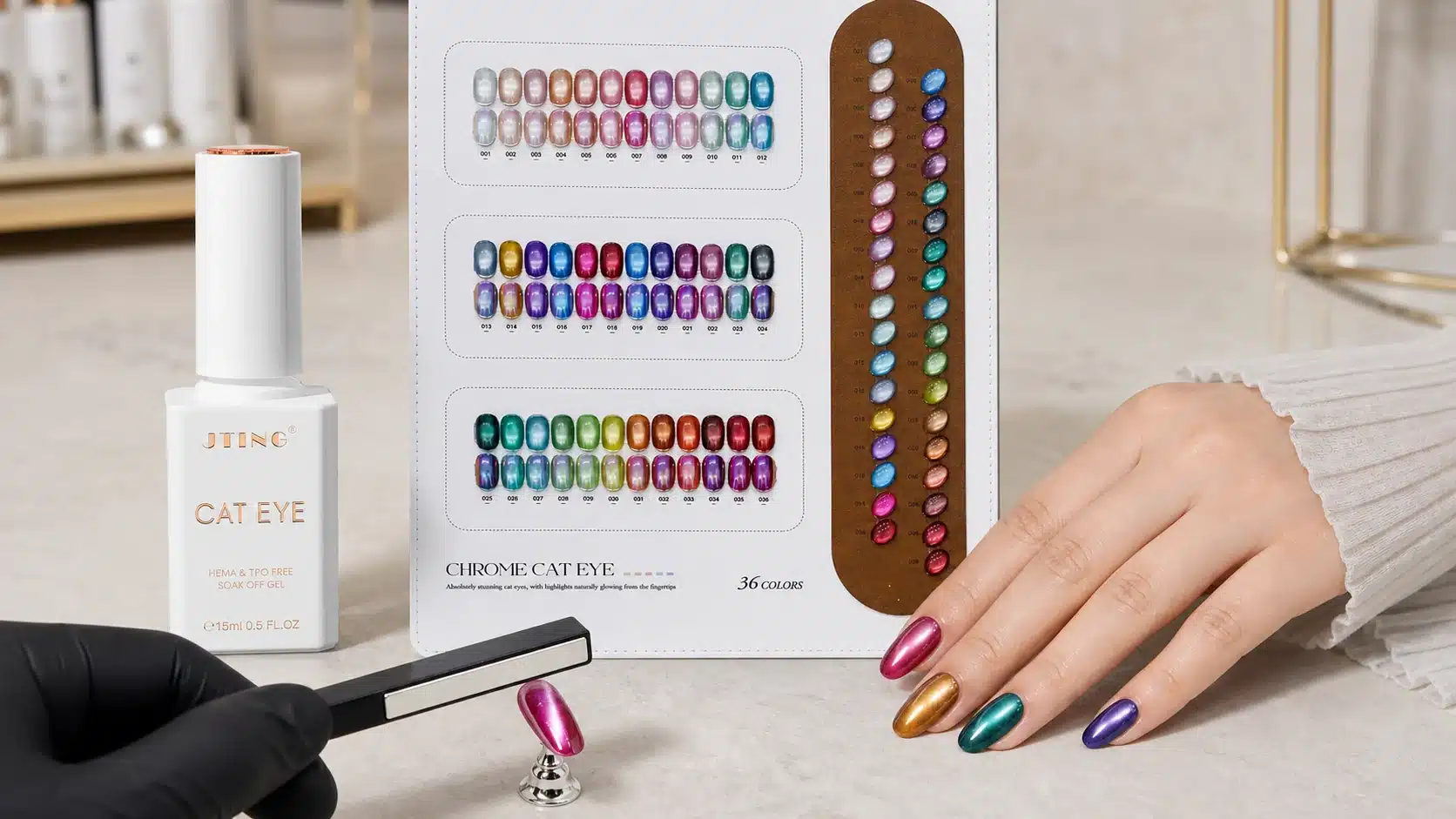
JTING 36-Color Chrome Cat Eye combines colored gel with magnetic reflective particles. The product is positioned as a one-step, no-wipe magnetic system with 36 shades. The magnet shapes the reflective particles before curing, so the result can show a concentrated cat-eye band, velvet glow or dimensional glass effect rather than a uniformly flat mirror.
7. Which Chrome System Should You Choose?
Choose according to the intended service and the result the customer is buying.
Choose chrome powder when:
- the priority is maximum mirror reflection;
- one powder should create multiple effects over different base colors;
- glazed, pearl, aurora or multichrome finishes are central to the collection;
- the salon team can control surface preparation, rubbing and sealing;
- or visual transformation is important for content creation.
Choose chrome gel polish when:
- application speed and cleanliness matter;
- the desired finish is metallic, brushed or liquid metal rather than a perfect mirror;
- consistent full-color application is more important than maximum reflection;
- the product needs to fit a familiar bottle-gel workflow;
- or a multi-technician salon wants fewer powder-handling steps.
Choose magnetic chrome cat eye gel when:
- the customer wants a moving light band, velvet glow or dimensional glass effect;
- the salon wants a chrome-like result without loose powder handling;
- a broad coordinated color collection is more important than one neutral mirror powder;
- or magnet technique is already part of the service workflow.
Choose chrome gel paint or liner gel when:
- the design uses French tips, outlines, frames or fine metallic lines;
- a raised or molten-metal detail is required;
- only selected areas should be reflective;
- or the artist needs high pigment density and shape control.
Choose a combined system when:
- the brand wants both full-cover chrome and detailed nail art;
- a transparent chrome transfer gel is used to isolate powder placement;
- multiple finishes must share coordinated colors and packaging;
- or the collection is designed for salon education and content creation.
For professional buyers, the best range is often not a single “chrome product.” It is a clearly documented system whose components have distinct jobs.
8. How to Apply Chrome Powder Over Gel Polish
The following workflow is a general decision framework, not a replacement for the selected product’s instructions.
For a JTING powder system, select the receiving layer according to the required background: FG128 Clear Chrome Base Coat preserves the color underneath, while FG123 Black and FG124 White Chrome Base Gel create high-contrast dark or light bases. JTING Chrome Magic Top Coat is the chrome-specific top-coat layer used for the powder-rubbing stage. Complete the final seal according to the tested JTING protocol for the selected combination.
Step 1: Prepare the nail and create a smooth foundation
Complete hygienic preparation and apply the approved base or enhancement system. Correct major ridges before the effect stage. Chrome emphasizes surface defects; it does not hide them.
Step 2: Apply and cure the base color
Use thin, even coats and the lamp specified for the gel system. The color should be fully even before the chrome layer begins. Dark colors often create dramatic mirror contrast, while pale colors support pearl and glazed effects.
Step 3: Apply the approved chrome receiving layer
This may be a no-wipe top coat, chrome base gel or another product identified by the manufacturer. Apply it evenly and avoid bubbles, flooding and ridges.
Step 4: Cure exactly as directed
Do not assume that every no-wipe top coat uses the same chrome cure window. A surface that is too soft may drag or wrinkle. A surface that is too slick for the selected powder may reject it. Use the approved lamp and timing for the exact product combination.
Step 5: Apply a small amount of powder
Rub the powder in controlled passes until the surface becomes even. Adding excessive loose powder does not necessarily increase reflection. It can make cleanup harder and leave particles where the final seal must bond.
Step 6: Remove loose residue
Use a clean tool and follow the system’s edge-preparation instructions. Loose particles left at the perimeter can interfere with sealing.
Step 7: Seal the free edge and surface
Apply the approved sealing layer without scraping the effect. Cap or otherwise prepare the free edge according to the system instructions. Cure completely.
Step 8: Inspect from multiple angles
Look for dull areas, uncovered sidewalls, trapped particles, edge separation and surface distortion. Inspection under a line light is more revealing than one front-facing photograph.
9. How to Apply Chrome Gel Polish or Metallic Gel
A direct-application chrome gel usually follows a simpler workflow:
- prepare the nail and apply the approved base;
- apply the recommended base color if the product requires one;
- stir the product if its instructions require pigment redistribution;
- apply a thin, controlled layer;
- allow the layer to level for the specified time when appropriate;
- cure with the approved lamp and time;
- apply a second layer only if required;
- seal with a compatible top coat unless the product is explicitly designed otherwise.
Metallic pigment can make application marks more visible than a cream color. Brush pressure should be controlled, and overworking the same area can create streaks. A thicker coat may appear more opaque before curing but can compromise leveling or cure. Follow the supplier’s approved layer thickness rather than trying to force one-coat coverage.
For gel paint or liner formats, the objective may be shape retention instead of self-leveling. A full-cover color gel and a high-viscosity metallic art gel should therefore be evaluated with different criteria.
For magnetic chrome cat eye gel, apply the gel evenly, hold the magnet close to the uncured surface without touching it, refine the light band from the required direction and cure only after the pattern is approved. The magnet step is part of the design, not an optional finishing detail. JTING 36-Color Chrome Cat Eye should be used according to its current product instructions and the approved lamp protocol.
10. How Base Color Changes Chrome Nails
Base color is part of the final chrome color architecture. The same translucent powder can create dramatically different results over different shades.
| Base color | Typical direction | Commercial use |
|---|---|---|
| Black | Deep, high-contrast metallic or mirror | Dramatic silver, gothic chrome, strong multichrome shifts |
| White | Clean pearl, brighter pastel shift | Bridal, glazed white, soft aurora |
| Milky nude | Translucent glazed finish | Natural salon looks and wearable collections |
| Pink | Rose pearl, strawberry glaze, pink chrome | Soft romantic and retail-friendly ranges |
| Red or burgundy | Dark red metal, black-cherry chrome | Evening, editorial and seasonal designs |
| Blue or green | Cool metallic and aurora effects | Futuristic, mermaid and color-shift collections |
| Similar-tone base | More saturated version of the powder | Predictable coordinated color stories |
Private label buyers should not approve a powder from one swatch over one base. A useful sample board tests each candidate powder over at least a dark base, a light base and the collection’s intended signature color.
The JTING base options make this comparison practical. FG123 Black and FG124 White Chrome Base Gel provide two deliberately different backgrounds, while FG128 Clear Chrome Base Coat lets the selected gel color remain part of the final effect.
11. The Role of No-Wipe Top Coat and the Cure Window
A no-wipe top coat cures without the inhibition layer normally removed after curing. Many chrome powder systems use this type of surface because it can provide a smooth receiving layer. However, “no-wipe” does not automatically mean “compatible with every chrome powder.”
JTING provides several clearly differentiated options: FG128 is a clear non-wipe Chrome Base Coat; FG123 and FG124 are black and white Chrome Base Gels; Chrome Magic Top Coat is formulated for the powder-rubbing stage. Their names do not make them interchangeable. The approved combination, cure window and final sealing step should be recorded together.
Compatibility depends on the complete system:
- top-coat formula;
- powder type;
- applied thickness;
- lamp output and wavelength range;
- cure time;
- surface temperature;
- and the time between curing and rubbing.
OPI’s published Chrome Effects process specifies its GelColor No-Wipe Top Coat and a short soft cure before powder application. Other professional systems publish different sequences. The correct lesson is not to copy one number; it is to validate and document one approved protocol for the selected products.
For multi-technician salons and private label brands, a written cure protocol is part of product quality. It should identify the lamp used, layer thickness direction, chrome application window and final seal. If the powder works only within a very narrow, poorly documented window, service consistency may suffer.
12. Chrome Nail Problems: Causes and Fixes
12.1 Why is my chrome powder not sticking?
Possible causes include an incompatible receiving layer, incorrect cure state, contamination, waiting too long after curing or using a powder designed for a different surface. Confirm the full product system before changing technique.
12.2 Why do chrome nails look grainy instead of mirror-like?
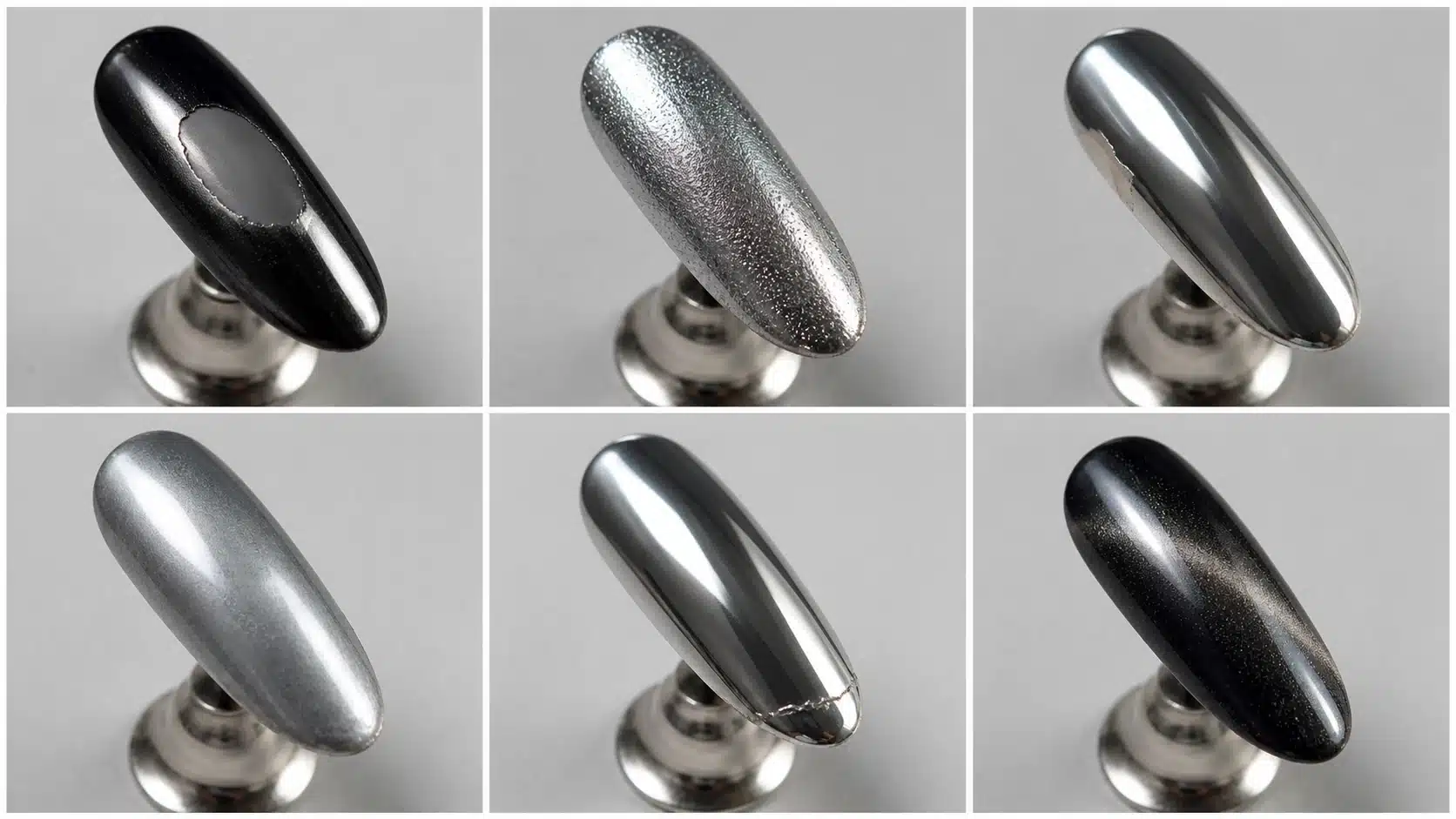
The underlying surface may be uneven, the receiving layer may contain brush marks, too much powder may be sitting loose on top, or the selected pigment may be intended to create sparkle or pearl rather than a true mirror. Inspect the product reference sample before labeling the result a failure.
12.3 Why are there bald patches?
Uneven top-coat application, incomplete powder contact, contamination or accidental touching can create areas that reject pigment. Patch repairs may remain visible on a full mirror nail; repeating the effect layer can produce a cleaner result.
12.4 Why does the chrome look dull after top coat?
The final seal can change the optical appearance. Excessive pressure may disturb the powder, an incompatible top coat may reduce clarity, or loose residue may become suspended in the seal. Test the exact top coat over the exact powder before approving the combination.
12.5 Why does chrome peel from the edge?
The free edge may contain loose powder or may not have been prepared and sealed according to the system. Product on the surrounding skin, inadequate base adhesion and mechanical wear can also contribute. Diagnose whether the failure is between the natural nail and base, within the gel system, or only at the chrome/seal interface.
12.6 Why does chrome gel polish show brush lines?
Metallic pigments can make direction and thickness visible. Stirring when approved, applying a thin controlled layer, reducing repeated brush passes and allowing the product to settle may improve the finish. If the product is intentionally a brushed chrome, visible direction is part of the design.
12.7 Why does the chrome transfer onto the top-coat brush?
Loose surface pigment can contaminate the brush. Remove excess powder properly and use the sealing method approved by the supplier. Some systems use an intermediate sealing step; do not add one unless it has been tested for compatibility.
12.8 Why does chrome wrinkle or remain soft?
That symptom concerns the gel layers, not the dry powder alone. Possible factors include excessive layer thickness, lamp incompatibility, insufficient curing, heavy pigmentation or an unapproved product combination. Stop using the service protocol until the system has been checked.
13. Popular Chrome Nail Effects and Collection Ideas
13.1 Silver mirror chrome
The clearest expression of the category. It needs a smooth surface and controlled reflection, making it a strong benchmark for comparing powder systems.
13.2 Glazed and pearl chrome
A translucent white, pearl or softly shifting effect over nude, milky or pastel bases. It is commercially flexible because the finish can be subtle enough for everyday salon wear.
13.3 Gold and champagne chrome
Gold can range from bright yellow metal to softer champagne and antique finishes. A private label collection should define undertone as well as reflectivity.
13.4 Pink and strawberry chrome
Pink bases and pearl overlays can produce wearable color with a high-impact surface. This direction can bridge a trend collection and an evergreen salon shade range.
13.5 Aurora and multichrome
These effects shift with viewing angle and base color. Approval photography should include more than one angle or a short video; one still image can conceal the shift.
13.6 Dark and gothic chrome
Black, burgundy, deep plum and smoked silver create a dark romantic metallic direction. Pinterest’s 2026 trend reporting identified strong growth in searches for gothic coffin nails, making this a useful styling direction inside a broader chrome collection rather than a reason to build another generic seasonal trend article.
13.7 Chrome French tips
Chrome French designs use the effect selectively and therefore depend on edge control. Powder-isolation gels, metallic liner gels or dense gel paints may be more efficient than full-nail rubbing, depending on the design.
13.8 Raised liquid-metal details
A dimensional gel creates the relief and a metallic gel or powder creates the surface effect. The structural gel and chrome layer must be treated as separate product roles even when the final design appears to be one material.
13.9 Magnetic chrome cat eye
Magnetic chrome cat eye combines colored gel, reflective particles and magnet-shaped movement. It can range from a narrow high-contrast beam to a soft velvet glow. A 36-color collection such as JTING Chrome Cat Eye can support both neutral salon shades and high-impact fashion colors without using loose powder.
14. How Long Do Chrome Nails Last?
There is no responsible universal wear-time promise for every chrome manicure. Durability depends on the underlying nail condition, preparation, base system, product compatibility, layer thickness, cure, edge sealing, service length and the client’s daily wear.
The chrome effect itself is only one layer in the service. If the base separates from the nail, the mirror finish cannot compensate. If the base remains intact but the chrome wears at the free edge, the diagnosis should focus on powder cleanup, sealing and mechanical exposure.
Salons should run wear tests using the intended complete system rather than combine the best-looking powder, top coat and base from unrelated demonstrations. Private label buyers should record the exact products and application conditions used for every approved sample.
15. Removal, Safety and Professional Use
Removal follows the underlying system, not the word “chrome.” A chrome powder sealed over soak-off gel may be removed through that approved soak-off process. A chrome design over a file-off enhancement follows the maintenance or removal instructions for the enhancement. Do not promise soak-off removal without confirming every structural layer.
Safe professional practice includes:
- following labeled directions and warning statements;
- avoiding skin contact with uncured gel;
- preventing loose powder from entering eyes or being unnecessarily inhaled;
- maintaining appropriate salon ventilation and clean work practices;
- using the lamp and cure schedule approved for the gel system;
- stopping use if irritation occurs;
- and removing gel without picking or forceful peeling.
The U.S. FDA advises users to read nail-product labels, follow warnings and maintain good ventilation. It also notes that ingredient declarations and appropriate warnings are important for retail cosmetics. The American Academy of Dermatology advises against picking gel polish and recommends professional, controlled removal practices. These sources do not certify a particular chrome product; they provide general safety context.
For private label supply, request the actual ingredient information and documents appropriate to the product and destination market. “Chrome,” “mirror,” “vegan,” “HEMA-free” or “professional” should never replace SKU-level review.
16. How Salons Can Build a Chrome Service Menu
A clear menu should sell the outcome while preserving the technician’s ability to choose the correct system.
| Service | Customer-facing result | Operational system | Pricing consideration |
|---|---|---|---|
| Glazed overlay | Soft pearl over a chosen base | Gel color + chrome powder + seal | Additional effect step and powder handling |
| Full mirror chrome | High-reflection metallic nail | Smooth base + compatible chrome system | Precision, cleanup and sealing time |
| Brushed metallic gel | Satin or liquid-metal full color | Direct-application metallic gel | Faster application; product-specific leveling |
| Chrome French | Reflective tip or detail | Powder isolation or metallic art gel | Fine-line control and symmetry |
| Aurora upgrade | Color-shifting overlay | Aurora powder over selected base | Base-color consultation and effect sample |
| 3D liquid metal | Raised metallic detail | 3D gel + chrome layer | Design time, structure and detailed sealing |
Avoid using one photograph to represent every service. A client who expects a perfect silver mirror may be disappointed by a deliberately brushed finish even when the product performs correctly.
For team consistency, keep a physical reference board with the approved base, effect product, top coat, lamp and cure instructions written beside each look.
17. How Private Label Buyers Should Evaluate Chrome Products
17.1 Define the effect before selecting the format
Start with a physical benchmark or controlled reference images. Decide whether the target is mirror, pearl, glazed, satin metallic, aurora, multichrome or raised liquid metal.
17.2 Identify every component in the system
For a powder route, specify the base colors, receiving layer, powder, applicator, final seal and lamp protocol. For a gel route, specify whether the product is full-cover color, topper, paint or liner.
17.3 Test reflectivity and coverage separately
A product can cover in one coat but remain brushed. Another can create excellent mirror reflection but require a very controlled surface. Score the attribute the collection actually needs.
17.4 Test multiple base colors
Approve the product over the bases customers will use. One powder photographed only over black is not a complete collection evaluation.
17.5 Evaluate application tolerance
Run the system with more than one technician. Record cure timing, rubbing window, cleanup time, brush marks, leveling and edge sealing. A visually exceptional sample may still be difficult to reproduce at salon scale.
17.6 Review packaging and contamination control
Loose powder needs secure packaging and clear net-content information. Applicators, inner seals and jar openings affect handling. Gel products need bottles, brushes or pots suited to pigment density and application role.
17.7 Approve instructions as part of the product
The instruction card should identify the role of each item, approved lamp protocol, layer sequence, cure direction, powder application, final seal and removal route. Ambiguous instructions create avoidable complaints.
17.8 Confirm documents by product and market
Request ingredient information and applicable compliance documentation for the exact SKU and destination. JTING can discuss SDS/MSDS, INCI, COA, CPNP, CPSR, GPSR and other documentation depending on product and target market; the required package must be confirmed project by project.
18. Building a Private Label Chrome Collection With JTING
A useful private label chrome range begins with an effect architecture, not a long list of nearly identical silver products. A focused launch may include:
- one strong silver benchmark;
- one soft pearl or glazed direction;
- one warm gold or champagne direction;
- one pink or rose effect;
- one aurora or color-shifting effect;
- one dark chrome look;
- and one product for selective French or liner details.
JTING can build the category around two distinct product architectures:
| Route | Confirmed JTING products | What the buyer is selecting |
|---|---|---|
| Chrome Powder system | FG128 Clear Chrome Base Coat, FG123 Black / FG124 White Chrome Base Gel, Chrome Magic Top Coat and the selected chrome powder | Clear, black or white receiving base; target powder effect; rubbing protocol; final sealing protocol |
| Magnetic Chrome Gel Polish system | JTING 36-Color Chrome Cat Eye | Shade range, magnet pattern, opacity, light-band strength and approved cure workflow |
The exact combination should be selected only after sample testing. A buyer should not assume that every powder works over every receiving layer or that a magnetic cat eye result can be evaluated with the same criteria as a flat mirror powder.
JTING supports custom color direction, formula discussion, coordinated shade planning, bottles, caps, brushes, labels, boxes, color charts, mockups, photography and video support for private label gel nail polish projects. Private label gel nail polish orders can start from 10 pieces per shade, while house-brand mixed-color orders can start from 100 pieces; final MOQ depends on product type, packaging, formula request and customization level.
Standard samples typically require 7-10 business days. Custom color or exclusive formula development typically requires 2-4 weeks, and bulk production after sample and packaging approval typically requires 15-20 days. Final timing depends on the product, revision rounds, packaging and order requirements.
Buyers can also review JTING’s OEM/ODM gel collections, top coat and base coat category, Build Your Brand service and manufacturing service page.
19. Professional Sample Approval Checklist
Product identity
- Is the sample a powder, colored gel, clear transfer gel, topper, paint or liner?
- Is the intended finish mirror, pearl, glazed, metallic, brushed or multichrome?
- Are all required companion products identified?
Application
- Which base colors were tested?
- Which receiving layer or top coat was used?
- Which lamp, cure time and layer thickness were used?
- How wide is the workable powder-rubbing window?
- Does the gel require stirring or settling?
Appearance
- Is reflection even under a line light?
- Are brush marks, grain, bald patches or edge defects visible?
- Does the sample match the approved reference from several angles?
- Does the color shift appear in video as expected?
Wear and removal
- Does wear failure occur at the base, color, chrome or top interface?
- Is the free edge still sealed after realistic wear?
- Does removal follow the documented underlying system?
Commercial readiness
- Is packaging appropriate for powder or pigmented gel?
- Are instructions understandable without sales explanation?
- Are labels, ingredient information and market documents aligned with the exact SKU?
- Can another technician reproduce the approved result?
20. Frequently Asked Questions
Are chrome nails and chrome powder the same thing?
No. Chrome nails are the finished appearance. Chrome powder is one material used to create that appearance.
Is chrome powder the same as chrome gel polish?
No. Chrome powder is a loose effect pigment rubbed onto a compatible surface. Chrome gel polish is a curable liquid gel containing metallic or reflective pigment.
Are chrome nails and chrome cat eye nails the same?
Not exactly. Chrome nails are a broad visual family. Chrome cat eye nails are one magnetic chrome-effect direction in which a magnet shapes reflective particles before curing.
Is chrome cat eye gel polish the same as chrome powder?
No. Chrome cat eye is a curable magnetic gel polish. Chrome powder is a loose pigment rubbed onto a compatible cured surface. They can both create reflective effects, but their products, tools and workflows are different.
What is chrome effect gel?
The name is ambiguous. It may describe a clear no-wipe receiving layer for chrome powder, a colored metallic gel or a specialized nail-art gel. Check the application instructions and product role.
Do you need gel polish for chrome powder?
Many professional chrome powder systems are designed for use over gel color and a compatible cured receiving layer. Some may be used over other completed enhancement systems when approved. Follow the selected manufacturer’s instructions.
Do you need a no-wipe top coat for chrome powder?
Many systems do, but not every no-wipe top coat is compatible with every powder. Some brands specify a dedicated chrome base or a particular cure window.
What is the best base color for chrome nails?
There is no universal best color. Black usually creates deeper contrast; white and milky shades create pearl or glazed results; colored bases shift the final tone. Choose according to the target effect.
Why is my chrome powder not sticking?
Common causes include an incompatible receiving layer, incorrect cure state, contamination, delayed application or a mismatch between the powder and surface.
Why do my chrome nails look glittery instead of mirrored?
The surface may be uneven, the powder may not be a true mirror-effect pigment, particles may not be rubbed evenly, or loose product may remain on top. Compare the result with the product’s approved reference sample.
Can chrome gel polish create a true mirror finish?
Some formulas can be highly reflective, but many create metallic, brushed or liquid-metal finishes rather than the sharp mirror associated with rubbed powder. Approve the physical sample instead of relying on the product name.
Does chrome gel polish need a top coat?
Usually a compatible top coat is used, but the exact requirement depends on the product. Follow its written application instructions.
How long do chrome nails last?
Wear depends on the complete manicure system, preparation, cure, edge sealing, nail condition and daily use. A universal duration should not be promised without testing the exact system.
Can chrome powder be used over dip or acrylic nails?
It may be applied over a properly finished enhancement if the selected gel or transfer layer is compatible. The powder still needs an approved receiving and sealing system.
Is chrome powder made from chromium?
Not necessarily. “Chrome” often describes the visual effect. Ingredient composition varies, so buyers should review the actual ingredient declaration and supporting documents.
What should private label buyers ask a chrome nail supplier?
Ask for product classification, intended effect, full application system, compatible base and top products, lamp protocol, cure timing, base-color swatches, ingredient information, packaging options, market documents and controlled samples.
Can JTING develop a private label chrome nail collection?
JTING can discuss custom color and effect directions, formula development, coordinated collection planning, packaging, labels, boxes, color charts, product photography and videos. The exact chrome product format, MOQ, documents and schedule must be confirmed for the selected project.
21. Conclusion
Chrome nails are a visual family, not one product. Chrome powder, magnetic chrome cat eye gel polish, metallic gel paint and chrome effect/base gel can all contribute to the finished look, but they perform different jobs.
For salons, the best system is the one that produces the promised finish repeatedly under a documented workflow. For private label buyers, the most important decisions are effect target, product format, companion products, base-color architecture, cure protocol, packaging and sample approval.
Choose the effect first. Then specify the material, method and system required to reproduce it.
To develop a coordinated professional range, send JTING your chrome effect references and sourcing brief. JTING can help evaluate the requested finish, sampling direction, packaging and private label project requirements before bulk production.