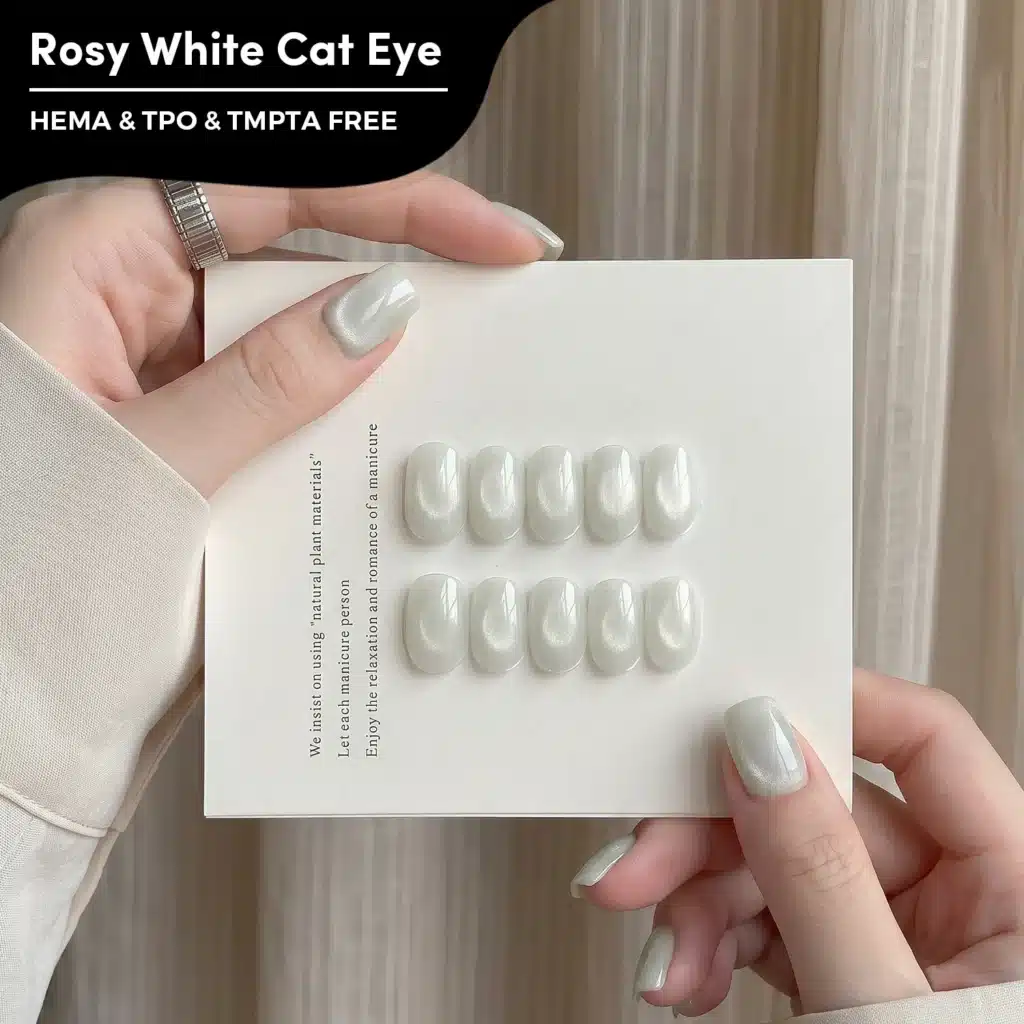
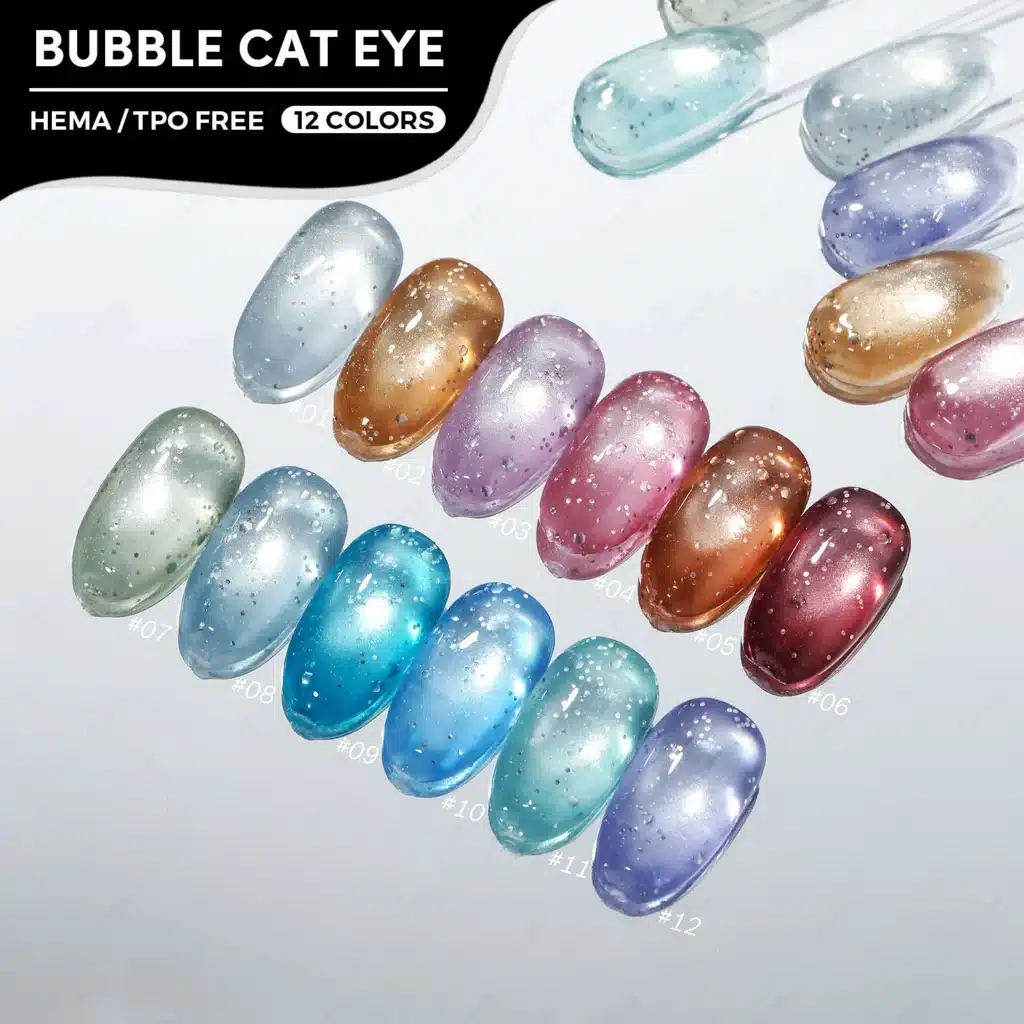
Gel nail polish is not simply color in a bottle. It is a light-cured chemical system whose ingredients, lamp compatibility, packaging and application method must work together. This guide explains what buyers should examine before approving a formula for salon use or a private label collection.
Ask a consumer what makes a good gel nail polish and the answer will probably involve color, shine and wear time. Ask a formulator or an experienced private label buyer and the answer becomes more complicated. The product must spread at a controlled rate, stay where the technician places it, allow light to penetrate the applied layer, form a durable film and remain compatible with its bottle, brush, base coat, top coat and curing lamp.
This is why two bottles that look almost identical can behave very differently. One may level smoothly and cure evenly in thin coats. Another may pull away from the edges, wrinkle over a soft lower layer or feel unusually hot during curing. The difference is not always “good ingredients” versus “bad ingredients.” More often, it is whether the complete formula has been designed, manufactured and used as a coherent system.
For a salon, that system affects service time and client retention. For a distributor or private label brand, it affects returns, training, regulatory documentation and the ability to reproduce the same product in the next production run. Understanding the ingredient categories does not turn a buyer into a cosmetic chemist, but it does make product evaluation far more disciplined.
1. What Is Gel Nail Polish Made Of?
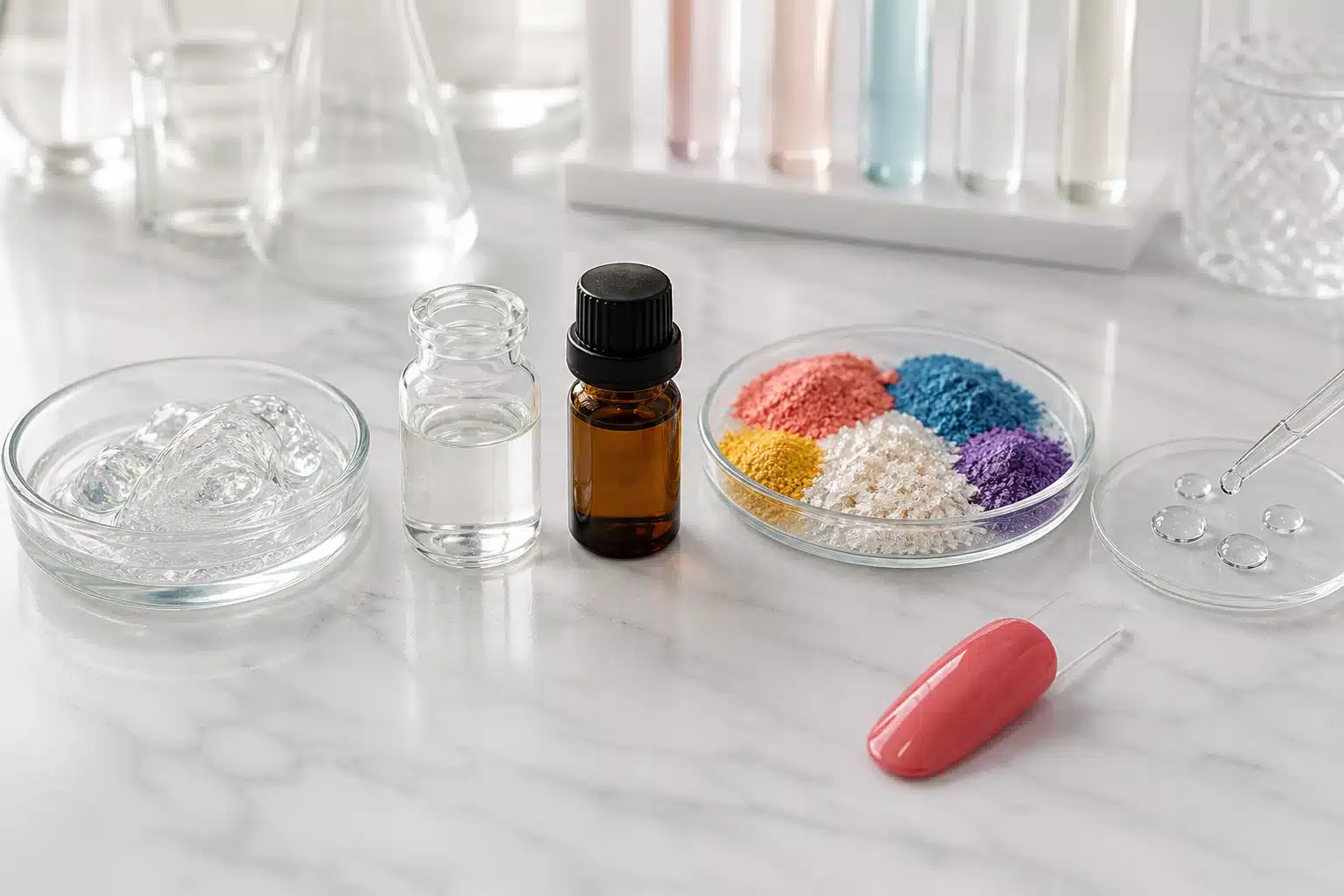
The short answer: most UV/LED gel nail polish formulas combine reactive oligomers, reactive monomers, photoinitiators, pigments or effect materials, and smaller quantities of functional additives. When a compatible lamp supplies the required light, the photoinitiator starts a polymerization reaction that converts the applied liquid gel into a crosslinked solid film.
Unlike conventional nail lacquer, gel nail polish does not dry mainly because volatile solvent evaporates into the air. Its defining step is light curing. The lamp delivers energy within a particular wavelength range; the photoinitiator absorbs suitable light and creates reactive species; those species trigger the acrylate or methacrylate components to link together. The result is the glossy, wear-resistant coating associated with a gel manicure.
That explanation also reveals why the lamp cannot be treated as an unrelated accessory. A bottle may remain liquid for months under appropriate storage, then cure in seconds under the correct lamp. If the formula and lamp output are poorly matched, the surface may appear hard while deeper material remains insufficiently cured. Wattage printed on the lamp alone does not prove compatibility. Wavelength distribution, irradiance, exposure time, distance from the LEDs, product color and layer thickness all influence the result.
1.1 Gel Nail Polish vs. Traditional Nail Polish
Basic differences between light-cured gel nail polish and conventional nail polish.
| Comparison | Gel Nail Polish | Traditional Nail Polish | Why It Matters to Buyers |
|---|---|---|---|
| Film formation | Light-initiated polymerization | Primarily solvent evaporation | Gel performance must be assessed with a compatible lamp and defined cure schedule. |
| Application state | Remains workable until cured | Begins drying after application | Technicians gain placement time, but uncured skin contact must be avoided. |
| Wear profile | Typically longer wear and higher gloss retention | Usually shorter wear and easier touch-ups | Long wear is valuable only when application and removal remain practical. |
| Removal | Soak-off, filing, or a product-specific method | Usually removed with polish remover | A buyer must validate removal time and nail-service protocol, not only initial appearance. |
| System dependency | High: base, color, top and lamp interact | Lower, although base and top still affect results | Testing a color bottle in isolation gives incomplete information. |
2. The Five Main Ingredient Groups in Gel Nail Polish
An ingredient list can look intimidating because it contains individual INCI names rather than simple categories. Buyers do not need to memorize every chemical name. They do need to understand the job each category performs and recognize that changing one part of the system may force adjustments elsewhere.
2.1 Oligomers: The Structural Backbone
Oligomers are relatively large reactive molecules that provide much of the cured coating’s body. They help determine whether the final film feels hard, flexible, tough, glossy or brittle. In practical terms, the oligomer system is one reason a builder gel can maintain an apex while a thin color gel can move easily under a brush.
A harder network may resist surface scratching but perform poorly on a flexible natural nail if it cannot move with the nail plate. A more flexible system may feel comfortable on thin nails but offer insufficient structure for an extension. Formulation is therefore a matter of balance, not a contest to maximize hardness.
2.2 Monomers: Flow, Crosslinking and Application
Reactive monomers are smaller molecules that can reduce viscosity, help the product wet the nail surface and participate in the curing network. The selection and concentration of monomers influence application, adhesion, flexibility and the density of the cured film. HEMA is one well-known example, but it is not the only reactive monomer used in nail formulations.
Replacing a monomer is not as simple as deleting a name from the ingredient list. A replacement strategy may change viscosity, wetting, cure response or adhesion. A competent HEMA-free formula therefore needs performance testing as a new system; it should not be approved solely because the front label carries a desirable claim.
2.3 Photoinitiators: Starting the Cure
Photoinitiators absorb light and generate the reactive species that start polymerization. Their absorption behavior must align with the light delivered by the curing device. Formulators may use a photoinitiator system rather than relying on a single material, particularly when they need to balance cure depth, color stability and surface cure.
More photoinitiator is not automatically better. The system must be optimized for the product’s layer thickness, pigment load, bottle protection and intended lamp. A highly pigmented black, white or opaque shade can be more demanding than a translucent nude because less useful light may reach the lower part of the coating.
2.4 Pigments and Effect Materials
Pigments create color and coverage. Mica, glitter, reflective particles and magnetic materials create visual effects. Their particle size, concentration, dispersion and stability affect far more than the color chart. Poorly dispersed pigment can streak; heavy effect particles can settle; excessive opacity can make a thick layer difficult to cure through.
Strong one-coat coverage may look attractive in a sales claim, but buyers should ask how the shade performs at the recommended application thickness. A formula that appears perfect in a very thick swatch may not be appropriate for a real salon service. Color strength, flow and cure depth have to be assessed together.
2.5 Functional Additives
Additives are often used at lower levels, yet they can have a visible effect on the user experience. Depending on the formula, they may help control flow, pigment suspension, foam, surface wetting, storage stability or inhibition caused by unwanted light exposure. A tiny change can alter how quickly a gel levels or whether effect particles remain evenly distributed during storage.
Additives cannot rescue a fundamentally unsuitable formula. They are fine-control tools within a complete system. Buyers should be cautious when a supplier explains every issue as a minor additive adjustment without repeating stability, cure and packaging tests.
Ingredient functions and the buyer-facing performance questions they create.
| Ingredient Group | Primary Function | Performance It Can Influence | Buyer’s Test Question |
|---|---|---|---|
| Oligomers | Build the main cured structure | Hardness, flexibility, toughness and gloss | Does the film suit the intended nail type and service? |
| Monomers | Control flow and participate in crosslinking | Viscosity, wetting, adhesion and flexibility | Does the product level without flooding the sidewalls? |
| Photoinitiators | Start polymerization under suitable light | Cure speed, cure depth and color stability | Is the formula validated with the specified lamp and cure time? |
| Pigments and effects | Provide color, opacity and visual effects | Coverage, dispersion, settling and light penetration | Do difficult shades cure and remain stable at the recommended thickness? |
| Functional additives | Fine-tune processing and application | Leveling, suspension, foam control and storage behavior | Does the result remain consistent after transport and storage testing? |
3. What Is HEMA in Gel Nail Polish?
HEMA is the commonly used abbreviation for 2-hydroxyethyl methacrylate. It is a small reactive monomer that has been used in nail products because it can support wetting, adhesion and polymer network formation. Its technical usefulness is also why the discussion should be more precise than “HEMA is good” or “HEMA is bad.” Risk depends on the substance, exposure and conditions of use.
3.1 Why HEMA Became a Purchasing Issue
Uncured or insufficiently cured methacrylate material can be a sensitization concern, particularly when it repeatedly contacts skin. Once a person becomes sensitized, later exposure may trigger an allergic response. The practical controls are familiar but important: avoid skin contact, apply controlled layers, use a validated lamp and cure schedule, train technicians and follow the product’s warnings.
The European Union’s Regulation (EU) 2020/1682 restricts HEMA and Di-HEMA TMHDC in nail products to professional use and requires the warnings “For professional use only” and “Can cause an allergic reaction.” The regulation reflects a key distinction: correct application to the nail plate while avoiding adjacent skin is not the same exposure scenario as imprecise or repeated skin contamination.
The U.S. FDA’s nail product guidance likewise notes that residual reactive monomers can cause adverse reactions in people who have become sensitive and advises avoiding skin contact. These sources support careful professional practice; they do not support marketing any gel system as universally allergy-proof.
3.2 What Does HEMA-Free Actually Mean?
HEMA-free normally means that HEMA has not been intentionally used in that formula. The claim does not automatically mean the product contains no other acrylates or methacrylates. It also does not mean “hypoallergenic,” “non-toxic,” “safe for every sensitive client” or “safe to apply on skin.”
A buyer should request the ingredient information for the exact product and confirm how the claim is controlled across raw materials, production and labeling. If the brand sells several systems, do not assume every base, color and top coat has the same free-from status. The claim should be checked at SKU level.
3.3 Questions to Ask About a HEMA-Free Formula
- Which product components are HEMA-free: base, color, top coat, builder gel, or the complete system?
- Has adhesion been evaluated on the intended nail types?
- Does the formula require a specific base coat or preparation method?
- Which lamp and cure schedule were used for validation?
- Can the supplier provide current ingredient and safety documentation for the exact SKU?
- How is the HEMA-free claim reflected in production control and final labeling?
4. What Is TPO, and Why Are Buyers Requesting TPO-Free Formulas?
TPO is the common abbreviation for Trimethylbenzoyl Diphenylphosphine Oxide, a photoinitiator formerly used in some artificial nail and gel systems. Its function was technical: absorb suitable light and help initiate curing. Its regulatory status, however, changed significantly in the European Union.
4.1 The EU Position Since September 2025
Under Commission Regulation (EU) 2025/877, TPO was added to the list of substances prohibited in EU cosmetic products, with the regulation applying from 1 September 2025. The European Commission also published a dedicated TPO in Nail Products Q&A addressing the scope of the prohibition, professional use and existing stock.
For a brand selling cosmetics in the EU, “we used this formula before” is therefore not a sufficient basis for a new order. The current formula and ingredient list must be checked. Buyers serving several markets should avoid assuming that the EU rule is identical everywhere; they need a market-by-market compliance review.
4.2 What Changes When TPO Is Removed?
A TPO-free formula still needs a photoinitiator system. Removing one photoinitiator can affect cure speed, depth of cure, color stability and lamp compatibility, so the rest of the formula may need rebalancing. A supplier should be able to state the recommended lamp characteristics and cure schedule for the revised product, then support that recommendation with practical testing.
Dark, white, highly opaque and effect shades deserve particular attention because pigment or particles can reduce light penetration. A clear sample curing successfully does not prove that every shade in a 100-color collection behaves the same way. Buyers should test difficult colors from each formula family.
Procurement note: “TPO-free” is a formula attribute, not a complete compliance certificate. Product safety assessment, labeling, responsible-person duties, notification and documentation depend on the destination market and the finished product.
5. HEMA-Free, TPO-Free, Vegan and “Non-Toxic”: What Is the Difference?
Free-from claims are useful only when the buyer understands their boundaries. A short front-label phrase cannot describe the complete formula, application risk or legal status of a finished product. Treat each claim as one defined piece of information, not a substitute for documentation.
Common claims describe different attributes and should not be used interchangeably.
| Claim | What It Usually Addresses | What It Does Not Prove | What a Buyer Should Verify |
|---|---|---|---|
| HEMA-free | HEMA is not intentionally used in the stated formula | Free of all reactive acrylates or allergy-proof | Exact SKUs, ingredient information and claim-control process |
| TPO-free | TPO is not intentionally used as a photoinitiator | Automatic compliance in every target market | Current formula, destination rules, cure performance and documentation |
| Vegan | Absence of intentionally used animal-derived ingredients under the brand’s standard | Low sensitization potential or cruelty-free status | Definition, raw-material declarations and labeling support |
| Cruelty-free | Animal-testing policy | A particular ingredient profile or universal legal acceptance | The scope of the policy and target-market requirements |
| Non-toxic | A broad marketing position | A defined scientific or regulatory threshold by itself | Specific substantiation and whether the wording is permitted in the market |
| Hypoallergenic | A reduced-allergen positioning | No user can experience a reaction | Evidence supporting the finished-product claim and local claim rules |
In the United States, cosmetic products and ingredients generally do not receive FDA premarket approval, except for color additives, but the companies marketing them remain legally responsible for safety under labeled or customary conditions of use. The FDA’s cosmetic ingredient guidance is a useful reminder that a marketing phrase does not transfer that responsibility away from the brand.
6. How Ingredients Affect Gel Nail Polish Performance
Ingredient knowledge becomes commercially useful when it helps explain performance. A buyer does not need to diagnose a formula from appearance alone, but should know which observations deserve investigation and which variables must be controlled during comparison.
6.1 Adhesion and Lifting
Lifting can be related to nail preparation, contamination, application on skin, an unsuitable base coat, film rigidity, cure conditions or the client’s nail type. It should not be blamed automatically on “weak pigment” or solved by simply increasing cure time. Compare products using the same preparation, lamp, layer thickness and wear-test conditions before drawing conclusions.
6.2 Viscosity and Self-Leveling
Viscosity describes resistance to flow; self-leveling describes how the applied surface smooths over time. A gel can be thick but still level well, or feel thin and yet leave brush marks. Temperature also changes application behavior, so samples evaluated in a cold warehouse may not represent salon use. Buyers should record test temperature and allow products to equilibrate before comparison.
6.3 Flexibility and Hardness
A hard coating is not always a durable coating. Natural nails flex, and a very rigid film may crack or separate when used on a flexible nail plate. Conversely, a highly flexible formula may not provide enough structure for reinforcement. Product claims should describe the intended service rather than imply that one mechanical profile suits every client.
6.4 Coverage and Cure Depth
Pigment concentration influences opacity, but opacity can also reduce the light reaching deeper material. Apply the specified thin coat rather than trying to force full coverage through thickness. Test difficult colors, and inspect for wrinkling, soft material or color transfer during removal. Apparent surface hardness is not, by itself, proof of complete cure.
6.5 Surface Tack and Oxygen Inhibition
Some cured gel layers retain a tacky dispersion layer because oxygen at the surface interferes with polymerization. That layer can be normal in systems designed for the next coat or for cleansing after the final cure. It should not be confused automatically with an uncured product. The manufacturer’s instructions must state whether the product is wipe, no-wipe or intended to bond to another layer.
6.6 Gloss, Stain Resistance and Removal
The network structure and additives can influence scratch resistance, gloss retention and staining. Removal depends on the coating structure, applied thickness and service system. A product that takes longer to remove is not automatically higher quality. Salon economics often favor a controlled balance: sufficient wear with predictable, non-destructive removal.
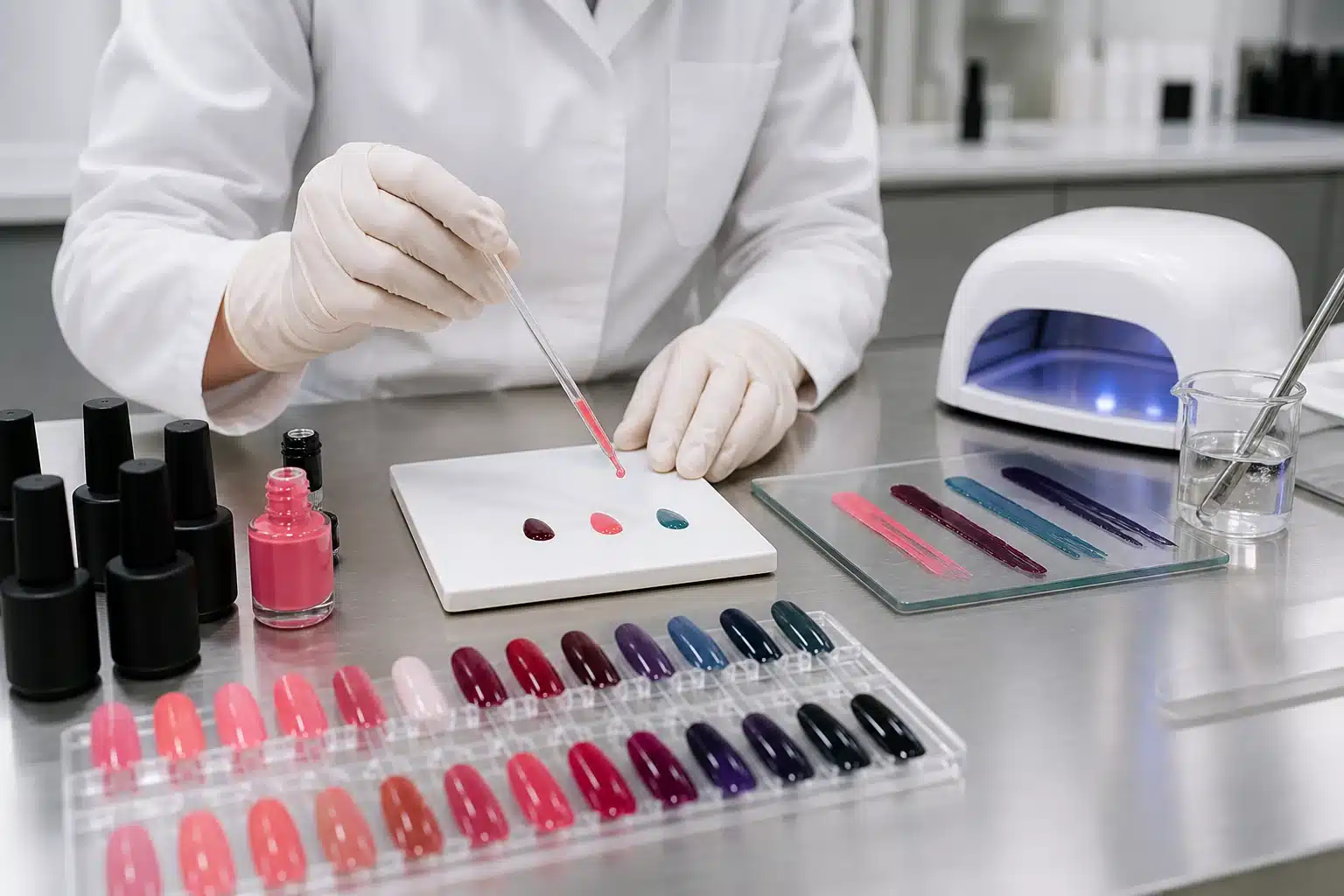
7. Why Different Gel Products Need Different Formulas
A complete nail line should not use one performance brief for every product. Base coat, color gel nail polish, top coat and builder products perform different jobs. Even when they share ingredient families, their balance can be very different.
7.1 Base Coat
Base coat is the interface between the prepared nail and the rest of the coating. Wetting, controlled adhesion and flexibility are central. The best base is not necessarily the one that grips hardest; it is the one that provides the required wear while supporting the intended removal process and nail type.
7.2 Color Gel Nail Polish
Color gel must balance brush control, leveling, coverage, pigment stability and cure. A private label range may need several bases for different shade families rather than forcing every pigment and effect into one universal color base. Consistent technician experience remains the goal, but the chemistry behind that experience may vary.
7.3 Top Coat
Top coat protects color and delivers the final gloss or matte effect. Buyers may evaluate scratch resistance, stain resistance, yellowing, surface feel and whether cleansing is required. Flexible overlays and rigid enhancements may need different top-coat behavior.
7.4 Builder Gel and Rubber Base Gel
Builder gel requires controlled structure, while rubber base gel is commonly positioned around flexibility and reinforcement. The names alone do not define performance. Buyers should specify application thickness, nail length, infill expectations, removal method and target user skill level.
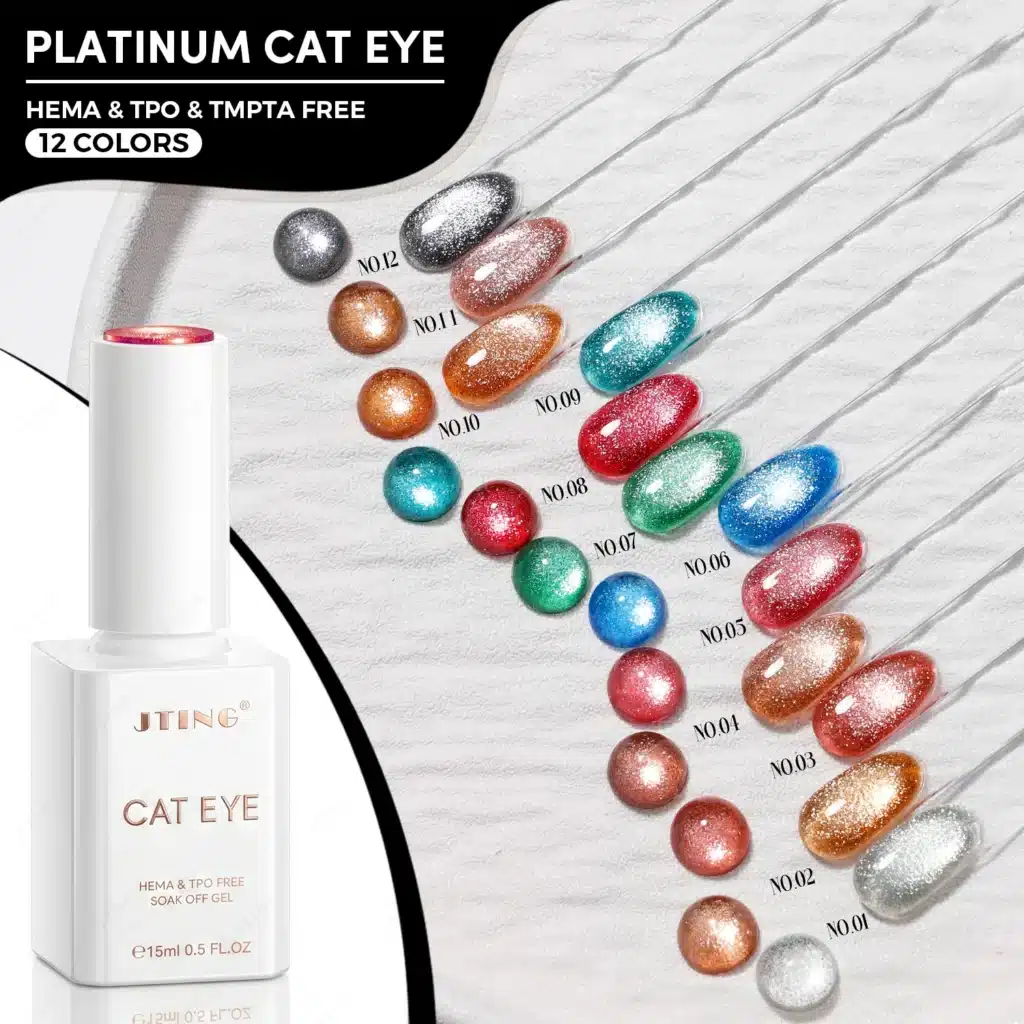
7.5 Cat Eye, Glitter and Other Effect Gels
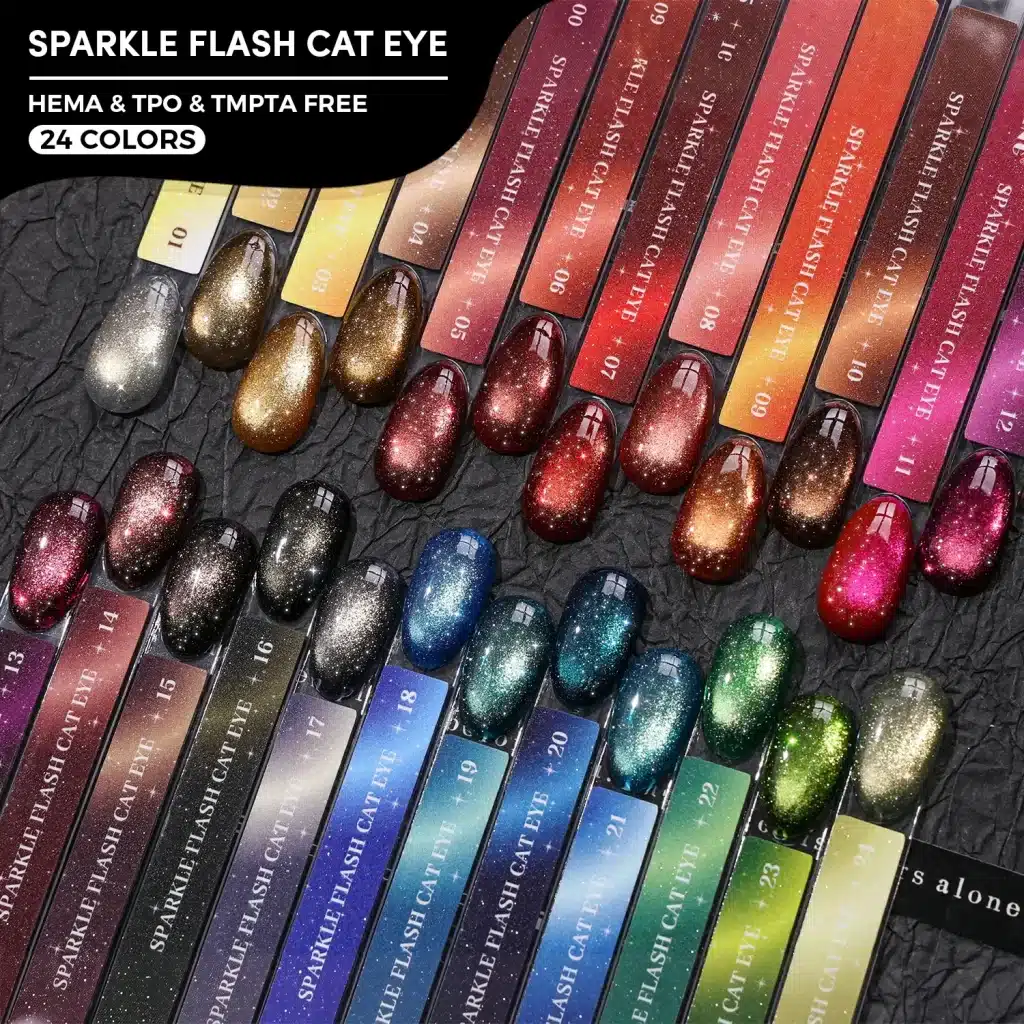
Effect products add another variable: particle behavior. In cat eye gel, magnetic particles need responsive movement and stable suspension. Glitter must distribute without making application unmanageable. Heavy or opaque effects need realistic cure instructions. A dramatic swatch is only commercially valuable if technicians can reproduce it.
8. How Professional Buyers Should Evaluate a Gel Nail Polish Formula
Start with a written product brief. “High quality” is not a measurable brief. Define the user, market, service method, target wear, removal, finish, price position and any ingredient restrictions. Then test samples against those requirements.
8.1 Define the Market and User First
A professional-only salon formula may use different warnings, instructions and application assumptions from a consumer retail product. A collection intended for the EU may require different formula decisions and documentation from one intended only for another market. Decide where the product will be sold before approving ingredients or packaging artwork.
8.2 Test the Complete System
Test base, color, top and lamp together. Record nail preparation, coat thickness, cure time, lamp model, removal method and observations. If the brand intends to claim compatibility with several lamps or bases, validate those combinations rather than assuming them.
8.3 Include Difficult Shades
A practical test set should include black, white, red, a pale nude, a highly pigmented shade and at least one effect product. These colors expose different challenges in opacity, pigment dispersion, staining and cure depth. Do not approve a large collection after testing only a forgiving translucent pink.
8.4 Separate Immediate Appearance from Wear Performance
Initial application can reveal flow, shrinkage, streaking and surface cure. It cannot reveal two-week adhesion, gloss retention, staining or removal behavior. Use a defined wear panel that represents the intended clients and technician skill level. Record failures by nail and day instead of relying on memory.
8.5 Recheck Production, Not Only Development Samples
The approved laboratory sample establishes the target; the production batch must reproduce it. Keep a signed or otherwise controlled approval sample, establish acceptable color and viscosity tolerances, and compare pre-shipment samples with that reference. Repeat-order consistency is a core part of product quality.
A practical formula approval plan for private label and wholesale buyers.
| Test Area | What to Record | Minimum Useful Sample | Warning Sign |
|---|---|---|---|
| Application | Brush control, leveling time, edge shrinkage and flooding | Several technicians and shade types | Results depend on unusually thick application or constant correction |
| Curing | Lamp, wavelength specification, time, layer thickness and shade | Clear, black, white, red and effect shades | Wrinkling, soft lower material or no defined lamp recommendation |
| Wear | Chipping, lifting, cracks, gloss and staining by day | Intended service length on varied nail types | Only one internal wearer or no documented protocol |
| Removal | Method, time, remaining film and nail condition | Full system at realistic thickness | Aggressive scraping is required to meet the claimed time |
| Stability | Viscosity, separation, settling, odor, color and packaging interaction | Defined storage and transport simulations | The supplier treats visible separation or leaking as purely cosmetic |
| Repeat batch | Color, viscosity, fill, brush and performance versus approval sample | Pilot or production batch | No retained standard or agreed tolerance |
9. What Documents Should a Gel Nail Polish Supplier Provide?
There is no single document pack that automatically makes a cosmetic legal in every country. Requirements depend on the destination, product type, claims and sales channel. The buyer, brand owner, responsible person, safety assessor and manufacturer may have different roles. Clarify those roles before artwork and production.
9.1 Ingredient and Safety Information
Buyers commonly request an ingredient list, Safety Data Sheet and product specification. These documents serve different purposes. An SDS communicates hazard and handling information for a substance or mixture; it is not a cosmetic safety assessment and should not be advertised as one. A product specification defines agreed physical or performance parameters. Ingredient information supports labeling and assessment but may require controlled handling for confidential details.
9.2 Finished-Product Safety and Market Files
For EU cosmetics, the route typically involves a responsible person, a Cosmetic Product Safety Report, a Product Information File and CPNP notification, alongside compliant labeling and good manufacturing practice obligations. Other regions use different systems. The supplier may provide manufacturing and formula information, but the brand should confirm who completes and owns each market obligation.
9.3 Batch Traceability and Quality Records
Ask how the manufacturer identifies raw-material and finished-product batches, records filling and inspection, retains samples and handles complaints. Traceability becomes important when a shade varies, packaging leaks or a market authority asks for information. A batch code printed on a bottle has little value unless it connects to usable records.
9.4 Stability and Packaging Compatibility
Light-cured products need protective packaging. Formula and bottle interactions can affect leakage, discoloration, thickening, brush performance and shelf stability. Request evidence appropriate to the package selected for the finished line, especially when changing from the supplier’s standard bottle to a custom component.
10. How Private Label Buyers Can Customize a Gel Nail Polish Formula
Customization exists on a spectrum. A stock formula with custom colors and packaging can be the right commercial decision for a new brand. A modified formula may provide useful performance differentiation without the cost and lead time of development from zero. A fully custom project offers more control but also requires a stronger brief, more testing and disciplined change management.
10.1 Stock, Modified or Fully Custom?
Choose the development route that matches the brand’s stage and risk tolerance.
| Development Route | Main Advantage | Main Trade-Off | Best Fit |
|---|---|---|---|
| Proven stock formula | Faster sampling and lower development burden | Less exclusive formula positioning | New brands, salons testing retail and focused market launches |
| Modified formula | Targeted changes to viscosity, cure or ingredient restrictions | Changes can trigger broader retesting | Growing brands with clear technician feedback |
| Fully custom formula | Greater control over the product brief and differentiation | Longer timeline, higher validation demand and larger commercial commitment | Established distributors and brands with defined volume and technical requirements |
10.2 Write Performance Targets, Not Adjectives
Replace “very thick,” “super shiny” and “lasts a long time” with measurable or testable requirements. State the target application method, number of coats, cure schedule, finish, wear-test period and removal method. Provide reference samples when possible, but explain what you like about them. The supplier cannot know whether the priority is brush control, color, gloss, flexibility or packaging.
10.3 Develop Color and Formula Together
Color development can change cure behavior, viscosity and stability. Approve the actual shade in the actual formula rather than signing off a digital image. Establish viewing conditions for color matching, because daylight, salon lighting, camera white balance and screen settings can make the same swatch look different.
10.4 Confirm Packaging Before Final Validation
The brush affects pickup and application; the neck and wiper affect product return; the bottle affects light protection and perceived color; the cap affects technician comfort. Validate the finished combination. A formula that works in a laboratory jar is not yet a finished retail product.
JTING NAIL supports OEM, ODM and private label gel nail polish development, including custom colors, formula options, bottles, caps, brushes, labels and boxes. Buyers can also discuss HEMA-free or TPO-free product requirements. As with any supplier, request current documents and approve the exact formula, shade and package intended for the destination market before bulk production.
11. Common Mistakes When Sourcing Gel Nail Polish
11.1 Choosing by Bottle Price Alone
A low unit price can become expensive when a formula needs extra coats, slows technicians, generates lifting complaints or arrives in leaking packaging. Compare cost per usable service and complaint risk, not only cost per bottle.
11.2 Treating Every Free-From Claim as Equivalent
HEMA-free, TPO-free, vegan and cruelty-free answer different questions. Define the claim, check every SKU and obtain evidence before creating packaging or advertising.
11.3 Approving Only Easy Shades
Translucent pink may perform beautifully while black, white or heavily pigmented red reveals cure or dispersion problems. Build difficult shades into the approval plan from the beginning.
11.4 Ignoring Lamp Compatibility
Do not replace a defined lamp specification with “48 watts or more.” Two lamps with the same nominal power can deliver different light to the nail. Use the supplier’s validated system and investigate any plan to make broad compatibility claims.
11.5 Requesting Compliance Files After Production
Formula restrictions, responsible-person review and labeling may require changes. Resolving them after bottles and boxes are printed creates avoidable waste. Put the destination market and document plan before final formula and artwork approval.
11.6 Failing to Control the Approval Sample
Comments in a chat thread are not a durable product standard. Keep the final sample, formula or version identifier, signed color reference, packaging specification and approved artwork together. Every later order should point back to that controlled version.
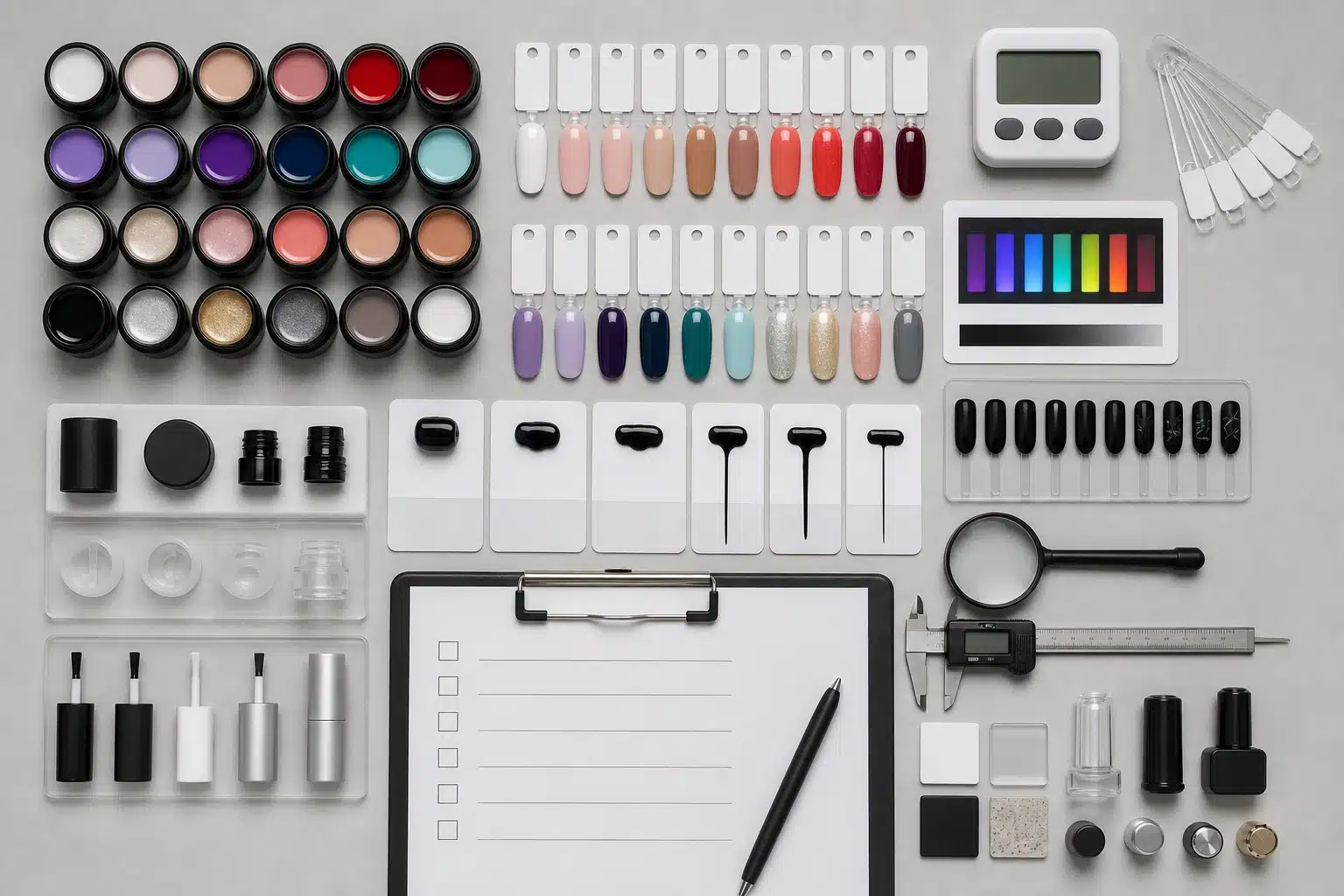
12. Professional Gel Nail Polish Buyer Checklist
Use this checklist before approving a private label formula or placing a repeat order:
- Target countries and sales channels are defined.
- Professional or consumer user is clearly specified.
- Ingredient restrictions and free-from claims are written.
- Base, color, top and lamp are tested as a system.
- Lamp specification and cure time are documented.
- Black, white, red, nude and effect shades are tested.
- Application thickness and number of coats are controlled.
- Wear testing represents the intended service period.
- Removal method and realistic removal time are recorded.
- Formula is tested in the final bottle and brush.
- Stability and transport risks are reviewed.
- Ingredient, safety and product specifications are current.
- Market-specific safety and notification roles are assigned.
- Claims have evidence and compliant wording.
- Final approval sample and version are retained.
- Batch traceability and complaint process are understood.
- MOQ, lead time and repeat-order tolerances are agreed.
- Production samples are compared with the approved standard.
13. Frequently Asked Questions
13.1 What are the main ingredients in gel nail polish?
Most gel nail polish formulas contain reactive oligomers, reactive monomers, photoinitiators, pigments or effect materials, and functional additives. Oligomers and monomers build the cured film, photoinitiators start polymerization under suitable light, pigments provide color, and additives fine-tune flow, suspension and stability. The exact materials and proportions vary by product type and manufacturer.
13.2 Is gel nail polish the same as regular nail polish?
No. Traditional nail polish forms a film mainly as solvent evaporates. Gel nail polish depends on a light-initiated polymerization reaction and therefore requires a compatible UV/LED lamp and a defined cure schedule. Its base, color and top layers also operate as a more interdependent system.
13.3 What does HEMA-free gel nail polish mean?
HEMA-free generally means HEMA has not been intentionally included in the specified formula. It does not necessarily mean the formula is free of all acrylates or methacrylates, and it does not guarantee that no user can develop an allergic reaction. Buyers should verify the exact SKU, ingredient information, intended user and cure instructions.
13.4 Is HEMA-free gel nail polish allergy-free?
No cosmetic gel nail polish should be described as universally allergy-free without a sound legal and scientific basis. Other reactive ingredients may still present sensitization concerns, and uncured material should not contact skin. Good application control, correct curing, technician training and clear warnings remain necessary.
13.5 What does TPO-free gel nail polish mean?
TPO-free means the photoinitiator Trimethylbenzoyl Diphenylphosphine Oxide has not been intentionally used in the stated formula. The claim is particularly relevant to EU cosmetic compliance because TPO has been prohibited in EU cosmetics since 1 September 2025. A TPO-free claim alone does not prove the finished product meets every other market requirement.
13.6 Can gel nail polish be both HEMA-free and TPO-free?
Yes. The two terms concern different ingredient functions: HEMA is a reactive monomer, while TPO is a photoinitiator. A formula can exclude both. The manufacturer must still balance adhesion, viscosity, curing and color performance and provide appropriate information for the finished product.
13.7 Why does gel nail polish wrinkle after curing?
Wrinkling often occurs when the top of an overly thick or highly pigmented layer cures faster than the material underneath. Lamp mismatch, insufficient exposure or excessive pigment can contribute. Apply the recommended thin coat and use the validated lamp and cure time. Persistent problems require investigation of the complete system rather than simply extending time without limit.
13.8 Why is gel nail polish still tacky after curing?
Some formulas are designed to retain an oxygen-inhibited dispersion layer, which helps the next coat bond or is removed by cleansing. That normal tack is different from a soft or insufficiently cured bulk layer. Check whether the product is a wipe or no-wipe formula and follow its instructions.
13.9 Do dark gel nail polish colors need longer curing?
Dark and highly opaque shades can reduce light penetration, but a buyer should not invent a longer cure schedule. Follow the formula-specific instructions, control layer thickness and use the specified lamp. The supplier should validate challenging shades and state any shade-specific application requirements.
13.10 What documents should private label buyers request?
The useful file set depends on the target market. It may include ingredient information, an SDS, product specifications, batch records, stability or compatibility support and documents needed by a finished-product safety assessor. EU projects also need clear responsibility for the CPSR, PIF, CPNP notification, labeling and responsible-person obligations. Confirm the exact list with qualified market specialists.
13.11 Can a manufacturer create a custom gel nail polish formula?
Yes. Development may start from a proven stock formula, a modified base or a fully custom brief. Buyers can specify target viscosity, application, finish, cure, removal and ingredient restrictions. Every meaningful formula change should be followed by suitable performance, stability, packaging and compliance review.
13.12 How should buyers compare gel nail polish samples?
Use the same preparation, base, layer thickness, lamp, cure time and top coat. Test several technicians and difficult shades, record initial application, run a wear panel, evaluate removal and compare the production batch with the retained approval sample. A controlled comparison is more reliable than choosing the sample with the strongest color on a display stick.
14. Conclusion: Choose a Formula, Not Just a Color
Gel nail polish is a coordinated light-cured system. Oligomers and monomers create the film, photoinitiators begin the cure, pigments create color, and additives refine application and stability. None of these categories works in isolation, and none can be evaluated properly without considering layer thickness, lamp output, packaging and technician practice.
HEMA-free and TPO-free options answer real purchasing needs, but they are not complete quality judgments. HEMA-free does not mean free of every reactive acrylate. TPO-free does not replace a market compliance review. A responsible buyer connects each claim to the exact SKU, supporting information, intended market and validated product system.
The strongest private label collection is not the one with the longest claim list. It is the one that can be applied consistently, cured according to clear instructions, documented for its destination, reproduced from batch to batch and supported by a supplier who understands both formula and packaging.