The past three seasons have seen a decisive shift in professional nail art toward what the industry is broadly calling the aqueous aesthetic: a visual language rooted in liquid dimensionality, surface tension, and wet-glass optics. From the backstage nail stations of Paris Fashion Week to the algorithm-driven feeds of professional nail artists building six-figure clienteles on social media, rain droplets, dew formations, and liquid mercury textures have become among the most-requested premium service upgrades in upscale salons worldwide. Yet for salon owners managing back-to-back appointment blocks, the technical execution of this aesthetic has remained a significant operational constraint. Traditional 3D bead construction requires a technician to load a dotting tool or fine brush with high-viscosity sculpting resin or builder gel, manually place each individual sphere, calibrate dome height by eye, and hope the bead holds its form before the client’s hand reaches the lamp. The margin for error is wide, the execution time is punishing, and the consistency across a full set of ten nails is almost impossible to guarantee at volume. JTING Water Drops Top Coat addresses this constraint directly by combining low-surface-energy base pairing with high thixotropic fluid dynamics, allowing technicians to seamlessly dot, slide, and position flawless 3D droplets without any of the messy stringing or trailing inherent to traditional sculpting gels.
The Design Inspiration: From Naturalist Morning Dew to Avant-Garde Gothic Horror
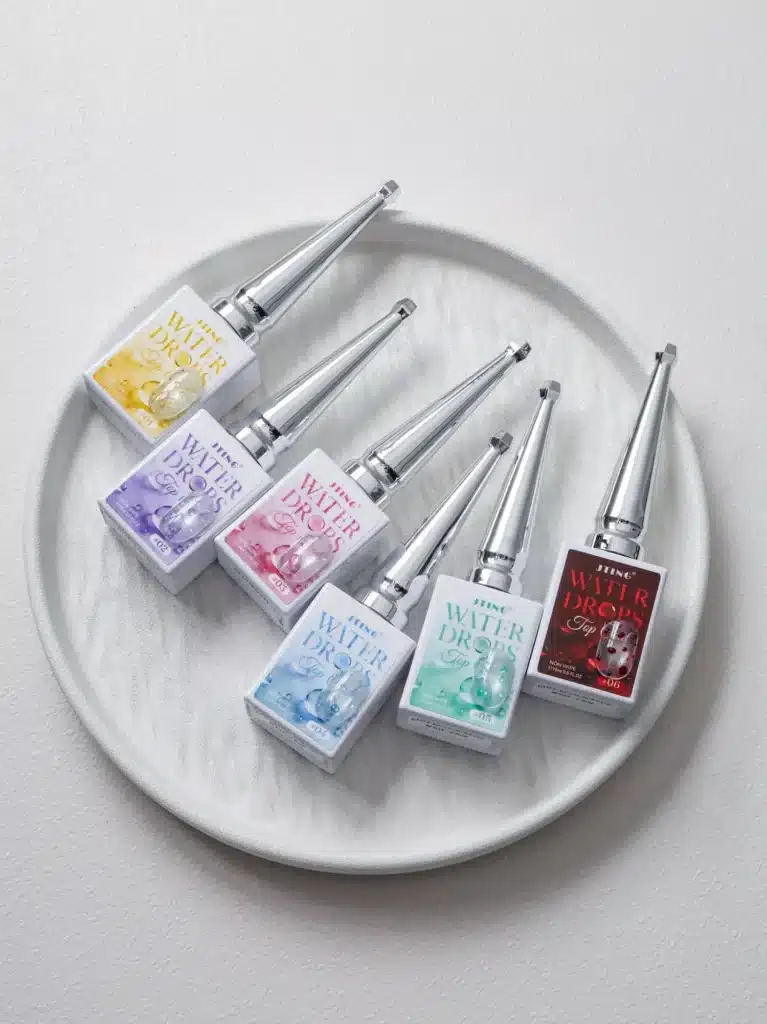
The six-color tint matrix within the Water Drops Top Coat line represents a deliberately broad creative range, designed to serve distinctly different aesthetic markets rather than a single narrowly defined trend. Shades No.01 through No.05 occupy the naturalist spectrum: near-colorless, faintly tinted translucent variations that replicate the optical characteristics of actual water droplets resting on a surface. Applied over sheer jelly bases, magnetic cat-eye gels, or mirror chrome powders, these tones function as a transparent amplifier rather than an opaque overlay, allowing the foundational color treatment to remain fully visible beneath a topography of perfectly formed spherical domes. The effect is optically convincing precisely because the tint is so restrained: it reads as liquid, not lacquer. The naturalist palette positions itself squarely in the bridal, resort, and minimalist editorial markets, where the client wants tactile interest without sacrificing the underlying investment in a complex base technique.
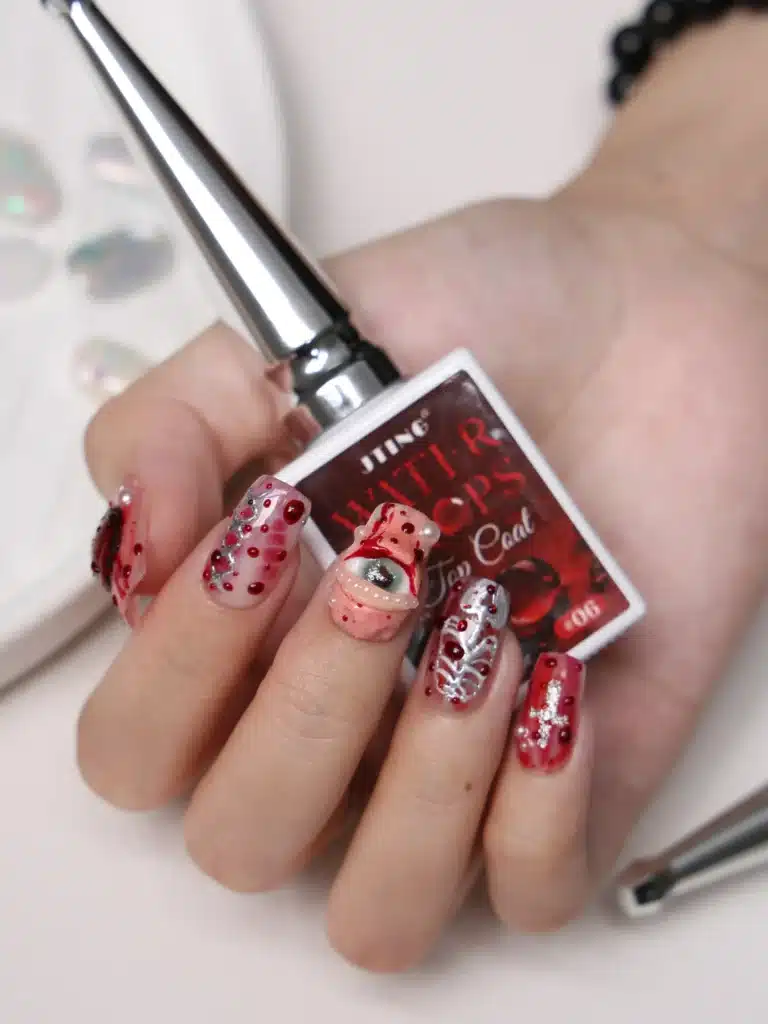
Shade No.06 operates in an entirely different conceptual register. The deep berry-to-blood-red pigmentation of this tint variant opens up a creative vocabulary that extends from moody editorial to outright surrealist body horror. When beaded droplets in this shade are positioned against black gel bases or graphite chrome grounds, the visual reference shifts unmistakably toward hyper-realistic blood or venom formations. Within art-forward nail installations, No.06 has shown particular versatility paired with sculpted three-dimensional structural elements: ceramic or acrylic eyeballs, gothic cross charms set in silver metallic filigree, or anatomical nail art built in layered acrylic. As a seasonal staple for Halloween editorial sets and avant-garde portfolio builds, the shade extends the commercial utility of the product line well beyond everyday salon menus into commissioned art projects and competition pieces.
Breaking Down the Chemical Physics: The Mechanics of Automatic Beading Technology
Understanding why this formulation produces perfect spherical beads automatically, without any manual dotting or shaping, requires a working grasp of interfacial surface tension dynamics and how controlled dewetting functions in polymer resin systems. When two liquid surfaces with significantly different surface energy values come into contact, the higher-energy liquid will attempt to minimize its contact area with the lower-energy substrate. Rather than spreading and leveling outward into a uniform sheet, which is the behavior observed in conventional topcoats applied to standard gel layers, the formulation is pulled inward by cohesive intermolecular forces that exceed the adhesive forces between the top coat and its foundation. This contraction force is what produces the bead-formation event.
The JTING Water Drops Top Coat is engineered to function within a matched system: it is specifically formulated to interact with the FG156 Water Drops foundational series, which carries a deliberately low surface energy profile. The extreme disparity between the surface energy of the foundation layer and the surface tension characteristics of the top coat triggers a rapid dewetting process the moment the product is brushed onto the nail. The liquid resin does not have time to flatten. Instead, it immediately contracts away from the low-energy foundation in multiple points simultaneously, drawing inward at each contraction nucleus to form a distinct, independent sphere. The result is an array of organically distributed yet visually consistent domes across the nail plate.
What prevents these beads from continuing to contract into themselves, migrating toward the sidewalls, or sagging under gravity before the client’s hand reaches the lamp is the thixotropic rheological profile of the polymer matrix. Thixotropy describes a material property in which a substance becomes less viscous under mechanical stress and then recovers its original high-viscosity state once stress is removed. The brush stroke applies the shear force that allows the product to flow out of the bottle smoothly, but once the application pressure is released and the liquid makes contact with the low-energy foundation, the shear stress drops to near zero. At that point, the polymer network immediately recovers its gel-like structural integrity, locking the high-dome architecture in place before any thermal or gravitational relaxation can occur. The product then enters the curing lamp in a fixed, stable three-dimensional form, where UV exposure over two minutes or LED exposure over thirty seconds polymerizes the structure permanently.
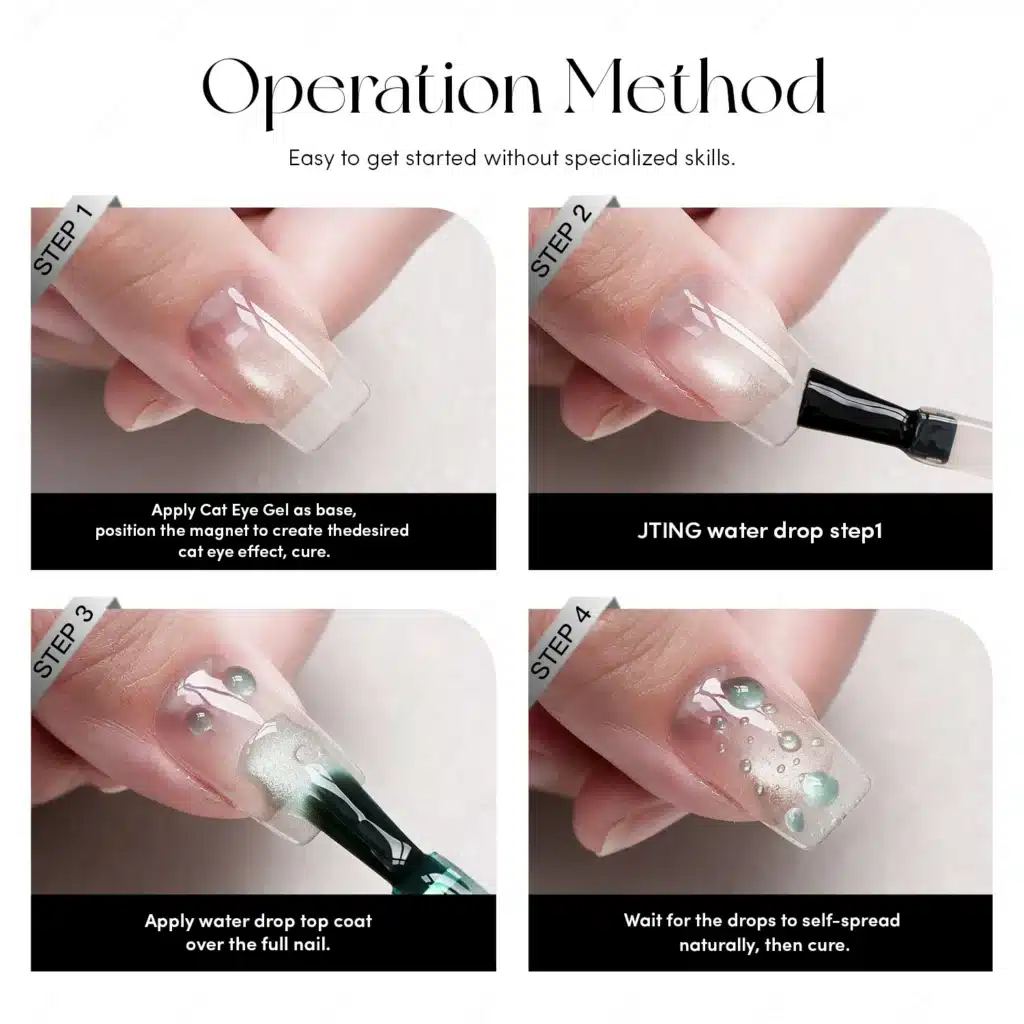
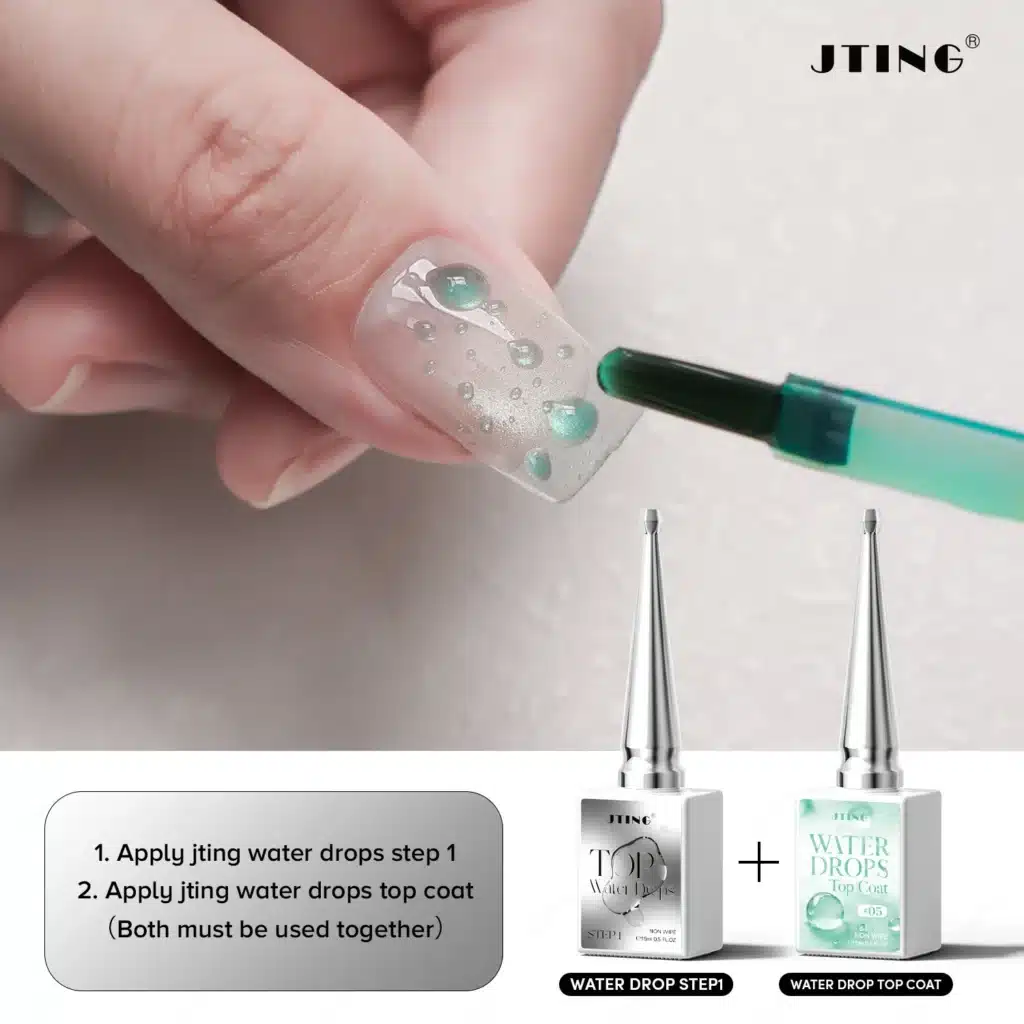
Exploring Diverse Visual Results: Optical Depth, Refraction, and Tint Layering
The cured dome structures produced by this technology are not simply decorative surface elements. Their geometry creates genuine optical effects that actively transform the visual character of the base layer beneath. A high-dome sphere functions as a plano-convex microlens: light entering the dome is refracted through the curved surface and concentrated toward the center of the bead, producing a magnified, intensified view of the substrate directly below. Over a cat-eye gel, this magnification effect causes each bead to appear to contain its own concentrated point of magnetic shimmer. Over a chrome or mirror powder finish, the dome captures and concentrates specular reflection, creating a liquid-metal depth that flat chrome cannot achieve on its own.
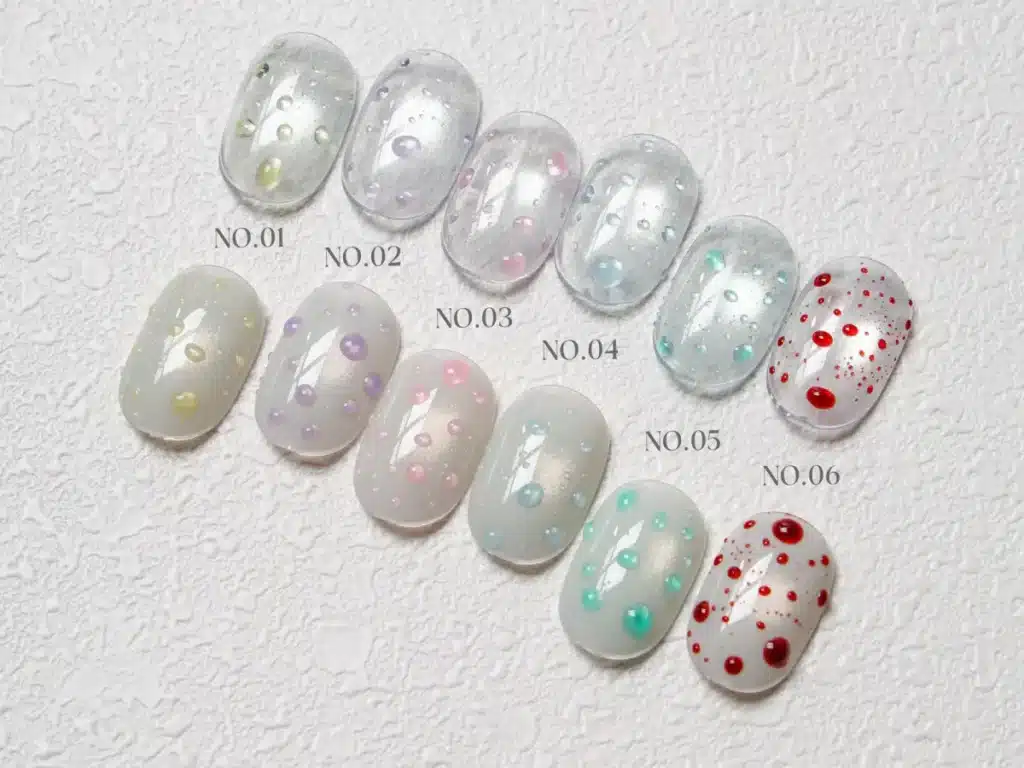
The six translucent tint variations compound this optical interaction in distinct ways. The near-clear shades add wet luminosity to any base without altering its hue. The faintly tinted mid-range shades introduce a subtle color wash that shifts the perceived temperature of the base beneath, cooling a warm chrome or deepening a pastel jelly. The deep red of No.06 introduces chromatic saturation into the refracted light itself, so that the lens effect of the bead produces a concentrated ruby glow rather than a neutral magnification. Across all variations, the crystal-clear polymer matrix ensures that the optical clarity of the dome is maintained through the product’s service life, with the formulation engineered to resist yellowing under UV exposure or fluorescent salon lighting over time.
Micro-Salon Application Scenarios: Turning Advanced 3D Art into a Zero-Threshold Project
Integrating three-dimensional texture into a standard service menu has historically forced salon owners into a difficult operational trade-off. While liquid glass accents and tactile art command top-tier pricing, their reliance on senior technician hand-skills introduces significant labor bottlenecks. When experienced staff are booked or absent, salons face service gaps that cap daily revenue potential.
JTING’s surface-tension system re-engineers this commercial dynamic from the bottom up, transitioning 3D artwork from a manual luxury into a standardized, high-speed salon system. By shifting the execution burden from human dexterity to chemical physics, multi-station chains can systematically stabilize their service output while maximizing technician throughput during peak holiday and booking windows.
(📊 Commercial ROI Comparison Table)
| Operational Metric | Traditional 3D Resin/Builder Gel | JTING Automated Beading System |
|---|---|---|
| Execution Time |
20+ Minutes Per Hand
Requires slow manual mapping, constant visual calibration, and flash curing.
|
Under 2 Minutes Per Hand
Seamless dot-and-slide application. Instantly locks in place before lamp entry.
|
| Skill Threshold |
Advanced Technicians Only
Demands elite hand dexterity and steady brush control to avoid flattening or running.
|
Zero-Threshold Entry
Apprentice-level technicians achieve consistent pro-grade results via matched chemical tension.
|
| Product Behavior |
High Defect & Waste
Gels commonly drag, string, or blur into cuticles, leading to costly set rebuilds and refunds.
|
Zero Trailing & Friction
Smooth fluid movement with instant thixotropic gel recovery. Perfect dome symmetry every time.
|
| Salon ROI |
Low-Margin Squeeze
High labor time drains daily station turnover, making 3D sets an inefficient premium service.
|
High-Density Scaling
Boosts Seat Surcharge & Traffic
|
Ultimately, this operational efficiency transforms 3D nail styling from a time-draining salon novelty into a high-margin premium add-on. By eliminating extra consumable expenditures and compressing structural execution into a standard service slot, salon owners can reliably implement an elevated pricing tier that drives immediate increases in average ticket size without altering existing chair schedules.
Supply Chain Parameters and Global Safety Compliance for B2B Procurement
International distributors and multi-unit salon chain operators evaluating this product line for wholesale integration will find the procurement specifications straightforward and operationally favorable. The 15ml commercial-grade bottle format is sized for controlled dispensing in professional environments, with a 24-month shelf stability window that supports standard inventory rotation cycles without meaningful spoilage risk. The 30-second LED cure time and 2-minute UV cure time maintain compatibility with the full range of professional lamp hardware already in wide deployment across salon chains in North America, Europe, and the Asia-Pacific markets.
The health and safety compliance profile of the formulation carries particular weight for distributors operating in strictly regulated markets. The complete absence of HEMA, or hydroxyethyl methacrylate, is the most significant compliance feature for professional procurement purposes. HEMA is among the most common causes of occupational type IV sensitization in nail technicians working high-volume full-day schedules, because repeated low-level monomer skin exposure over time produces cumulative allergic sensitization that can ultimately force career exit. A HEMA-free formulation substantially reduces this chronic exposure pathway. The concurrent absence of TPO, a photoinitiator associated with sensitization concerns under European Cosmetics Regulation scrutiny, further streamlines regulatory approval documentation for EU market entry. For distributors navigating ingredient disclosure requirements under EU Regulation 1223/2009 and equivalent frameworks in the United States, a clean monomer and photoinitiator safety profile simplifies both customs classification and retail labeling compliance, reducing the administrative load that commonly delays product registration and border clearance for professional cosmetic goods across international trade channels.