HEMA-free and TPO-free specifications have moved from optional label badges to standard purchasing requirements across professional salons, wholesale distribution, and private label nail brands. With the European Union TPO prohibition already in force, Great Britain’s February 2027 off-shelf deadline approaching, and salon technicians paying close attention to methacrylate sensitization, buyers need to verify what is inside a gel bottle before they approve a shade chart.
This guide gives salon owners, importers, wholesalers, and brand teams a practical playbook for sourcing HEMA-free and TPO-free gel nail polish. It covers monomer and photoinitiator INCI names, regional compliance dates, category-by-category performance checks, salon backbar transitions, private label packaging and labeling rules, supplier paperwork audits, and bench testing.
Quick Answer
HEMA-free gel nail polish removes monomeric 2-Hydroxyethyl Methacrylate (CAS 868-77-9) to reduce skin sensitization risk at the nail table, while TPO-free gel nail polish removes Trimethylbenzoyl Diphenylphosphine Oxide (CAS 75980-60-8) to comply with the European Union prohibition (in force since September 1, 2025) and Great Britain’s phase-out (new stock cutoff August 15, 2026; final off-shelf cutoff February 14, 2027). When sourcing a compliant range, upgrade your full system together (base coat, rubber base, builder gel, color gel, and top coat) and test jet black, pure white, deep burgundy, and thick builder overlays under a 365+405 nm UV/LED lamp. Always verify supplier claims by checking the 100% INCI list and CAS numbers against SDS Section 3 and batch COAs.
Key Takeaways
- HEMA (a monomer) and TPO (a photoinitiator) serve different functions in a gel formula and follow different rules in the EU, Great Britain, and the US.
- All JTING products are HEMA-free across our catalog, and we supply TPO-free formulations across color, base, top, rubber base, builder, and effect categories.
- Audit ingredients by CAS number: banned TPO is CAS 75980-60-8, whereas TPO-L (CAS 84434-11-7) and BAPO (CAS 162881-26-7) are permitted alternatives.
- High-pigment blacks, whites, and deep reds are the real test of a TPO-free formula; run a two-coat peel-and-cut underside cure test before bulk ordering.
- Upgrade base coats, rubber bases, builder gels, and top coats alongside color gels so the entire nail service runs on one compliant system.
- Private label orders starting from 10 pieces per shade at JTING let brands and distributors launch or transition collections without excess inventory risk.
Regulation and Ingredient Fundamentals
01. Why HEMA-Free and TPO-Free Now Define Professional Gel Purchasing
Open any recent purchase order from a European distributor, a British salon group, or a North American private label brand, and two technical requirements appear before color charts even come up: HEMA-free gel nail polish and TPO-free gel nail polish. Buyers still care about two-coat coverage, smooth brush flow, and competitive landed cost, but ingredient compliance and skin compatibility now decide which suppliers make the shortlist.
Although buyers often ask for both in the same email, HEMA and TPO belong to different chemical families and solve different problems. Removing HEMA reduces the risk of skin sensitization and occupational contact allergy at the nail table. Removing TPO satisfies legal prohibitions on reproductive toxicants in the European Union and Great Britain. When a salon chain updates its backbar, when a wholesaler plans next quarter’s stock, or when a founder develops a private label gel nail polish line, addressing both specifications together prevents the expense of reformulating the same collection twice.
How Purchasing Priorities Differ by Business Model
A single salon owner and a national beauty supply importer do not face the exact same pressure. Salons deal with daily skin exposure and client retention at the chair. Importers and brands deal with customs clearance, Responsible Person sign-offs, and warehouse inventory value.
| Buyer Segment | Primary Business Risk | First Products to Upgrade | Key Supplier Requirement |
|---|---|---|---|
| Professional salons and chains | Technician hand dermatitis and sensitive-client reactions | Base coats, rubber bases, builder gels, top coats, and core everyday colors | Consistent 2-coat coverage, low heat in the lamp, and clear curing instructions |
| Distributors and wholesalers | Unsellable stock after regional off-shelf cutoff dates and lost salon accounts | High-turnover single shades, functional gel staples, and starter kits | Verified INCI lists, batch coding, and single-shade reorder availability |
| Private label and E-commerce brands | Customs holds, label non-compliance, and reformulation delays | Hero color collections, bottle builders, and signature top coats | Full INCI and CAS disclosure, market file support, and custom formula options |
If your team needs a basic introduction to the five chemical groups inside a bottle of gel, start with our guide to gel nail polish ingredients. The guide below focuses on commercial execution: how to read monomer and photoinitiator names on an INCI sheet, how EU, UK, and US rules work on the calendar, how each gel category behaves without HEMA or TPO, and how to test, label, and source a compliant range with JTING.
02. HEMA vs. TPO in Gel Nail Polish
HEMA and TPO do completely different jobs inside a gel formula, and regulators treat them differently for that reason. One is a structural monomer that becomes part of the cured plastic film; the other is a light-activated trigger that starts the curing reaction. Understanding what each ingredient does explains why removing HEMA changes adhesion and viscosity, while removing TPO changes curing behavior in dark colors and clear top coats.
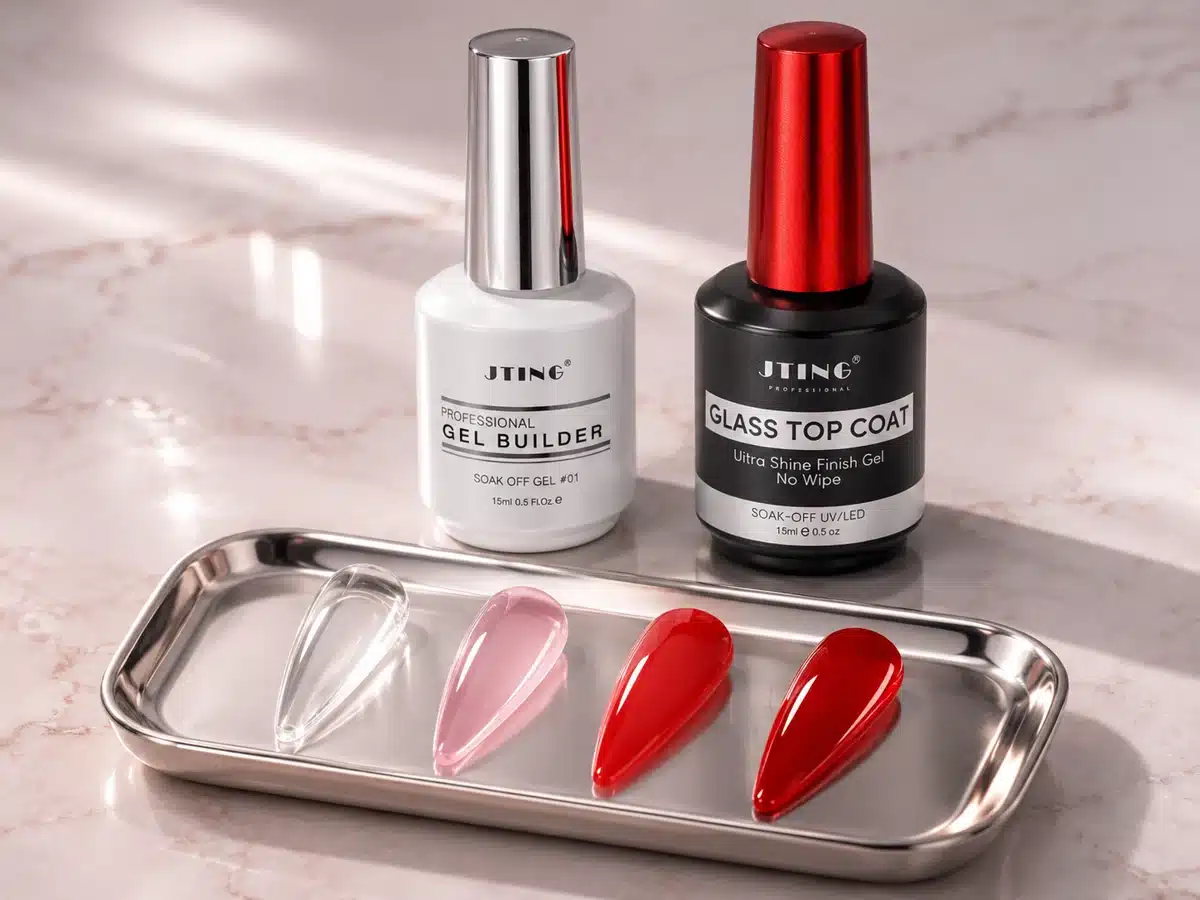
HEMA (2-Hydroxyethyl Methacrylate, CAS 868-77-9) is a small methacrylate monomer. Formulators used it for decades because its low molecular weight helps wet the natural nail plate, thins down heavy oligomers, and builds strong adhesion in base coats, builder gels, and color coats. That tiny molecular size is also what causes trouble at the salon table. If wet gel touches the cuticle or sidewalls, or if a coat is left under-cured, free HEMA molecules can pass through the skin barrier and trigger allergic contact dermatitis. Once a nail technician or client develops sensitization to methacrylates, the allergy is permanent and can affect future dental or medical procedures that use related acrylates.
TPO (Diphenyl(2,4,6-trimethylbenzoyl)phosphine oxide, listed on cosmetic labels as Trimethylbenzoyl Diphenylphosphine Oxide, CAS 75980-60-8) is a photoinitiator rather than a monomer. It absorbs UV and violet light between roughly 350 nm and 410 nm, generating free radicals that link monomers and oligomers into a hard polymer network. Formulators favored TPO in LED gels because it cures quickly, reaches deep into thick builder layers, and photobleaches to a water-clear finish without yellowing whites. However, European authorities reclassified TPO as a Category 1B reproductive toxicant (CMR 1B), leading to a full cosmetic ban in the EU and a scheduled phase-out in Great Britain.
| Attribute | HEMA | Di-HEMA TMHDC | TPO |
|---|---|---|---|
| Standard INCI Name | HEMA | Di-HEMA Trimethylhexyl Dicarbamate | Trimethylbenzoyl Diphenylphosphine Oxide |
| CAS Number | 868-77-9 | 41137-60-4 / 72869-86-4 | 75980-60-8 |
| Chemical Role in Gel | Small reactive monomer for adhesion, flow, and cross-linking | Larger urethane dimethacrylate monomer/oligomer for structure and flexibility | Photoinitiator that absorbs UV/LED light to start polymerization |
| Typical Role & Load in Legacy Gels | Used as a primary reactive diluent across bases, builders, and colors | Used as a main structural urethane dimethacrylate in HEMA-free bases and builders | Used at low photoinitiator percentages to trigger UV/LED curing |
| Primary Risk Concern | Skin penetration and allergic contact dermatitis from uncured contact | Lower skin penetration than HEMA, though still a regulated methacrylate | Classified as CMR 1B (toxic for reproduction) under EU CLP rules |
| EU / UK Legal Status | Permitted for professional use only; package must carry required allergy and professional warnings | Permitted for professional use only; package must carry required allergy and professional warnings | Banned in EU cosmetics; phasing out in Great Britain |
Because the two ingredients work independently, a gel can be HEMA-free while still using TPO, or TPO-free while still using HEMA. All JTING products are HEMA-free. For markets and brand briefs that also exclude TPO, we manufacture TPO-free color gels, foundations, builders, and finishing coats matched to your target compliance standard.
03. Reading Monomer Names on an INCI List: HEMA, Di-HEMA TMHDC, and HPMA
When buyers ask what HEMA is in gel polish or review a sample’s ingredient sheet, one question comes up almost immediately: why does a product labeled HEMA-free sometimes list Di-HEMA Trimethylhexyl Dicarbamate on the back of the bottle? Knowing how cosmetic nomenclature works prevents confusion during compliance reviews and helps your sales team answer questions from salon owners.
Why Di-HEMA TMHDC Is a Separate Substance from HEMA
Although the name includes the letters “HEMA,” Di-HEMA Trimethylhexyl Dicarbamate (CAS 41137-60-4) is a much larger molecule created by reacting HEMA with trimethylhexamethylene diisocyanate. Because the resulting urethane dimethacrylate molecule has a substantially higher molecular weight than monomeric HEMA (CAS 868-77-9), it does not penetrate intact skin as easily. In European Scientific Committee on Consumer Safety (SCCS) opinions and EU/UK cosmetic annexes, HEMA and Di-HEMA TMHDC are evaluated and listed as two separate chemicals with distinct CAS numbers.
In commercial sourcing, buyers generally choose between two monomer specifications:
- Standard HEMA-Free Formulas: Exclude monomeric
HEMA(CAS 868-77-9) and build the resin system from urethane acrylate oligomers alongside larger monomers such as Di-HEMA TMHDC, HPMA, or IBOA. Under international INCI rules, a formula free of CAS 868-77-9 is accurately labeled HEMA-free. - Formulas Free of Both HEMA and Di-HEMA TMHDC: Some private label brands serving sensitive-salon niches prefer that the substring “HEMA” never appear anywhere on the label. If your brand positioning requires excluding both monomeric HEMA and Di-HEMA TMHDC, specify both CAS numbers in your product brief before sampling.
Other Monomers Commonly Used in HEMA-Free Systems
| INCI Name | Role in HEMA-Free Systems | What Buyers Should Know |
|---|---|---|
| HPMA (Hydroxypropyl Methacrylate) | Reactive diluent for adhesion and viscosity adjustment | Larger than HEMA; still a methacrylate monomer that requires clean, skin-free application |
| IBOA (Isobornyl Acrylate) or IBOMA | Adds surface hardness, gloss, and low shrinkage | Helps maintain crisp wear in color gels and builders without monomeric HEMA |
| Bis-EMA / Ethoxylated Bisphenol A Dimethacrylate | Higher-molecular-weight structural cross-linker | Supports durable film formation in builder and base coats |
| Aliphatic or Aromatic Urethane Acrylate | Primary oligomer backbone (usually the first ingredient on the INCI list) | Determines overall flexibility, toughness, and soak-off vs. hard-gel behavior |
| HEMA Maleate or Acetoacetate Derivatives | Modified adhesion promoters used in specialty base coats | Check exact CAS numbers if your brand requires excluding all HEMA-derived names |
When reviewing formula sheets from an OEM gel nail polish manufacturer, always check the INCI name alongside its CAS number so your label designer and safety assessor work from exact chemical identities.
04. TPO vs. Alternative Photoinitiators: TPO-L, BAPO, and Blended Systems
Once a buyer decides to remove TPO (CAS 75980-60-8), the practical question is what replaces it and whether the new formula cures reliably under standard 365–405 nm salon LED lamps.
A replacement photoinitiator has to absorb light in the 365 nm and 405 nm range emitted by nail lamps, cure deep to the bottom of dark shades, and leave clear top coats free of yellow tint. In a TPO-free gel nail polish, chemists replace CAS 75980-60-8 with permitted phosphine oxides, hydroxyketones, or multi-initiator combinations.
What Replaces TPO in Modern Gel Formulas
TPO-L (Ethyl Trimethylbenzoyl Phenylphosphinate, CAS 84434-11-7) is the most important substitute to understand because its trade nickname often confuses buyers. Despite the “TPO-L” shorthand used by raw material suppliers, its legal INCI name is Ethyl Trimethylbenzoyl Phenylphosphinate, and its CAS number is 84434-11-7. It is a different chemical compound from banned TPO (CAS 75980-60-8) and is not prohibited under EU or Great Britain cosmetics rules. Because TPO-L is a liquid at room temperature, it disperses evenly into resin blends and cures efficiently under 380–405 nm LED light.
BAPO (Bis-Trimethylbenzoyl Phenylphosphine Oxide, CAS 162881-26-7) is a powerful photoinitiator that generates four free radicals per molecule and absorbs further into the visible violet spectrum. That makes BAPO valuable for curing jet black, deep burgundy, and thick builder layers where pigment or thickness blocks light. Because raw BAPO powder has a slight yellow cast, experienced formulators use it at controlled percentages or reserve higher doses for pigmented shades rather than water-clear top coats.
Hydroxycyclohexyl Phenyl Ketone (CAS 947-19-3) is a classic non-yellowing surface initiator. On its own, it responds mainly to shorter UV wavelengths, so chemists pair it with a 405 nm LED photoinitiator like TPO-L to get both a hard, crystal-clear surface and a complete through-cure.
| Photoinitiator / INCI Name | CAS Number | Curing Strength | Formulation Watch-Out | Regulatory Status (EU / GB) |
|---|---|---|---|---|
| Trimethylbenzoyl Diphenylphosphine Oxide (TPO) | 75980-60-8 | Fast LED cure, low yellowing, strong through-cure | Reclassified as CMR 1B reproductive toxicant | Prohibited in EU; phasing out in Great Britain |
| Ethyl Trimethylbenzoyl Phenylphosphinate (TPO-L) | 84434-11-7 | Strong 365–405 nm LED reactivity, easy liquid blending | Needs balanced monomer pairing for crisp surface hardness | Permitted; distinct chemical from CAS 75980-60-8 |
| Bis-Trimethylbenzoyl Phenylphosphine Oxide (BAPO) | 162881-26-7 | Excellent deep cure in dark and thick gels | Can add slight warmth to clear or pure white shades if overdosed | Permitted; widely used in high-pigment TPO-free gels |
| Hydroxycyclohexyl Phenyl Ketone | 947-19-3 | Hard surface cure and non-yellowing clarity | Must be combined with a 405 nm initiator for LED nail lamps | Permitted; standard co-initiator for top coats and sheer shades |
How to Read Supplier Paperwork: Do not audit an ingredient list by doing a text search for the three letters “TPO” alone. Check the full INCI name and CAS number. Trimethylbenzoyl Diphenylphosphine Oxide (75980-60-8) is the banned substance; Ethyl Trimethylbenzoyl Phenylphosphinate (84434-11-7) and Bis-Trimethylbenzoyl Phenylphosphine Oxide (162881-26-7) are permitted alternatives.
05. Global Regulatory Timeline: EU, Great Britain, the United States, and Export Markets
Cosmetic compliance follows the law of the country where the bottle is sold or used in a salon. Importers, multi-country e-commerce brands, and distributors need their production and shipping schedules aligned with the exact enforcement dates in each target market.
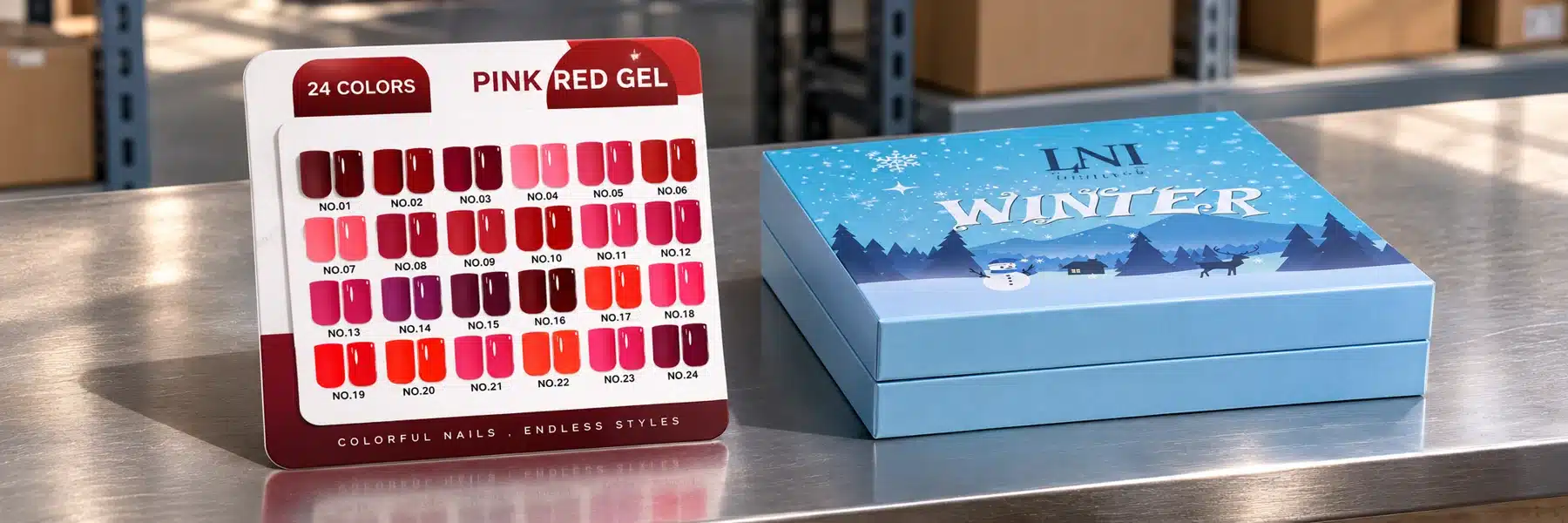
European Union (Including Northern Ireland)
Under Commission Regulation (EU) 2025/877 (Omnibus Act VII amending Regulation (EC) No 1223/2009), Trimethylbenzoyl Diphenylphosphine Oxide (TPO, CAS 75980-60-8) entered Annex II (prohibited substances) on September 1, 2025. Since that date, cosmetics containing TPO cannot be placed on the EU market, sold by distributors, or used commercially in EU salons. By contrast, HEMA and Di-HEMA Trimethylhexyl Dicarbamate are not banned; they sit in Annex III, restricted to professional use only with mandatory package warnings (For professional use only and Can cause an allergic reaction).
Great Britain (England, Scotland, and Wales)
Great Britain administers its own UK Cosmetics Regulation and set a two-step phase-out schedule for TPO:
- August 15, 2026 (Placing on the Market Cutoff): New cosmetic products containing TPO could no longer be placed on the Great Britain market after this date.
- February 14, 2027 (Making Available / Off-Shelf Cutoff): The final deadline for wholesalers, distributors, brands, and retailers in Great Britain to sell or supply existing TPO-containing stock. After February 14, 2027, remaining TPO inventory must be off the shelf.
United States (MoCRA) and International Export Markets
In the United States, neither HEMA nor TPO is federally prohibited under current FDA regulations, but the Modernization of Cosmetics Regulation Act (MoCRA) requires facility registration, product listing, safety substantiation files, and contact details for serious adverse event reporting on labels. Commercially, many US distributors, salon educators, and e-commerce sellers now order HEMA-free and TPO-free ranges so they can sell a single unified inventory across North America, Great Britain, and the EU without splitting warehouse SKUs by region.
| Market | TPO (CAS 75980-60-8) Status | HEMA & Di-HEMA TMHDC Status | Key Documentation & Notification |
|---|---|---|---|
| European Union & Northern Ireland | Prohibited in all cosmetics since September 1, 2025 (Annex II) | Restricted to professional use only with mandatory warnings (Annex III) | EU Responsible Person, Product Information File (PIF), CPSR, and CPNP notification |
| Great Britain (England, Scotland, Wales) | New stock prohibited from August 15, 2026; final off-shelf supply cutoff February 14, 2027 | Restricted to professional use only with mandatory label warnings | UK Responsible Person, UK PIF/CPSR, and SCPN notification |
| United States | Not federally prohibited; widely excluded by brands for global catalog unification | Permitted; strong salon and buyer preference for HEMA-free systems | MoCRA facility registration, product listing, safety substantiation, SDS, and INCI labeling |
| Middle East, Southeast Asia & Other Markets | Varies by authority; ASEAN and GCC frameworks closely track EU Annex updates | Permitted; professional buyers favor HEMA-free for salon safety | Certificate of Analysis (COA), SDS, INCI list, ISO 22716 / GMPC, and local import registration |
JTING exports to more than 30 countries across North America, Europe, the Middle East, and Southeast Asia. You can review our manufacturing credentials on our certification page.
06. Decoding Free-From Claims: HEMA-Free, TPO-Free, Hypoallergenic, Vegan, and 10-Free
Buyers comparing professional gel nail polish brands regularly encounter badges like best non toxic nail polish, hypoallergenic gel nail polish, vegan nail polish, and 10-free. Some of these terms describe concrete formula choices; others are borrowed from traditional air-dry nail lacquer and tell you almost nothing about a UV/LED gel.
| Claim | Exact Technical Meaning | Important Boundary to Know | How to Verify It |
|---|---|---|---|
| HEMA-Free | Formulated without monomeric 2-Hydroxyethyl Methacrylate (CAS 868-77-9) | Removes the most common small-molecule sensitizer, though other acrylates still require skin-free application and full curing | 100% INCI breakdown and SDS Section 3 check |
| TPO-Free | Formulated without Trimethylbenzoyl Diphenylphosphine Oxide (CAS 75980-60-8) | Uses permitted alternative photoinitiators to cure under UV/LED light | INCI and CAS check confirming absence of 75980-60-8 |
| Vegan & Cruelty-Free | Contains no animal-derived pigments or raw materials and involves no animal testing | Independent of monomer or photoinitiator choice; a vegan gel can still contain HEMA or TPO unless specified | Ingredient origin review and raw material declarations |
| 5-Free / 10-Free / 21-Free | Created for solvent nail polish to exclude formaldehyde, toluene, DBP, camphor, etc. | Most “10-free” solvent chemicals are not used in UV/LED gels in the first place, so a “10-free” badge does not confirm HEMA-free or TPO-free status | Specify HEMA-free and TPO-free directly rather than relying on a number-free label |
| Hypoallergenic / Low-Sensitizing | Formulated to reduce common sensitizers by removing monomeric HEMA and maximizing cure conversion | No UV/LED acrylate system is 100% allergy-proof if flooded onto skin or left under-cured | Check monomer profile, cure completeness, and application instructions |
| Non-Toxic / Chemical-Free | Informal retail phrase for cleaner formulations | Every cosmetic is made of chemicals; regulators frown on blanket “non-toxic” claims that imply a product is safe to misuse | Use clear, verifiable label claims such as “HEMA-Free & TPO-Free” |
Specific claims protect your brand far better than vague ones. Printing HEMA-Free & TPO-Free alongside an accurate INCI panel tells salon professionals and safety assessors exactly what your product delivers.
Performance Across Product Categories
07. What Changes in a Gel Formula When You Remove HEMA and TPO?
Taking HEMA and TPO out of an older formula is not a simple subtraction. If a chemist pulls out 20% HEMA and 2% TPO without re-engineering the resin and initiator balance, four defects show up immediately on the salon table: base coats peel off in sheets within a week, black and burgundy shades wrinkle in the lamp, white top coats turn creamy yellow, and builder gels either slump into the sidewalls or burn on thin nails.
Knowing how a capable factory solves these four engineering problems helps you spot the difference between a mature formula and a rushed substitute during sample testing.
1. Rebuilding Nail Plate Adhesion without Monomeric HEMA
HEMA’s small molecular size and polar hydroxyl group let it wet natural nail keratin easily. Without it, chemists build adhesion by combining higher-molecular-weight urethane acrylates with functional monomers that bond to the nail surface without penetrating living skin as readily. The cured film must be tough enough to resist free-edge chipping yet flexible enough to bend with a natural nail plate through three weeks of wear, and it still has to release cleanly during standard acetone soak-off removal.
2. Curing Through Heavy Dark and White Pigments without TPO
Carbon black, titanium dioxide, iron oxides, and concentrated organic reds block UV and violet light from reaching the bottom of a wet coat. TPO was popular because it drove polymerization deep through those opaque pigments. In a TPO-free system, the factory has to pair surface-curing and deep-curing initiators that match the 365 nm and 405 nm peaks of salon LED lamps, while milling pigments on three-roll mills to a fine, uniform particle size. When two thin coats cover completely, curing light reaches the bottom of each coat and locks it to the layer below without surface wrinkling.
3. Keeping Clear Top Coats and Milky Shades Water-Clear
TPO bleaches cleanly under UV/LED light and leaves almost no color cast. Some alternative photoinitiators start slightly yellow in the bottle or warm up after sun exposure. To keep a TPO-free top coat or sheer milky shade crisp over pure white French tips, formulators blend non-yellowing surface initiators with tightly controlled phosphine-oxide levels and UV stabilizers.
4. Controlling Viscosity and Lamp Heat in Structural Gels
Removing small HEMA monomers raises the base viscosity of a resin blend. In color gels, chemists adjust reactive diluents so brush strokes still level out within seconds. In thicker builder gels, controlling reaction speed matters just as much. If an alternative photoinitiator fires too fast inside a built structural apex, rapid cross-linking releases a sudden spike of exothermic heat on the nail bed. A balanced HEMA-free and TPO-free builder stages free-radical generation across the cure cycle so the apex cures solid without stinging the client.
08. HEMA-Free and TPO-Free Base Coats and Rubber Bases
If a salon or brand upgrades only one category first, it should be the base layer. Base coat and rubber base gel sit directly on the natural nail plate during every appointment, and they account for the majority of whether a manicure lasts three weeks or starts lifting at the cuticle by day four.
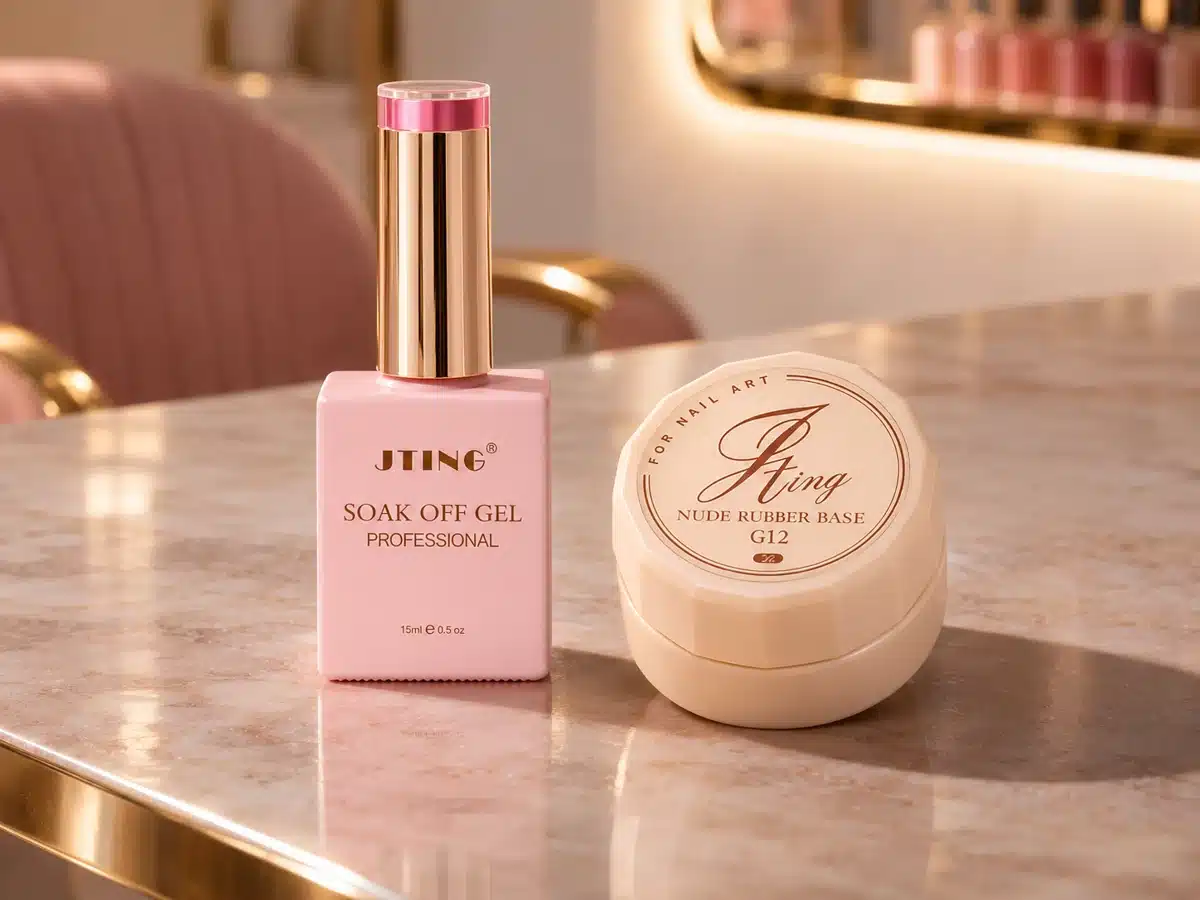
Choosing Between Standard Base Coat and Rubber Base Gel
Older formulas often relied on high HEMA levels and acidic monomers to force adhesion on flexible or oily nails. That approach gripped hard at first, but it frequently left natural nails dry and chalky after removal. Modern HEMA-free and TPO-free base coats get their retention by matching the flexibility of the base layer to the client’s natural nail.
HEMA-Free Standard Base Coat is a low-to-medium viscosity clear base built for firm, healthy natural nails. It brushes on in a thin, even film, cures in 30 to 60 seconds under UV/LED light, and leaves a consistent tacky layer that grips the first coat of color.
HEMA-Free Rubber Base Gel is a medium-thick, self-leveling elastic base designed for thin, bendy, ridged, or damaged nails. Instead of fighting the natural flex of a soft nail plate, a rubber base bends with the nail and rebounds so the color coat on top does not crack. In tinted shades such as milky white, sheer blush pink, and warm nude, a HEMA-free rubber base fills ridges and delivers a finished natural manicure in a single step.
Three Practical Checks When Sampling Base Systems
- Cuticle margin control before curing: Brush a thin layer onto four or five nails before putting the hand into the lamp. A stable HEMA-free base stays right where the brush places it along a clean hairline cuticle margin instead of creeping into the sidewalls.
- Cured film elasticity: Cure a coat of base on a clear plastic form backing, peel it off once cool, and bend it between your fingers. A quality standard base folds without snapping like brittle glass, while a rubber base stretches slightly and springs back.
- Clean acetone flake release: File open the top coat seal, wrap the nail with an acetone-soaked cotton pad, and check how the base comes off. A well-balanced HEMA-free base crumbles into soft flakes that push off gently with a wooden stick, rather than turning into a gummy glue layer that forces the technician to scrape the nail plate.
Compare clear, structural, and tinted foundation options in JTING’s top coat and base coat category and rubber base gel collection.
09. Color Gel Polish: High-Pigment Blacks, Whites, Reds, and Deep Shades
Almost any factory can get a sheer pink to cure in a HEMA-free and TPO-free base because light passes straight through translucent tint. The real test of a manufacturer’s color chemistry sits at the tough ends of the shade chart: jet black, pure French white, classic scarlet red, deep burgundy, espresso brown, and midnight navy.
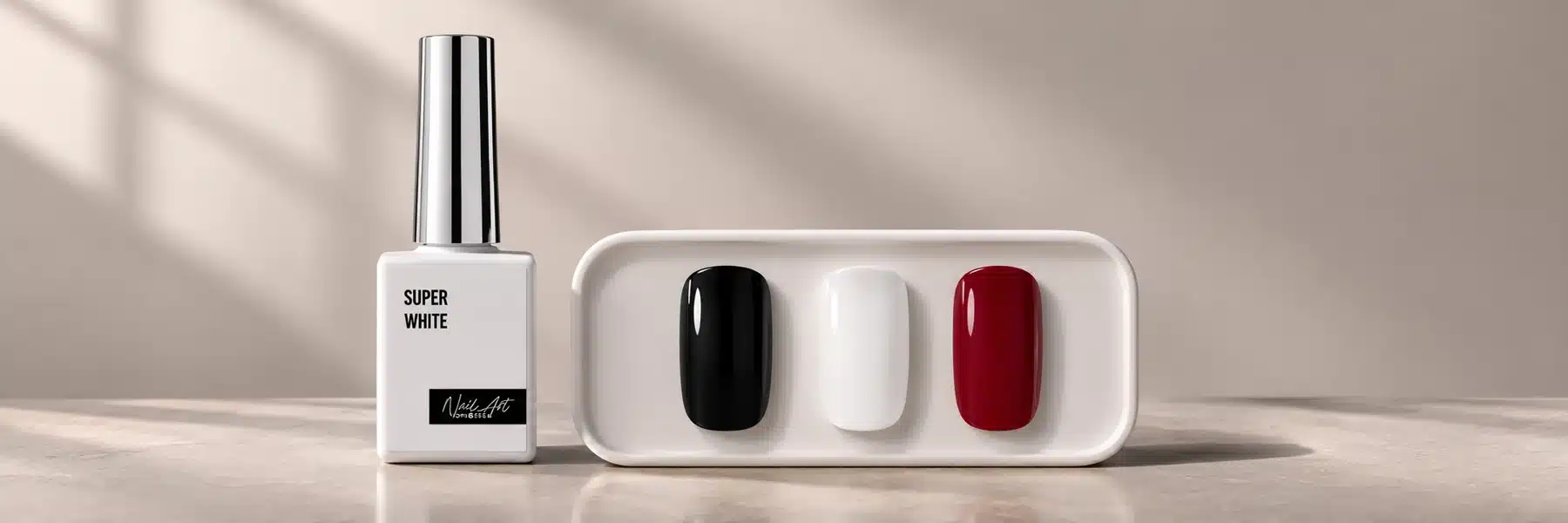
Why Dark and White Shades Separate Good Chemistry from Weak Substitutes
In a dark shade like black or oxblood burgundy, carbon black and iron oxide pigments absorb UV and violet light in the upper part of the wet coat. In a pure white or opaque pastel lilac, high loads of titanium dioxide scatter curing light backward. When a supplier removes TPO without upgrading pigment dispersion and deep-curing photoinitiators, only the top skin of the coat hardens in the lamp. As that thin top skin shrinks over a wet layer underneath, the surface pulls into ripples and wrinkles.
What to Look for in JTING’s High-Pigment Color Gels
At JTING, we engineer our HEMA-free and TPO-free gel polish color sets so technicians do not have to fight dark or pastel shades at the table:
- Fine three-roll pigment milling: Grinding pigments to a tight, even particle size delivers full opacity in two thin coats. Because the technician does not need to puddle on a thick coat to hide the nail line, lamp light reaches the bottom of every layer.
- Synchronized surface and bottom curing: Pairing surface-active and deep-curing TPO-free photoinitiators locks the bottom of the color coat to the base layer at the same pace the top surface cures.
- Controlled brush recovery: The gel thins smoothly under the brush bristles so pastel and dark shades self-level without streaks, then firms up within seconds so pigment does not pull back from the free edge or flood the sidewalls.
| Benchmark Shade | Why It Tests the Chemistry | What a Passing Sample Looks Like | Signs of a Weak Substitute |
|---|---|---|---|
| Jet Black | Carbon black absorbs UV and violet light strongly | Smooth mirror gloss in 2 thin coats, crisp free edge, dry underside | Surface ripples, soft wet pigment underneath, black transfer onto top coat brush |
| Pure French White | Titanium dioxide scatters curing light and shows yellowing | Even opacity without chalky brush tracks, true cool white out of the lamp | Streaky coverage, soft center, warm cream or yellow cast after curing |
| Deep Burgundy / Wine Red | High organic red and dark pigment load prone to patchy strokes | Rich wine depth in 2 coats, crisp cuticle line, no staining over base coat | Needs 3 coats to look even, dark halo pooling along sidewalls |
| Opaque Pastel / Butter Yellow | White base plus light pigment highlights every leveling flaw | Self-levels smoothly before curing, retains true pastel tone out of the lamp | Brush ridges stay visible after curing, color turns dull or muddy |
| Sheer Milky Pink / Jelly | Reveals trapped micro-bubbles or photoinitiator tint immediately | Even glass-like translucency, zero micro-bubbles, no amber shift | Cloudy patches, pinhead bubbles, warm yellowish cast |
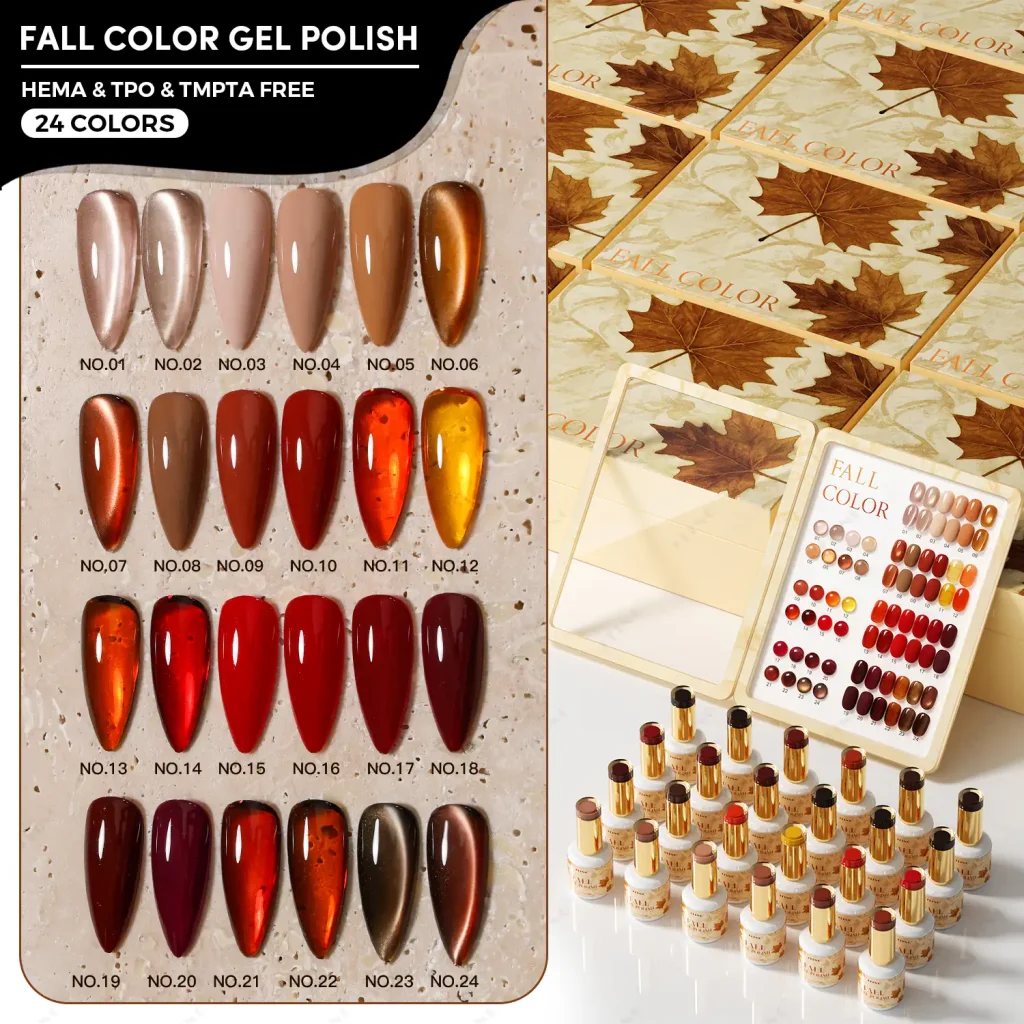
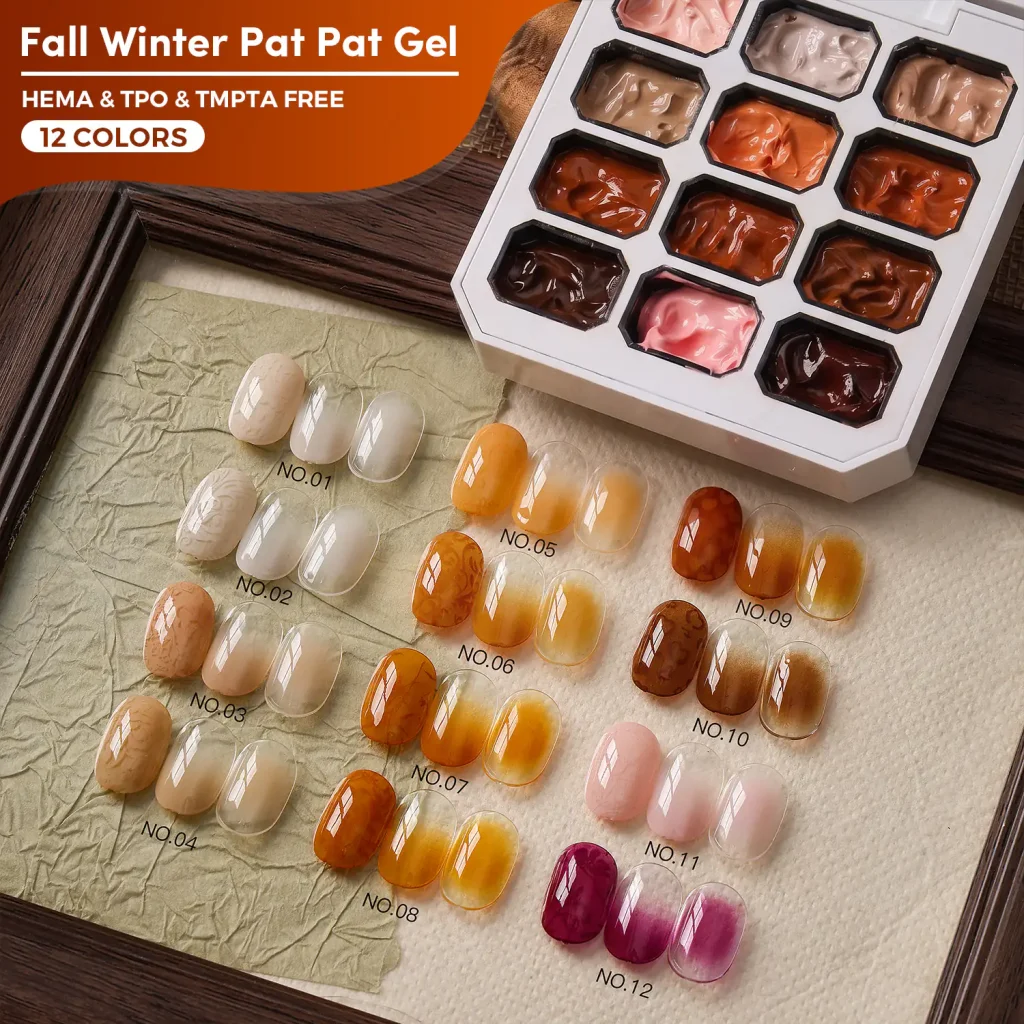
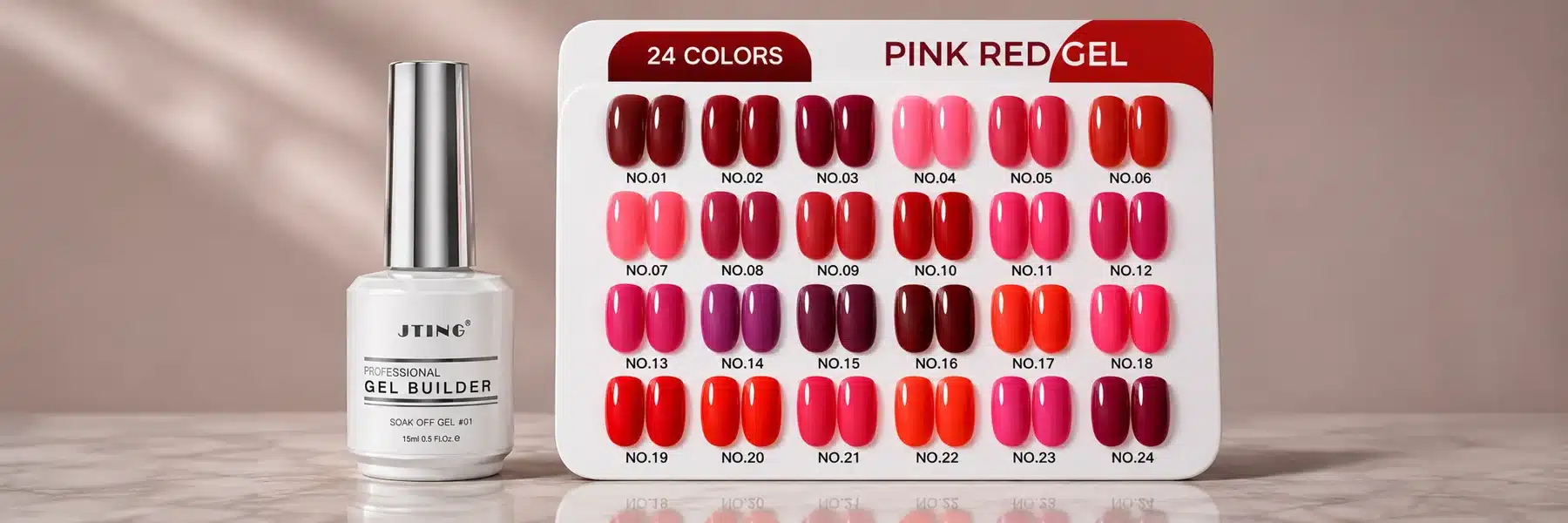
To sample across wide color families, explore JTING’s 195-color high-pigment gel nail polish range, our 48-color red gel polish collection, or seasonal ranges like the D47 24-color fall collection.
10. Top Coats: Clarity, Non-Yellowing, and Scratch Resistance without TPO
Clients judge a gel manicure by whether the top coat still looks wet two weeks later, and nail technicians judge it by whether it turns a crisp white French tip yellow the moment it comes out of the lamp. When evaluating a HEMA-free no wipe top coat and a TPO-free top coat, focus on optical clarity, scratch resistance, and effect compatibility.
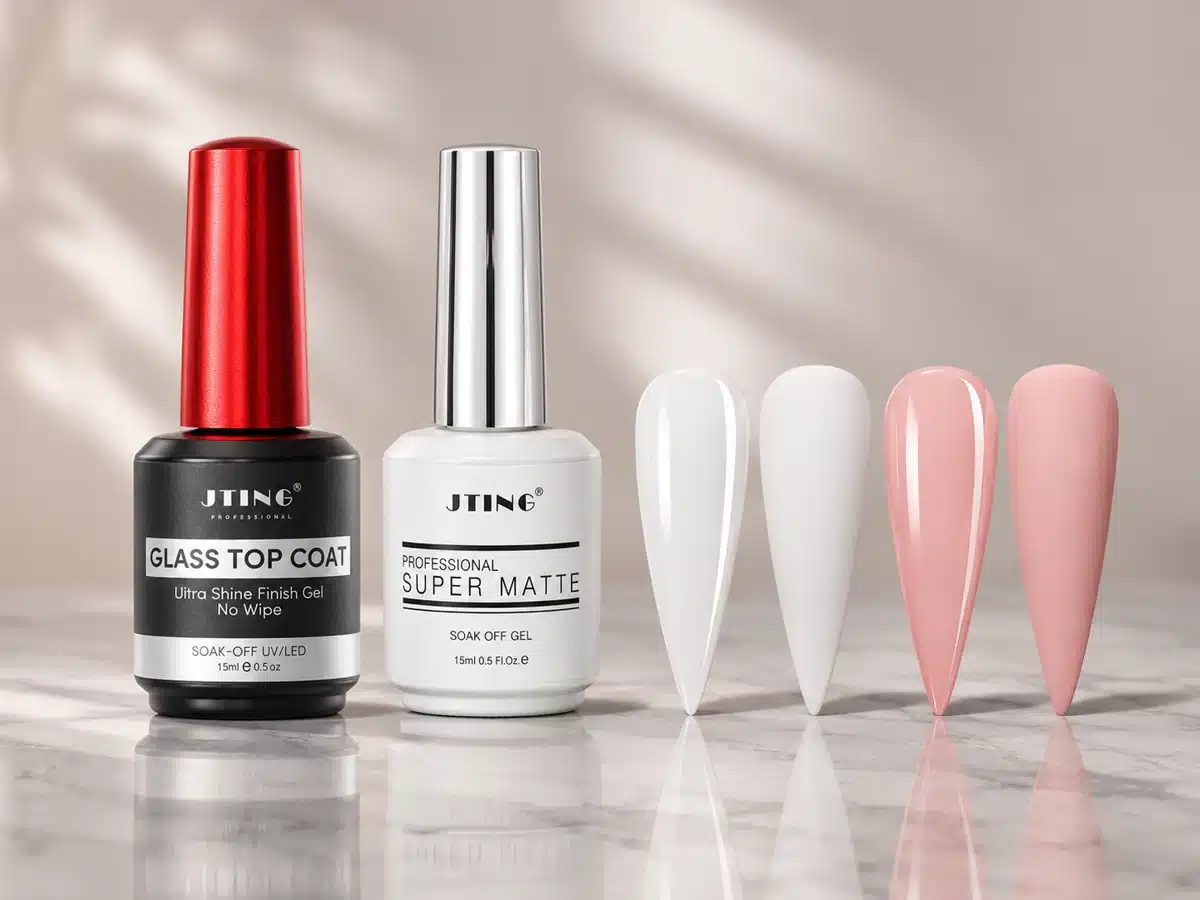
1. Water-Clear Finish over Pure White and Milky Shades
TPO was widely used in clear top coats because it bleached colorless during curing. If a supplier replaces TPO with an unbalanced phosphine oxide blend, the freshly cured top coat can leave a faint warm tint over white, milky pink, or pale lilac nails. Always test a candidate top coat over half of a pure white swatch tip and compare the coated half against the uncoated white side in natural daylight.
2. Two-Week Gloss Retention and Stain Resistance
Beyond initial clarity, a salon top coat has to resist yellowing from sunlight and block everyday stains from hair dye, makeup foundation, spices, and dark denim. A tightly cross-linked HEMA-free urethane acrylate network creates a dense, low-porosity surface that shrugs off dye transfer and resists fine scuffs from typing and handwashing.
3. Glass No-Wipe, Velvet Matte, and Chrome-Ready Options
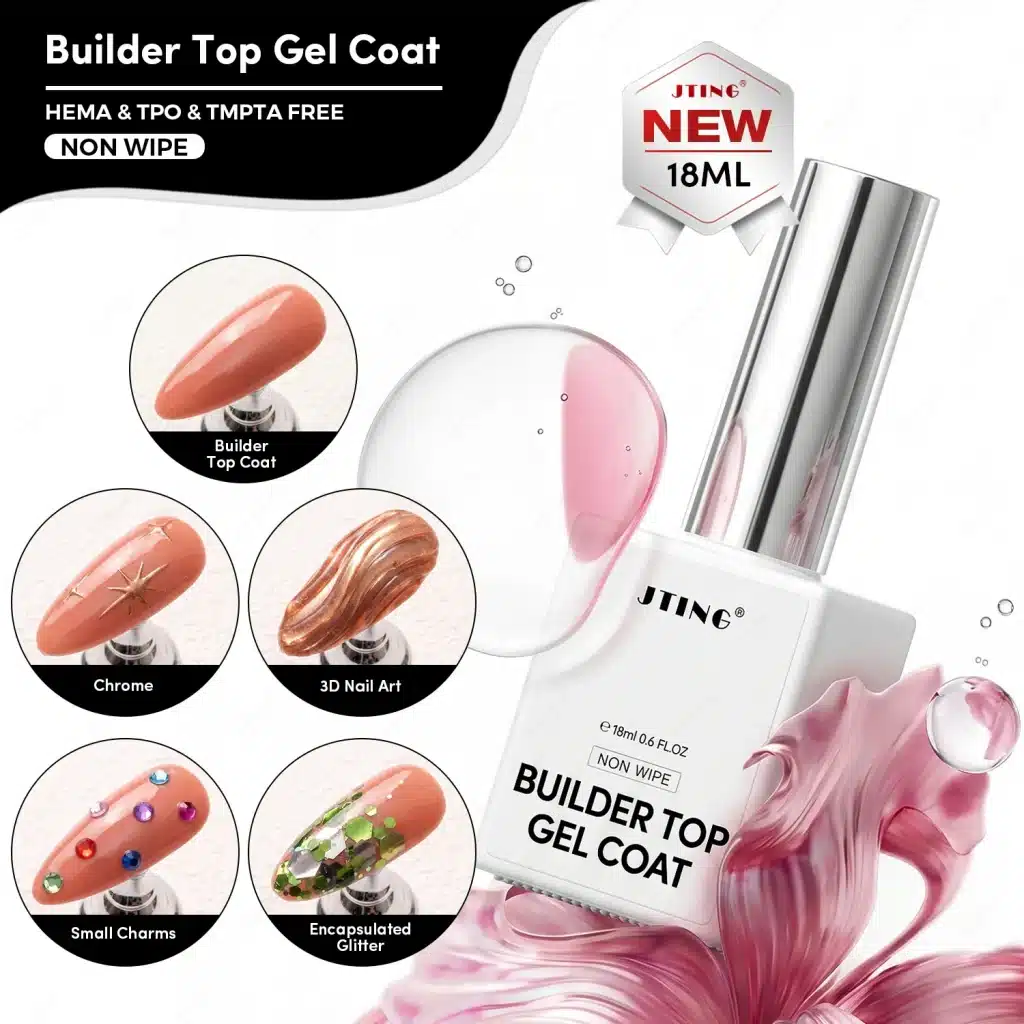
Most professional catalogs need three finishing options to cover salon requests. A No-Wipe Glass Top Coat cures tack-free and should also offer a consistent intermediate cure window matched to your salon lamp so technicians can burnish mirror chrome powders without patchy spots. A Velvet Matte Top Coat uses evenly suspended matting agents that stay dispersed in the bottle and keep a soft, dead-matte touch without polishing shiny at the fingertips during daily wear. A Tempered Scratch-Resistant Top Coat adds extra surface hardness for clients who work heavily with their hands. For a full comparison of finishing coats, see our gel top coat guide.
11. Builder Gels, BIAB-Style Bottle Builders, and Poly Gel Systems
Salons and distributors now ask for a HEMA-free builder gel, a TPO-free builder gel, or a HEMA-free poly gel on almost every enhancement order. Because builder overlays and extensions are built up in a thicker structural apex than thin color coats, both through-cure depth and client comfort in the lamp are tested far more severely.
Matching the Right Structural Gel to Each Salon Service
JTING’s Gel Builder category and extension products cover five distinct salon workflows (note that BIAB™ is a registered trademark of The GelBottle, so private label and wholesale buyers should describe brush-on structural overlays generically as BIAB-style, Bottle Builder Gel, or Builder Gel in a Bottle):
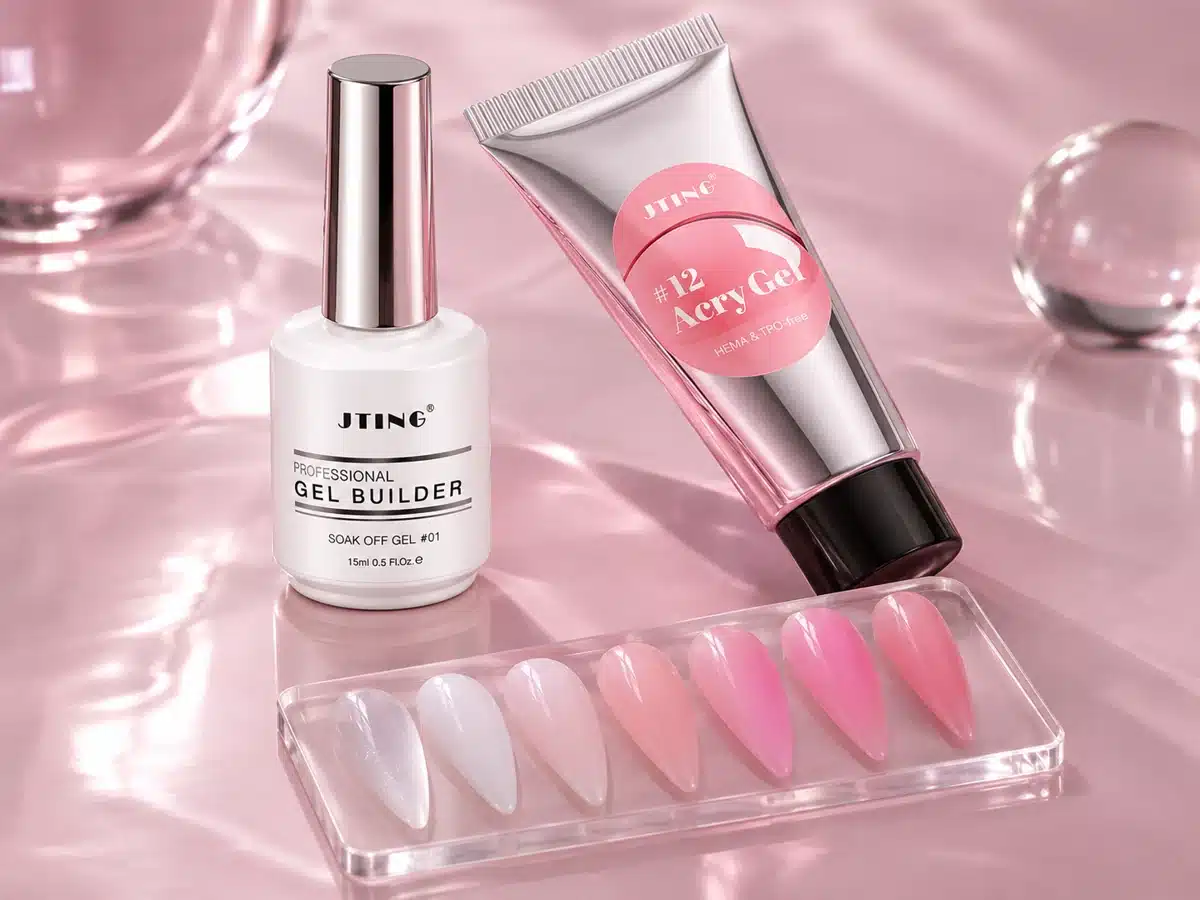
| Product Type | Packaging & Removal | Key Priority Without HEMA & TPO | Core Salon Use |
|---|---|---|---|
| BIAB-Style / Bottle Builder Gel | Brush-on bottle; soak-off or infill-ready by SKU | Controlled self-leveling when flipping the finger, low heat spike, stable nude/milky tints | Natural nail strengthening overlays and fast structured manicures |
| Standard Sculpting Builder Gel | Jar or bottle; soak-off or file-off by SKU | Holds apex height without running into sidewalls, cures solid through the built apex | Short-to-medium form extensions and structured overlays |
| File-Off Hard Gel Builder | Cosmetic jar; file-off removal for maximum rigidity | High flexural strength, zero sidewall lifting, controlled lamp warmth | Long extensions, 3-week salon infills, and wet-work clients |
| Poly Gel / Acrygel | Squeeze tube or jar; shaped with slip solution | Smooth putty texture that stays in place until brushed, fine dust during filing | Dual-form or paper-form extensions with no monomer odor |
| Extend Gel for Full-Cover Soft Gel Tip Systems | Brush-on bottle or solid/semi-solid gel adhesive | Bubble-free tip wetting, rapid initial flash-pinning, 3-week retention without HEMA | Full-cover soft gel tip extensions and 3D charm attachment |
Apex Self-Leveling and Heat Spike Control on the Nail Bed
Watch how an experienced nail technician works with a bottle builder: she applies a thin slip layer, floats a bead down the center of the nail, and flips the client’s finger upside down briefly so gravity pulls the gel into a symmetrical central apex. If a HEMA-free builder is too stiff, it leaves uneven ridges that require heavy hand-filing; if it is too runny, it floods the cuticles before the hand reaches the lamp. JTING tunes builder viscosity for smooth self-centering control, and pairs higher-molecular-weight oligomers with staged TPO-free photoinitiators so the curing reaction spreads heat gently instead of stinging thin nail beds.
For a side-by-side comparison of enhancement lines, read our builder gel, BIAB-style, hard gel, rubber base, and soft gel tip guide, or view our 4-in-1 Extend Gel for full-cover soft gel tip systems.
12. Cat Eye, Reflective, Chrome, and Nail Art Gels
When a brand or distributor upgrades its core colors to HEMA-free and TPO-free specs, specialty effect gels need to follow the same rule. Leaving older TPO formulas inside seasonal cat eye kits, reflective flash sets, or liner gels creates avoidable compliance risks when an entire shipment goes through customs or a Responsible Person review.
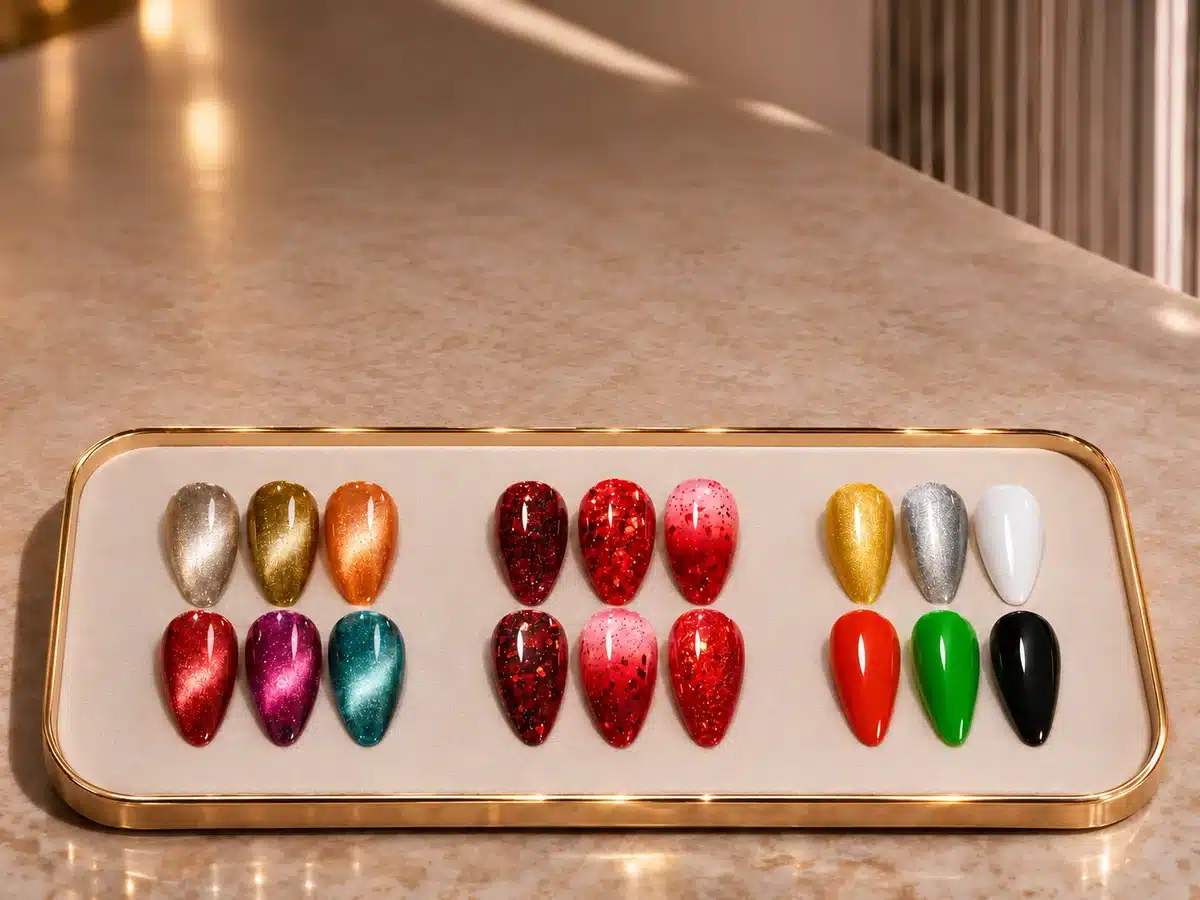
Magnetic Mobility and Freeze Speed in Cat Eye Gels
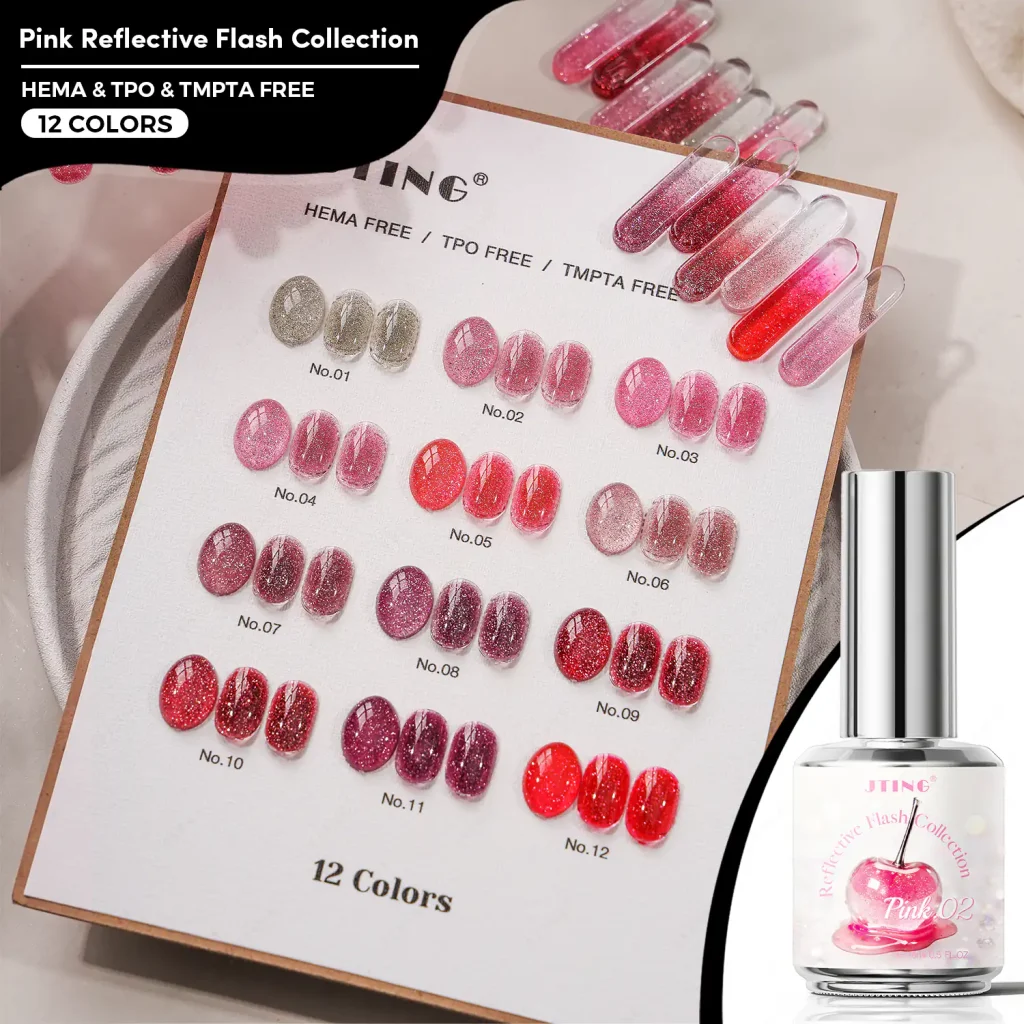
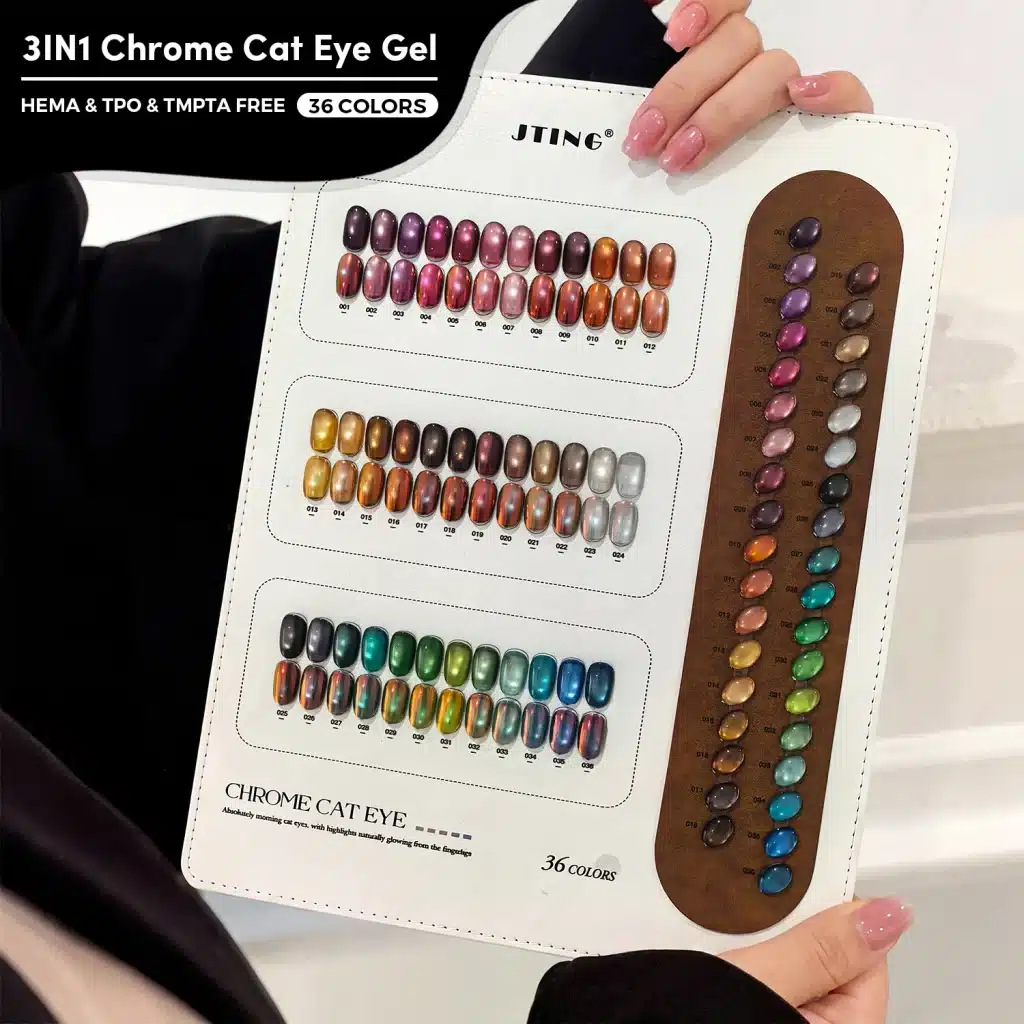
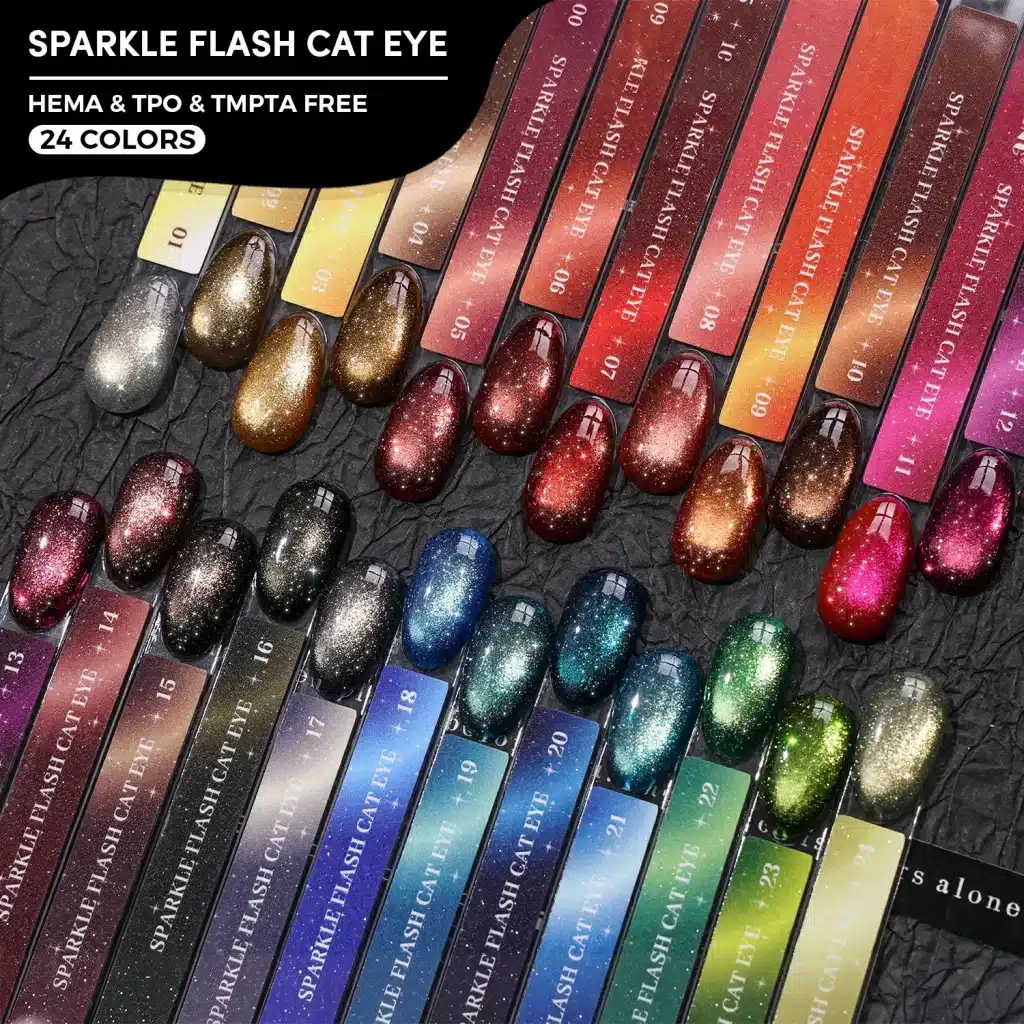
In a cat eye gel polish, magnetic iron-oxide and pearlescent pigments have to glide smoothly through the wet resin when a magnet is held over the nail, then lock in place the moment the lamp switches on. Removing HEMA changes the baseline drag of the liquid resin. If the substitute resin blend is too heavy, magnetic particles move sluggishly and leave a muddy gray cast across the base color. If the resin is too thin, a sharp diagonal light band drifts apart in the seconds it takes the client to move her hand into the lamp. JTING balances viscosity and particle suspension across velvet, glass aurora, water-light, and 36-color chrome cat eye collections so magnetic particles respond quickly to the magnet and hold a crisp highlight.
Through-Cure Around Reflective Beads and Metallic Flakes
In reflective gel and platinum glitter gel, dense glass micro-beads and metallic aluminum or mica flakes bounce UV light back toward the surface like tiny mirrors. Without TPO, weak glitter formulas often cure only on the top surface while staying soft around the bottom of the glitter flakes, leading to corner peeling after a few days. Our TPO-free initiator blends are tuned to penetrate around heavy flake loads so the base of the coat bonds firmly during curing.
One-Stroke Opacity in Liner, Painting, and 3D Sculpting Gels
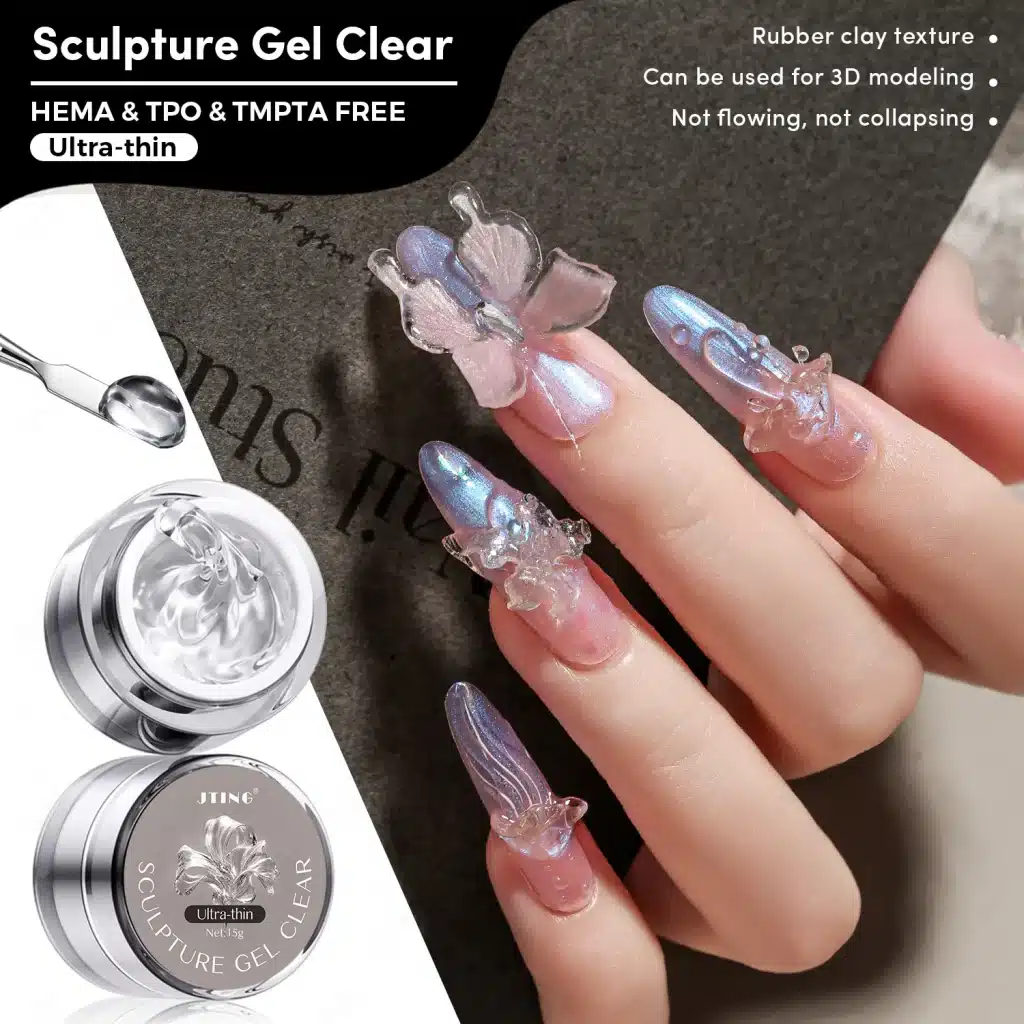
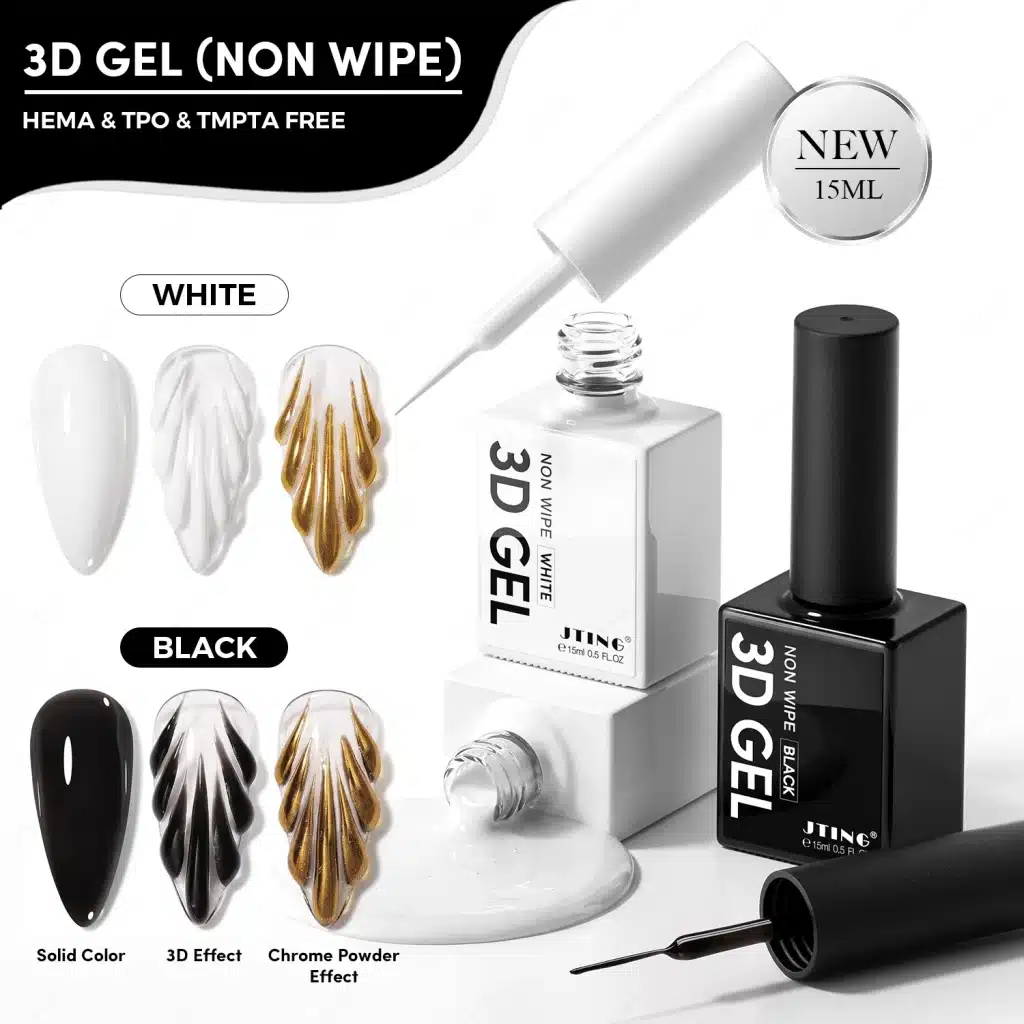
Because liner gel and painting gel draw micro-French tips, fine swirls, and raised chrome outlines in a single pass, they carry a substantially higher pigment concentration than standard bottle color gels. Similarly, HEMA-free 3D gel and sculpting gels are applied in raised petals, shells, and ribbed textures. When testing HEMA-free and TPO-free art gels, paint both a hairline stripe and a raised 3D bead, cure according to product directions, and press firmly with a silicone tool to confirm the center cures solid from top to bottom.
13. Matching HEMA-Free and TPO-Free Systems with UV/LED Nail Lamps
Even the best HEMA-free and TPO-free gel will lift, wrinkle, or leave unreacted monomer behind if it is cured under a weak or mismatched nail lamp. In salon troubleshooting, many of the service complaints blamed on a new gel line actually trace back to aging lamp bulbs, dirty reflectors, or flash-lamp shortcuts.
Why Dual-Wavelength 365 Nm + 405 Nm Output Matters
Every photoinitiator absorbs light within a specific wavelength band. Most professional LED nail lamps combine 365 nm and 405 nm diodes so they trigger both surface-curing initiators (which prevent excessive surface tack and yellowing) and deep-curing initiators (which harden the bottom of dark shades and builders). When a formula transitions from TPO to permitted TPO-free photoinitiators, its absorption profile relies heavily on strong, even output across both 365 nm and 405 nm.
How Salons and Educators Should Manage Lamp Equipment
First, keep handheld gooseneck flash lamps strictly for brief initial pinning of soft gel tips or charms. A single-diode flash lamp does not deliver the irradiance or angle coverage needed to polymerize a full coat of gel across five fingers; every nail still requires a full cure inside a chamber lamp.
Second, train buyers to evaluate lamps by diode placement, optical irradiance, and reflective base plates rather than inflated wattage stickers on a box. A well-engineered 36W or 48W dual-wavelength lamp with evenly spaced dual-spectrum LEDs and a removable reflective floor plate cures thumb edges and pinky nails far more reliably than a bargain lamp advertising inflated wattage with wide dead zones.
Finally, replace heavily used salon lamps on a regular maintenance schedule before diode output drops. LED diodes lose optical output gradually long before they burn out visibly, and wiping cured gel smudges off the inside diodes with acetone clouds the plastic lenses. For step-by-step methods to verify cure completeness, see our gel nail polish curing guide.
Salon Operations and Client Care
14. How Salons Can Transition Their Menu to HEMA-Free and TPO-Free Systems
Unless a statutory cutoff date requires immediate stock removal in your country, a salon owner does not need to sweep 300 color bottles into the bin on a Monday morning. Rolling out a HEMA-free and TPO-free backbar in three planned stages upgrades technician safety and service quality while keeping monthly product spend under control.
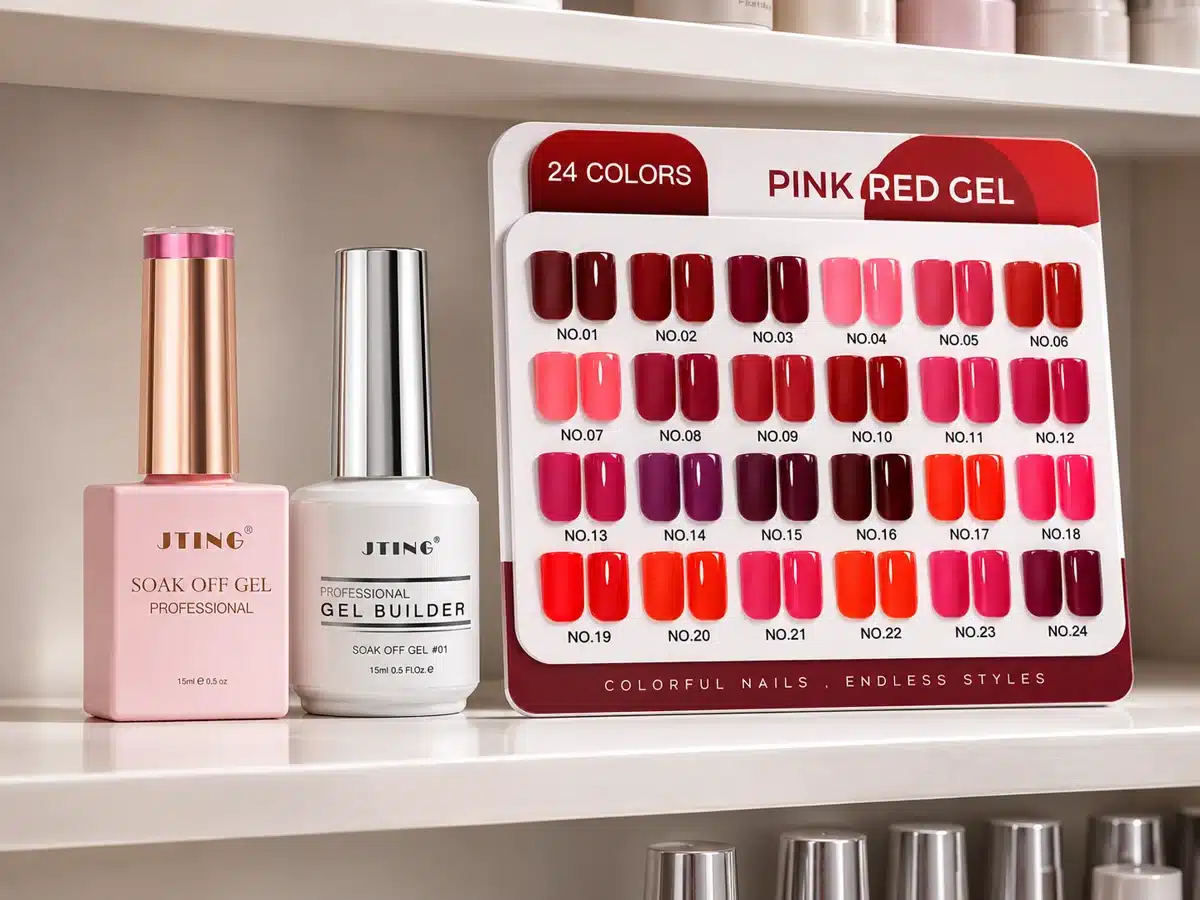
Stage 1: Switch Every Base, Builder, and Top Coat First (Weeks 1–2)
Start by replacing your clear base coat, rubber bases, bottle builders, soft gel tip adhesive, and top coats with a matched HEMA-free and TPO-free lineup from one manufacturer. Those core functional bottles are used on every single client who walks through the door, and the base layers sit in direct contact with the natural nail plate. Upgrading the foundation and finishing stack first raises the baseline quality of every appointment immediately, at a fraction of the cost of replacing an entire color wall.
Stage 2: Replace the Top 20 to 36 Workhorse Shades (Weeks 3–6)
Pull your salon’s appointment history or look at which bottles on the rack are always half-empty. In almost every studio, two to three dozen shades handle the majority of daily bookings: French white, jet black, milky white, four or five sheer nudes and blushes, classic scarlet red, two burgundies, espresso brown, and two velvet cat eye shades. Move these high-turnover colors into your new HEMA-free and TPO-free range next so technicians work with the upgraded chemistry all day long.
Stage 3: Rotate Seasonal Capsules on Normal Restock Cycles
As spring pastels, summer brights, autumn earth tones, or holiday glitters come up for reorder, bring in the new seasonal capsules under your compliant specification and retire older bottles as they finish. Within two seasonal cycles, your entire salon rack runs on one cohesive lineup without a sudden cash-flow hit. Explore how JTING works with nail salons and spas and read our nail salon supply case study.
15. Reducing Sensitization Risk at the Nail Table: Prep, Application, and Removal
Switching to HEMA-free and TPO-free gel nail polish removes the most common small-molecule sensitizer from the bottle. Pairing that cleaner chemistry with disciplined habits at the nail station protects both clients and technicians across years of daily salon work.
Six Salon Habits That Keep Uncured Gel Off the Skin
- Leave a crisp hairline margin around the cuticle and sidewalls: Do not push wet gel into the proximal nail fold to make a manicure look closer to the skin. Use a fine liner brush to guide color neatly along the cuticle contour without touching living tissue.
- Clean away any accidental skin contact before the hand enters the lamp: If gel touches a sidewall, wipe it off immediately with an alcohol-dampened lint-free pad or wooden stick before curing starts. Once gel cures onto skin, both heat and monomer contact increase.
- Brush on two thin coats instead of one heavy coat: Thin layers allow UV/LED light to penetrate all the way to the base coat, maximizing monomer conversion and leaving minimal uncured residue inside the cured film.
- Wipe the tacky dispersion layer toward the free edge: When cleansing an inhibition layer, swipe from the cuticle toward the tip using a fresh corner of the lint-free wipe on each finger so uncured surface oligomers are never dragged across surrounding skin.
- Wear nitrile gloves at the worktable: Latex and thin vinyl gloves allow methacrylate monomers to permeate within minutes. Technicians should wear fitted nitrile gloves during application, bottle wiping, and removal.
- Run a table dust collector during filing: Freshly filed gel dust can still carry trace unreacted monomer, so capture dust at the source and ensure gels are cured for the full recommended time before e-filing.
When every technician in a studio follows these six habits alongside a HEMA-free product line, cuticle irritation drops sharply and retention becomes far more predictable. Training schools and salon educators building safety modules can also review JTING’s support for nail academies and educators.
16. How to Position and Price a Sensitive-Client Service Tier
Once a salon upgrades to HEMA-free and TPO-free gel lines, clear menu wording helps clients recognize the value of that investment immediately. Most salon guests do not track chemical registration numbers, but they care about gentle formulas, low odor at the table, and healthy natural nails after soak-off.
Ready-To-Use Menu Titles and Client Consultation Copy
On online booking platforms, printed service menus, and reception display cards, replace vague buzzwords with straightforward descriptions of what makes the manicure different. Salons get strong client response with menu titles such as HEMA-Free & TPO-Free Gel Manicure, Gentle-Formula Structured Gel Overlay, or EU/UK-Compliant HEMA-Free Gel System.
Under the title, a two-sentence booking description sets clear expectations: “Formulated without monomeric HEMA or TPO photoinitiators. Designed for clients who want a low-odor, gentle professional gel manicure with three-week shine and flake-off removal.” When a new client mentions past sensitivity to nail enhancements during intake, offer an advance single-nail patch test before booking a full set, and record the exact base coat, shade number, and top coat on her digital profile card.
Choosing Between a House-Wide Upgrade and a Dedicated Menu Tier
Salons generally recover their product upgrade cost in one of two ways. Boutique studios and nail bars that focus on natural nail care usually make HEMA-free and TPO-free their house-wide standard and build a modest adjustment into their base manicure price. Because the gel cost for a two-coat manicure represents only a small fraction of the service ticket, a small menu adjustment covers the entire backbar transition quickly.
Larger multi-chair salons transitioning in stages often launch a dedicated HEMA-Free Structured Manicure tier priced above a basic color service. That tier bundles a tinted HEMA-free rubber base or bottle builder overlay with a HEMA-free color coat and a nourishing cuticle oil finish, turning a compliance upgrade into a high-margin repeat booking.
17. Staff Training and Multi-Location SOPs for Salon Chains
Across multi-store salon groups, most retention complaints happen when technicians mix products from different brands on the same hand. Putting a new HEMA-free color coat over an older third-party base coat, or curing a deep TPO-free shade too briefly in a worn lamp, leads to peeling and wrinkling that store managers mistakenly blame on the gel.
Four Store-Level Controls That Keep Quality Consistent
| Control Area | Store Standard Operating Procedure (SOP) | Practical Result |
|---|---|---|
| System Matching | Use the approved HEMA-free and TPO-free Base Coat, Rubber Base, Color Gel, and Top Coat together on every set | Keeps tacky-layer bonding and curing behavior consistent across every coat |
| Lamp Maintenance | Standardize one 365+405 nm UV/LED lamp model across all branches and log lamp replacement dates on a regular schedule | Prevents station-to-station cure differences and thumb-corner lifting |
| Bottle Identification | Mark upgraded bottles and swatch rings with a color dot or collection code and pull retired bottles off worktables | Stops staff from grabbing older stock during busy weekend rushes |
| Station Quick-Card | Keep a laminated card at each table showing prep steps, thin two-coat application, and recommended cure times by product type | Gives new technicians and float staff an instant reference at the chair |
Running a Smooth Multi-Branch Rollout
Before rolling a new range out across multiple locations, test the full product stack with lead technicians at one pilot store first. Use their feedback to finalize your one-page station card, noting exact cure times for dark shades and whether your bottle builder works best on standard mode or low-heat mode. When placing your opening order, ask the manufacturer to pull all initial branch sets from the same production batch and keep a master swatch ring at headquarters so shade #18 in your downtown branch looks identical to shade #18 across town.
Distribution and Private Label Strategy
18. Inventory Transition Playbook for Distributors and Wholesalers
For importers, distributors, and beauty supply wholesalers, switching a catalog to HEMA-free and TPO-free stock requires tight warehouse coordination. In the European Union, the September 1, 2025 TPO prohibition is already enforced. In Great Britain, the August 15, 2026 cutoff for placing new TPO stock on the market has passed, and the February 14, 2027 final off-shelf deadline is right ahead. Even in markets without a statutory cutoff date, professional salon buyers increasingly ask for HEMA-free and TPO-free confirmation before opening a wholesale account.
Four Steps to Transition Warehouse Stock without Dead Inventory
- Audit Every Active SKU by INCI and CAS Number: Pull the current INCI sheet and SDS for every color gel, base coat, top coat, rubber base, builder gel, poly gel, cat eye, and nail art gel in your catalog. Flag any item listing
Trimethylbenzoyl Diphenylphosphine Oxideor monomericHEMA. - Clear Legacy Stock Ahead of Local Cutoffs: Group flagged SKUs into fast-moving core singles, slower seasonal shades, and boxed sets. Where local rules still permit a sell-through window before an off-shelf cutoff, stop reorders on legacy stock immediately and bundle slower shades into promotional sets so shelves are clear well ahead of the deadline.
- Prevent Warehouse Bin Collisions with SKU Suffixes and Box Stickers: The biggest operational headache for distributors is mixing old stock and new TPO-free stock in the same picking bin. Assign a clear suffix (such as
-TF) on the barcode or apply a bright color-coded sticker on the inner box and master carton of all new compliant batches so warehouse pickers never ship an older bottle to an EU or UK salon account. - Keep Best-Selling Shade Numbers Consistent: When upgrading your core line with your manufacturer, keep your top-selling shade numbers in the same color positions (for example, #01 Pure White, #02 Jet Black, and #15 Classic Burgundy) while updating the batch code and INCI label. That lets salon customers reorder their favorite numbers without confusion.
When you notify salon accounts about the upgraded stock, provide a downloadable one-page compliance sheet and updated SDS folder in their wholesale portal so salon owners have ready documentation if a local inspector asks to see ingredient records. Read our wholesale gel nail polish case study to see how JTING helps distributors manage custom branding, shade continuity, and repeat orders.
19. How to Structure a HEMA-Free and TPO-Free Core Collection
A strong wholesale or private label launch works as a complete service lineup rather than a random assortment of color bottles. When your base coats, structural overlays, core colors, and top coats all share the same HEMA-free and TPO-free specification, salons buy the full system from you instead of mixing brands.
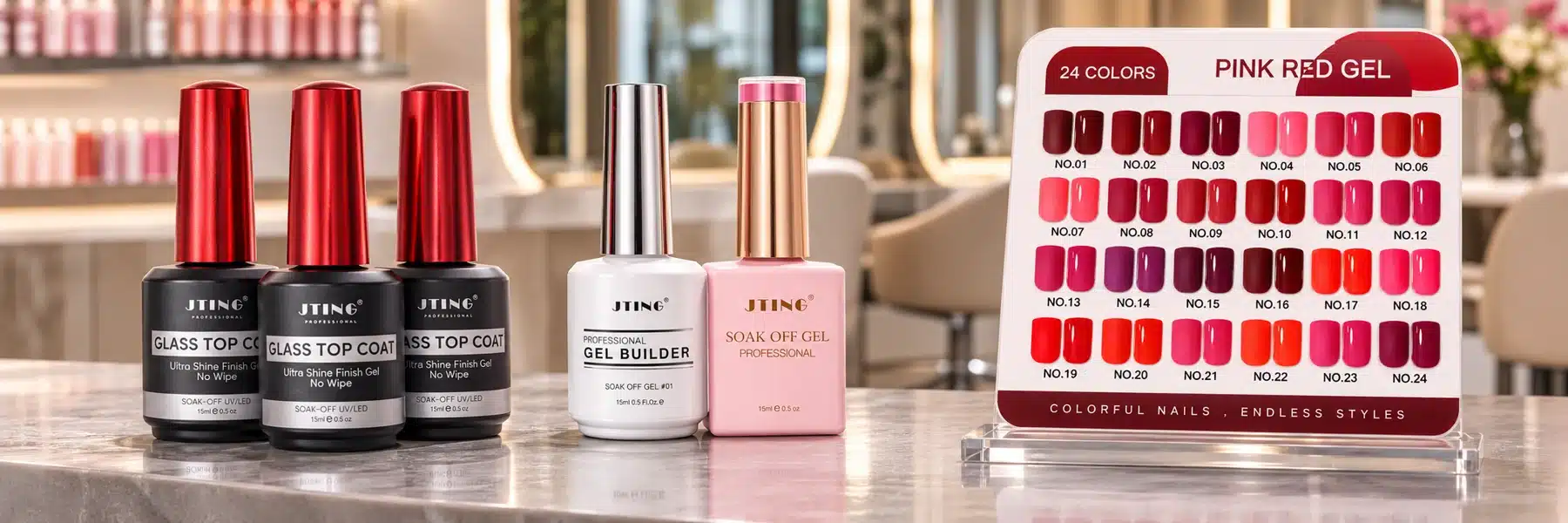
A Practical 40-to-69-SKU Collection Blueprint
| Collection Pillar | Recommended SKU Count | Products to Include | Commercial Role |
|---|---|---|---|
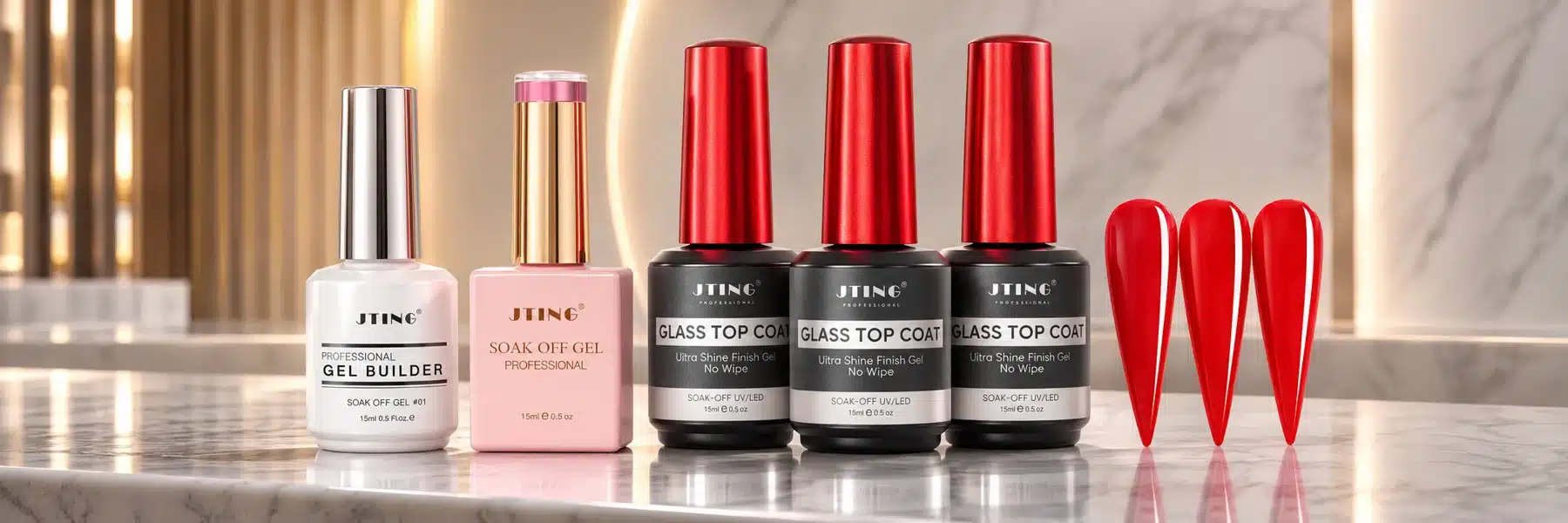
| 1. Essential Functional Trio | 3 SKUs | Hard / Standard Base Coat, Glass No-Wipe Top Coat, Velvet Matte Top Coat | Included in every starter kit and reordered monthly by every salon |
| 2. Structural & Prep Upgrades | 4–6 SKUs | Clear + 3 Tinted Rubber Bases (Milky White, Sheer Blush, Warm Nude), 1–2 Bottle Builder Gels | Serves the high-repeat natural nail strengthening and overlay market |
| 3. Core Salon Solids | 24–36 SKUs | Pure White, Jet Black, 6 Nudes/Sheers, 6 Pinks, 6 Reds/Burgundies, 4 Browns/Taupes, 4 Seasonal Solids | Covers everyday salon color requests year-round |
| 4. High-Margin Effect Capsules | 6–18 SKUs | 6 Velvet / Glass Cat Eye Shades, 6 Jelly Shades, 4–6 Reflective Glitter or Liner Gels | Drives higher salon ticket prices and visual social media content |
Why Functional Staples Anchor Long-Term Reorder Revenue
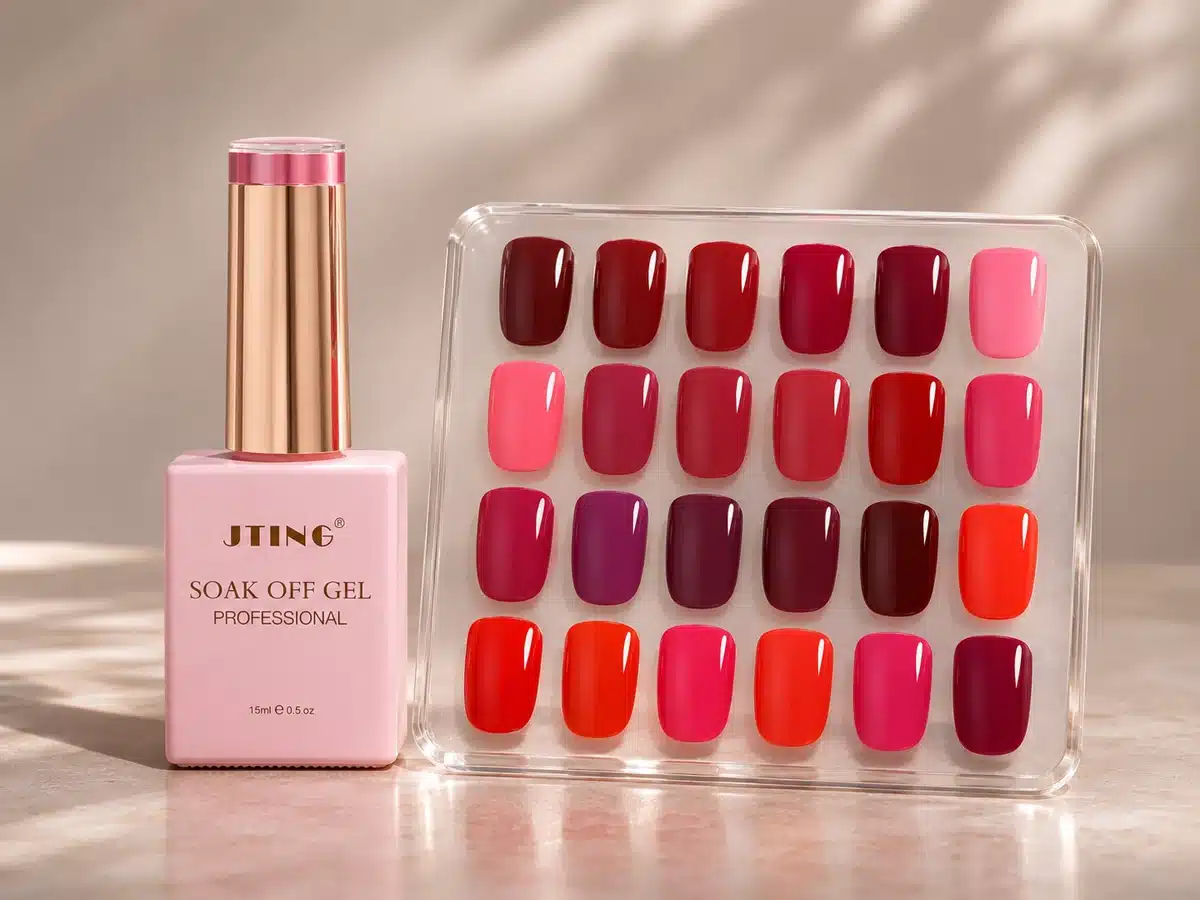
New brand founders often spend most of their planning time picking color shades and treat base and top coats as an afterthought. In wholesale reality, a salon may take months to finish a bottle of seasonal teal, but it will empty bottles of Base Coat, Milky Pink Rubber Base, Bottle Builder, and No-Wipe Glass Top Coat every few weeks. A proven model for combining both is JTING’s OEM/ODM collection format, such as our 66-color plus 3-functional-gel collection structure, which pairs 66 curated shades with Velvet Matte Top Coat, Hard Base Coat, and Glass Top Coat in distinctive light-toned square bottles with tall silver cylindrical caps and a matched painted swatch book.
20. Private Label Positioning: Building a Clean, Compliant Professional Brand
For a private label gel nail polish brand, a verified HEMA-free and TPO-free formula gets your foot in the door with professional buyers, and well-matched bottles, brushes, labels, and color cards turn first-time trial orders into long-term salon accounts.
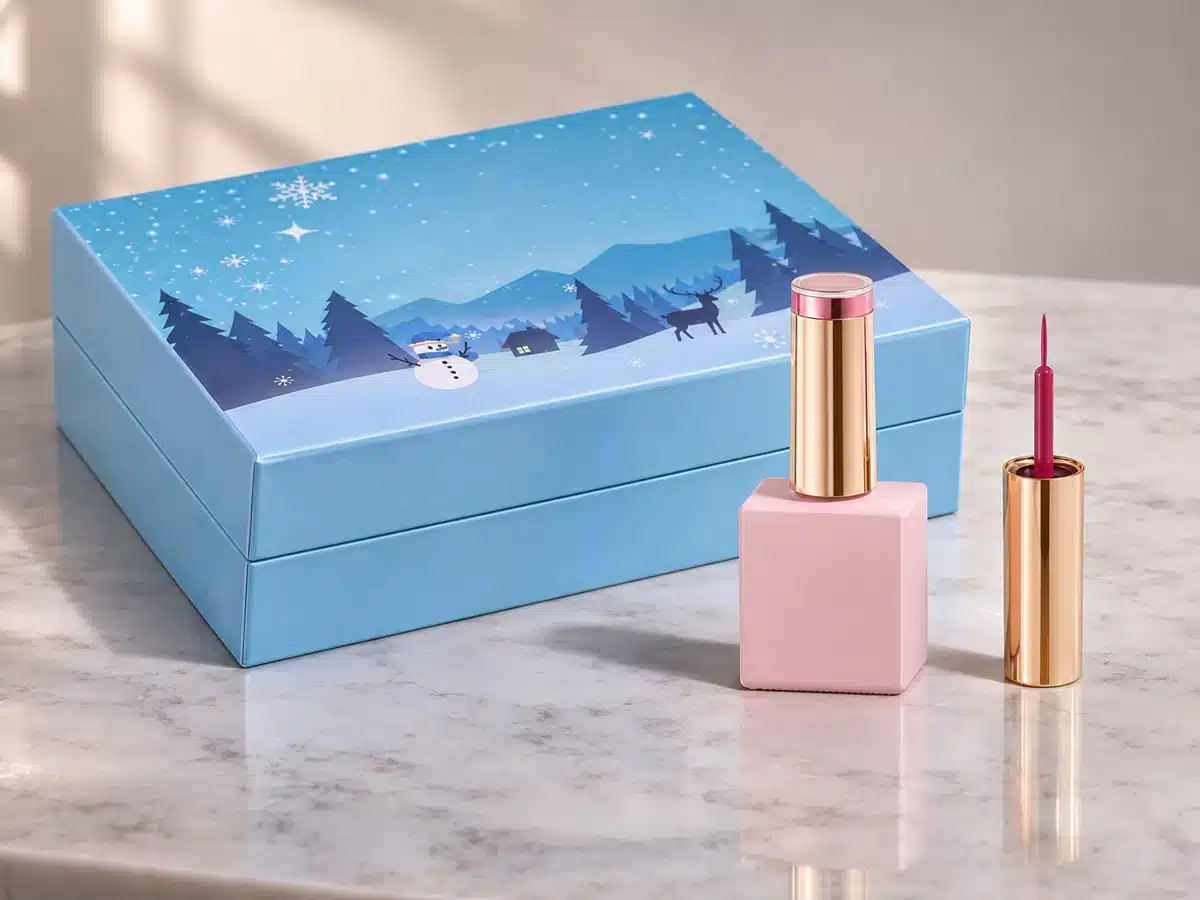
Selecting 15 Ml Bottle Profiles That Protect and Present the Range
Your bottle silhouette is the first physical cue a technician touches. JTING offers 100+ bottle and cap options, with our featured 15 ml bottle styles including popular reference profiles 363 in electroplated gold, glossy black, and glossy white; 489 in matte black and glossy white; and 562 in matte black, matte white, matte pink, and matte red. Using one bottle silhouette in matte black for your core colors and a contrasting electroplated gold or matte white bottle for your functional bases and top coats makes your lineup instantly recognizable on a busy salon table. See our custom gel polish bottles page for full options.
How Factory Brush Pairing Changes Salon Application
Because HEMA-free resins have a slightly different flow profile from older high-HEMA gels, putting the same generic brush into every bottle is a mistake. Across JTING’s 50+ brush options made with solvent-resistant nylon bristles and plastic stems, we match brush geometry to the viscosity of the gel inside. For dense products like Rubber Base Gel and Bottle Builder Gel, a slightly shorter, firmer oval brush with strong snap lets the technician push and float a structural bead without the bristles splaying apart. For high-pigment color coats and sheer jellies, a softer, finely tapered flat or round-cut brush glides over the nail plate without leaving furrow lines. Browse our custom gel polish brushes page to see how brush shapes are paired.
Coordinating Labels, Boxes, and Real Painted Color Charts
With 1000+ label design options and 100+ packaging box options, you can start from JTING’s existing design templates adapted with your logo or build custom packaging from the ground up. Pair every collection launch with hand-painted swatch charts rather than printed paper color cards so salon buyers can judge true cured opacity, jelly translucency, and magnetic cat eye depth in person. Explore custom labels and stickers, custom packaging boxes, and our private label case study.
21. Labeling Requirements: INCI Order, Warning Statements, Batch Codes, and PAO
A compliant formula still needs a compliant label to clear customs and pass local trading standards inspections. Before approving private label artwork for print, check that your bottle label and outer box leave proper room for these seven mandatory elements.
| Label Element | Regulatory Rule & Formatting Standard | Practical Packaging Tip |
|---|---|---|
| 1. Product Identity & Function | Clear statement of product function (e.g., “UV/LED Gel Nail Polish” or “Soak-Off Rubber Base Gel”) | Place clearly on the front or back panel |
| 2. Full INCI Ingredient List | Ingredients listed in descending order of weight above 1%, followed by ingredients at or below 1% in any order, using official INCI names | Confirm that neither HEMA nor Trimethylbenzoyl Diphenylphosphine Oxide appears on HEMA-free and TPO-free lines |
| 3. Professional-Use & Allergy Warnings | In the EU and UK, professional methacrylate gels require warnings such as For professional use only, Can cause an allergic reaction, and Avoid skin contact. Read directions for use carefully | Use legible type size; if the bottle is compact, use a peel-back multi-layer label or individual unit carton |
| 4. Net Content | Nominal fill volume in metric (15 ml) and imperial (0.5 fl. oz.) for dual US/UK/EU labeling | Keep the 15 ml declaration consistent across your bottle and box artwork |
| 5. Batch Number / Lot Code | Printed on both the bottle and the outer box so every production lot links directly to its COA | Leave a high-contrast area on the bottle base or back label for lot coding |
| 6. Durability / PAO Symbol | Period After Opening icon (such as 12M or 24M open-jar symbol) or minimum durability date | Keep the open-jar icon crisp and legible on curved bottle surfaces |
| 7. Responsible Person & Origin | Name and address of the local EU/UK Responsible Person (or US distributor/brand) plus country of origin (Made in China) | Verify Responsible Person address details before final plate printing |
Fitting a full INCI list, multi-language warnings, Responsible Person addresses, and curing instructions onto a 15 ml bottle without making the type unreadable requires practical packaging layout. Most established brands keep the front bottle face clean with the brand logo, product type, and volume, then use either a two-layer peel-and-read back label on the bottle or an individual printed unit carton to hold the full multi-language regulatory text.
22. Developing or Reformulating a Custom Line with JTING
Working directly with the factory that formulates, mills, fills, and packages your gels removes trading-company markups and technical translation errors. Founded in 2015 in Guangzhou, JTING operates a 3,000-square-meter manufacturing facility with 5 production lines, 23 production machines, 5 QC inspectors, and a team of 100+ staff producing over 10 million bottles a year for buyers in 30+ countries.
A Built-In HEMA-Free Baseline and Full TPO-Free Capability
All JTING products are HEMA-free. Because that baseline is built into our regular production, buyers do not face extra R&D surcharges or huge minimum runs just to exclude monomeric HEMA. For brands and distributors supplying the European Union, Great Britain, or global clean-label channels, we also produce TPO-free ranges across color sets, base and top coats, rubber bases, bottle and jar builders, poly gels, magnetic cat eyes, reflective glitters, and art gels, alongside Vegan, Cruelty-free, and Low-odor options.
How Custom Color Matching and Rheology Tuning Work in Our Lab
Our R&D team develops around 60 to 100 new colors and effects every week. When you send us physical nail swatches, competitor benchmarks, fabric samples, or Pantone references, our chemists do more than match the surface hue. We adjust pigment load so darks and pastels cover in two thin coats, tune thixotropic recovery so the gel levels smoothly without flooding cuticles, and test curing under standard 365+405 nm lamps before sending out your approval samples.
Once your shades and formulas are approved, JTING handles the entire turnkey production under one roof, including custom bottles, brushes, labels, packaging boxes, hand-painted color charts, product photography, and product videos so your collection arrives ready for launch.
Verification, Testing, and Supply Chain
23. How to Audit a Supplier’s HEMA-Free and TPO-Free Claims
Whenever cosmetic regulations tighten, some middlemen update their sales brochures to say “HEMA-Free & TPO-Free” while still shipping older factory stock, or they email a three-year-old SDS that does not match the sample bottle on your desk. Before paying a deposit, run this 20-minute paperwork check.
Three Paper Checks That Catch Mismatched Formulas
- Ask for the 100% Full INCI Sheet with CAS Numbers and Percentage Ranges: Do not accept a short list of “key ingredients.” Photoinitiators like TPO usually make up 0.5% to 4% of a formula, so a summary sheet that hides ingredients below 3% can conceal TPO. Check that all ingredients add up to 100%, and confirm that neither CAS
868-77-9(HEMA) nor CAS75980-60-8(TPO) is listed. - Compare SDS Section 3 Against the INCI Sheet: Open Section 3 (Composition / Information on Ingredients) of the Safety Data Sheet. If the sales sheet promises a TPO-free formula, but SDS Section 3 still lists
Diphenyl(2,4,6-trimethylbenzoyl)phosphine oxideor CAS75980-60-8, the supplier is sending you outdated paperwork. Both documents must match the exact formula code of your sample. - Confirm That Valid Photoinitiators Are Listed: Watch out for crudely edited Word files where a salesperson deleted the TPO line without replacing it. Every UV/LED gel requires at least one photoinitiator (such as CAS
84434-11-7,162881-26-7, or947-19-3) to harden in the lamp. If an INCI list shows zero photoinitiators at all, the document has been altered by someone outside the lab.
If a supplier hesitates to share the full 100% INCI breakdown with CAS numbers before you place a bulk order, or claims that photoinitiator names are “trade secrets” that cannot be shown on an INCI label, walk away. Under EU, UK, and US cosmetic labeling laws, every ingredient in a cosmetic product must be disclosed by its INCI name on the package, so a legitimate manufacturer always has that table ready.
24. The Five Essential Compliance Documents for B2B Buyers
Customs brokers, EU/UK Responsible Persons, and retail compliance teams review a standard set of technical files before clearing a professional gel nail polish line. Requesting these five documents during sample evaluation keeps your launch schedule on track.
| Document | What It Covers | When Buyers Need It | Key Detail to Verify |
|---|---|---|---|
| 1. Full INCI & Formula Composition Sheet | 100% ingredient breakdown by INCI name, CAS number, function, and percentage band | Before sample sign-off, label layout, and safety assessment | Matches exact formula version; confirms HEMA-free and TPO-free status |
| 2. SDS / MSDS (Safety Data Sheet) | 16-section chemical safety, handling, storage, and air/sea freight classification | Before courier sample shipping and bulk air or ocean freight booking | Section 3 components align with the INCI sheet; current issue date |
| 3. COA (Certificate of Analysis) | Batch-specific QC test results for appearance, shade match, viscosity, and curing | Issued with every bulk production run before shipment | Shows the exact batch/lot number printed on bottles and cartons |
| 4. CPSR, PIF & CPNP / SCPN Support Files | Toxicological safety assessment (Part A & B) and portal notification for EU and Great Britain | Before placing branded products on the EU or Great Britain market | Safety assessor confirms compliance with current EU/UK annexes |
| 5. ISO 22716 / GMPC Manufacturing Credentials | Good Manufacturing Practice verification for cosmetic production, hygiene, and batch traceability | During supplier onboarding and Product Information File compilation | Covers cosmetic nail gel manufacturing at the factory |
How Private Label CPSR and CPNP Registration Work Between JTING and Your Responsible Person
First-time private label buyers in Europe and Great Britain often ask who is responsible for creating the Cosmetic Product Safety Report (CPSR) and submitting the CPNP (EU) or SCPN (UK) portal notification when a product is sold under the buyer’s own brand name. Under EU and UK cosmetics law, the notification must be filed under the brand name that appears on the bottle by the brand’s designated EU or UK Responsible Person, and the CPSR must be signed by a qualified safety assessor.
To make that process fast and straightforward for your assessor, JTING prepares the technical manufacturing dossier required for Part A of the safety assessment. Depending on the product and destination market, JTING can support buyers with the 100% quantitative INCI composition sheet, raw material SDS and specifications, finished-product SDS/MSDS, batch COA, stability and packaging compatibility records, ISO 22716 and GMPC/CGMP credentials, CPSR, CPNP, GPSR, SGS, FSC, FDA-related support, REACH-related support, and customs documentation. Sharing your target markets with our team when you request samples lets us align the technical file package while you test the physical bottles.
25. Hands-On Sample Testing Protocol for HEMA-Free and TPO-Free Gels
Once your sample box arrives, do not approve a range by looking at factory-painted swatch sticks alone. Spend one afternoon running these eight bench tests in your own studio lighting and lamps so you know how the gels behave in real salon hands.
How to Run the Peel-and-Cut Underside Cure Test
This two-minute test catches under-cured dark shades and builders immediately:
- Brush two normal salon coats of jet black, pure white, or deep burgundy onto a clear plastic nail form backing or silicone mat, curing each coat for 60 seconds in your 365+405 nm UV/LED lamp.
- Peel the cured film off the backing with tweezers and flip it over to check the bottom face.
- Cut across the center of the film with a sharp blade. Both the underside and the inner cross-section must be completely dry, firm, and solid. If wet pigment smears onto a white wipe from the underside, the formula is not curing through at normal salon thickness.
| Test # | Evaluation Check | Testing Method | Pass Benchmark | Score (1–5) |
|---|---|---|---|---|
| 1 | Brush & Leveling Control | Apply 1st and 2nd coats on curved tips; observe self-leveling | Levels smoothly before curing without flooding cuticles | |
| 2 | 2-Coat Opacity on Benchmark Shades | Test Jet Black, Pure White, Classic Red, Deep Burgundy, and Pastel | Uniform full coverage in two thin salon coats | |
| 3 | Underside Through-Cure | Peel cured 2-coat dark film from clear sheet; inspect bottom | Dry, solid underside with zero uncured pigment transfer | |
| 4 | Top Coat Clarity & Non-Yellowing | Coat half of a pure white tip; check after cure & daylight exposure | Water-clear gloss with no warm or yellow shift | |
| 5 | Builder Lamp Heat Comfort | Build a normal structural apex on a live tester nail; cure in your UV/LED lamp | Gentle warmth only; no sharp sting in low-heat mode | |
| 6 | 14-to-21-Day Live Wear Test | Apply full system on live tester hands across varied nail types | 14–21 days with zero cuticle lifting, tip chipping, or peeling | |
| 7 | Soak-Off Removal Cleanliness | File open top seal and wrap with acetone per product directions | Flakes off cleanly with a wooden stick without scraping the nail plate | |
| 8 | Warm-Storage Stability | Store a sealed sample bottle under controlled warm storage | No hard pigment caking, oil separation, or neck thickening |
When a sample set passes all eight checks, label the cured swatch tips with the sample date and formula code, and keep the remaining half-full sample bottles in a dark drawer. Those bottles serve as your physical reference when your first bulk production shipment arrives.
26. Packaging and Light-Barrier Checks for Sensitive Photoinitiator Systems
Because TPO-free photoinitiators respond actively to wavelengths up to 405 nm at the edge of visible violet light, the liquid inside the bottle reacts quickly if exposed to bright studio ring lights, overhead LEDs, or window sun. If a bottle wall or cap seal leaks light, gel will thicken on the brush stem or form a cured ring inside the bottle neck long before the bottle is empty.
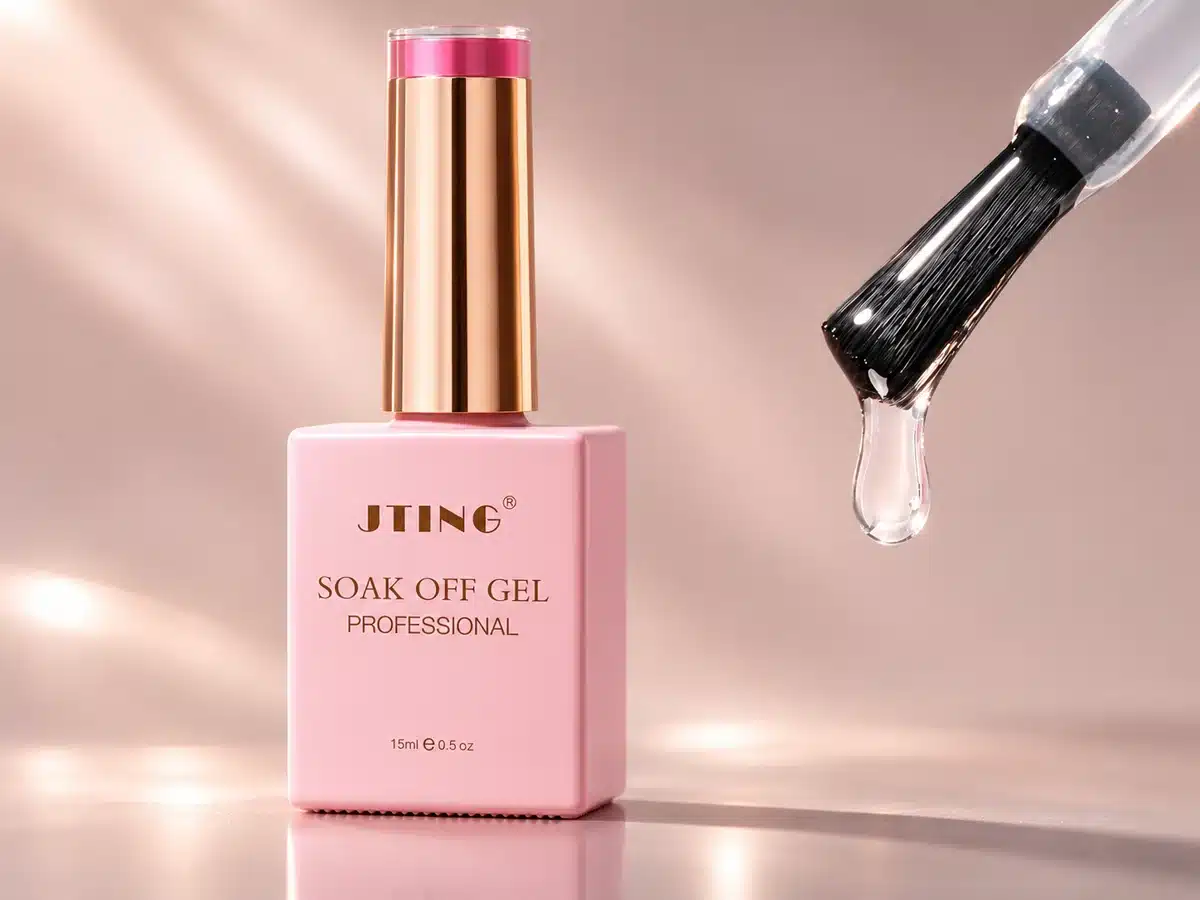
Flashlight Opacity Testing and Solvent-Resistant Brush Fit
Start by holding an empty candidate 15 ml bottle against a bright phone flashlight in a dark room. Quality gel bottles use thick UV-shielded glass coatings, double-sprayed matte or glossy finishes, or electroplated surfaces that block external light completely. If your brand uses a color-window bottle, verify that the window uses a UV-filtering coating and remind salons to keep open bottles turned away from nail lamps.
Next, check how the brush bristles behave after sitting immersed in the gel during warm-storage stability testing. Different HEMA-free monomer blends have distinct solvency profiles; if cheap synthetic bristles are used, they can swell, flare outward, or lose their spring within weeks. JTING selects solvent-resistant nylon bristles matched to our gel nail polish formulas so flat, oval, and liner brushes hold a crisp edge through the life of the bottle.
Headspace Fill Control and Neck Seals for Sea and Air Freight
Experienced export buyers also check one detail that domestic testing often misses: bottle headspace and neck wiper tolerances during international transit. When pallets of gel nail polish travel in summer ocean containers or unpressurized air cargo holds, temperature and pressure swings cause the liquid gel inside the bottle to expand slightly. If a bottle is overfilled without proper headspace, or if the plastic neck wiper and cap threads do not seal cleanly, expanded gel creeps over the rim and fouls the threads, making caps sticky when the customer opens the box. JTING’s automated filling lines control fill weight and headspace for 15 ml bottles and pair each bottle profile with its matched wiper and cap torque so export cartons arrive clean.
27. Comparing Wholesale Quotes, MOQs, and Reformulation Timelines
When comparing quotes for wholesale gel nail polish or a private label launch, looking only at the single-bottle price can hide major differences in pigment concentration, bottle hardware, or compliance readiness. Breaking every quotation into six clear lines lets you compare suppliers on equal footing.
| Quote Item | Questions to Confirm With Each Supplier | JTING Standard Reference |
|---|---|---|
| Formula Specification | Is it HEMA-free as standard? Is it TPO-free? How are solids, jellies, builders, and cat eye gels priced? | All JTING products are HEMA-free; TPO-free formulas quoted clearly across each product line |
| Minimum Order Quantity (MOQ) | What is the minimum per shade and total order minimum for private label vs. house brand? | Private label gel nail polish orders start from 10 pieces per shade; house-brand mixed-color orders start from 100 pieces (final MOQ depends on product type, packaging style, formula request, and customization level) |
| Bottle, Cap & Brush Hardware | Are bottle coating, cap finish, and brush style included in the unit price? Are 15 ml bottles standard? | 100+ bottle/cap options and 50+ brush options; 15 ml main reference styles clearly specified |
| Labels, Boxes & Swatch Cards | Does the price include label printing, inner/outer boxes, and painted color charts? | 1000+ label design options, 100+ box options, and hand-painted collection swatch cards supported |
| Sampling & Development Time | How long do stock samples vs. custom shades or custom TPO-free adjustments take? | Standard samples: typically 7–10 business days; custom color or exclusive formula development: typically 2–4 weeks |
| Bulk Production Lead Time | How many days from sample and packaging sign-off to shipment readiness? | Typically 15–20 days after sample and packaging approval |
Unit Bottle Price vs. Real Salon Cost-Per-Service
When evaluating two quotes that differ by a small amount per bottle, look at how the gel performs at the salon table before choosing the cheaper option. In a professional manicure, the liquid gel inside a 15 ml bottle represents only a tiny fraction of the service price; technician chair time is the real expense. If a bargain formula is diluted with low-grade fillers so technicians need three coats instead of two to get even coverage, every manicure consumes roughly 50% more gel and adds an extra brush-and-cure cycle on both hands. Worse still, the chair time lost to even one or two lifting or wrinkling reworks costs a salon far more than the savings on an entire case of cheap polish.
Because JTING’s private label orders start from 10 pieces per shade, brands and distributors can launch a tested 24-shade or 36-shade HEMA-free and TPO-free range, or trial a 6-shade seasonal capsule, without tying up capital in oversized minimum runs.
28. Batch Traceability, Stability Testing, and Reorder Consistency
The true test of a manufacturing partner is not the first order; it is whether the third reorder six months later matches the first batch in shade depth, brush feel, and 60-second curing. Salon customers notice immediately if their favorite sheer nude turns pinker or their rubber base runs thinner on a restock.
Master Reference Samples and Five-Inspector QC
To keep production consistent across months and years, both the factory and the buyer need a physical benchmark. For every approved shade and functional gel, JTING seals master reference bottles and painted swatches stored in a temperature-controlled dark cabinet, and we recommend buyers keep an identical set at their office. During bulk production at our Guangzhou facility, 5 dedicated QC inspectors check incoming raw resin lots, three-roll pigment grind fineness, viscometer readings, 60-second lamp curing, shade match against the sealed master sample, automated fill weight, and label alignment before cartons are closed.
Lot Coding and Single-Shade Replenishment
Every production run receives a batch code printed on the bottle and outer carton, backed by a batch-specific COA. If a distributor or salon chain ever wants to verify the production date or QC record of a specific shipment, that lot number pulls up the exact batch file immediately.
Equally important for working capital, JTING supports single-shade replenishment orders. High-turnover staples like French white, jet black, milky pink, and deep burgundy always empty out long before slower seasonal colors. Being able to restock individual best-sellers from 10 pieces per shade on private label lines keeps your warehouse balanced and prevents backorders for your salon accounts.
Checklists, Glossary, FAQ, and Samples
29. 7 Common Mistakes When Switching to HEMA-Free and TPO-Free Gel Polish
Even experienced buyers can run into avoidable delays when transitioning a product line or salon backbar under tight regulatory deadlines. Watch out for these seven pitfalls during your rollout:
- Replacing Color Coats While Keeping Legacy Base and Top Coats: Putting a compliant color gel over an older HEMA-heavy base coat or sealing it with an older TPO-containing top coat leaves your service stack non-compliant. Upgrade your base, builder, color, and top coats together.
- Approving a Supplier After Testing Only Sheer Pinks and Shimmers: Translucent shades cure easily in almost any formula. Always test jet black, pure French white, deep burgundy, and a thick builder apex before approving a TPO-free line.
- Confusing Banned TPO (CAS 75980-60-8) With Permitted TPO-L (CAS 84434-11-7): Rejecting a compliant formula because an INCI name includes the word “phosphinate,” or accepting a banned formula because a supplier used a vague nickname, wastes time and money. Verify by exact CAS number.
- Using Vague “Chemical-Free” Claims Instead of Specific Ingredient Badges: Regulators and educated nail technicians distrust exaggerated claims. Print accurate, verifiable badges like “HEMA-Free & TPO-Free” paired with a complete INCI panel and clear application directions.
- Skipping the Flashlight Test on Custom Bottles: Thinly coated pastel or frosted bottles can let studio light thicken TPO-free gels around the brush neck. Test bottle opacity before ordering mass packaging.
- Leaving Too Little Label Space for INCI Text and Warnings: EU and UK professional methacrylate rules require specific warning text alongside the ingredient list. Plan a peel-back label or printed unit box early in the design process.
- Asking for SDS, INCI, and CPSR Files After Bulk Production Starts: Review compliance paperwork alongside your first physical samples so label printing and customs clearance run smoothly.
Catching these seven issues during the sampling stage costs almost nothing; catching them after 5,000 bottles are printed and packed is expensive. A structured pre-order checklist keeps every team member aligned.
30. A HEMA-Free and TPO-Free Gel Polish Sourcing Checklist
Run through this 12-point checklist with your purchasing, technical, and packaging teams before signing off on a new range:
- Target sales markets defined (EU, Great Britain, US, Middle East, Southeast Asia, or unified global inventory)
- Monomer specification confirmed (monomeric HEMA-free CAS 868-77-9 as baseline; Di-HEMA TMHDC policy noted if required by brand brief)
- Photoinitiator specification confirmed (zero TPO CAS 75980-60-8 for EU, Great Britain, and global TPO-free lines)
- 100% Full INCI sheets with CAS numbers received and checked against SDS Section 3 across all product types
- Complete system sampled together: Base Coat, Rubber Base, Builder Gel / Poly Gel, Benchmark Colors (Black, White, Red, Burgundy, Pastel, Jelly, Cat Eye), and Glossy/Matte Top Coats
- Two-coat peel-and-cut underside cure test passed on Jet Black, Pure White, and Deep Burgundy under a 365+405 nm UV/LED lamp
- Non-yellowing clarity checked on Glossy and Matte Top Coats over Pure White swatch tips
- Live-model 14-to-21-day wear test and 10-to-12-minute acetone soak-off test completed
- 15 ml bottle light-blocking opacity, neck wiper fit, headspace fill level, and solvent-resistant nylon brush fan verified
- Label artwork checked for INCI order, professional warnings, net content, PAO icon, Responsible Person address, and batch code area
- MOQ per shade (from 10 pcs/shade for private label at JTING), sample lead time (7–10 business days), and bulk lead time (15–20 days) confirmed
- Master reference swatches sealed and single-shade reorder terms agreed for ongoing restocks
Keep a signed copy of this checklist inside each collection’s project folder so your compliance, warehouse, and marketing teams work from the same approved specifications.
31. Compliance and Formulation Glossary for Gel Buyers
Use this quick reference to decode the chemical names, regulatory abbreviations, and testing terms that appear on gel nail polish INCI sheets, safety reports, and factory quotations:
- HEMA (2-Hydroxyethyl Methacrylate, CAS 868-77-9)
- A small reactive methacrylate monomer historically used for adhesion and low viscosity in gel nail products. If uncured HEMA touches skin repeatedly, its small molecules can penetrate the skin barrier and cause allergic contact dermatitis.
- Di-HEMA Trimethylhexyl Dicarbamate (Di-HEMA TMHDC, CAS 41137-60-4)
- A larger urethane dimethacrylate monomer/oligomer distinct from monomeric HEMA. It has a higher molecular weight and lower skin penetration than HEMA, and is permitted for professional use with mandatory warnings in the EU and UK.
- TPO (Trimethylbenzoyl Diphenylphosphine Oxide, CAS 75980-60-8)
- A photoinitiator used to cure UV/LED gels. Reclassified as a Category 1B reproductive toxicant (CMR 1B), it has been banned in EU cosmetics since September 1, 2025, and is subject to Great Britain’s August 15, 2026 and February 14, 2027 phase-out dates.
- TPO-L (Ethyl Trimethylbenzoyl Phenylphosphinate, CAS 84434-11-7)
- A liquid acylphosphine oxide photoinitiator with a different chemical structure and CAS number from banned TPO (75980-60-8). Widely used as a permitted LED photoinitiator in TPO-free gel formulations.
- BAPO (Bis-Trimethylbenzoyl Phenylphosphine Oxide, CAS 162881-26-7)
- A high-efficiency photoinitiator that absorbs into the visible violet range, supporting deep through-cure in heavily pigmented TPO-free dark and white gels.
- CMR 1B Substance
- A substance classified under the EU CLP Regulation as presumed to be carcinogenic, mutagenic, or toxic for reproduction based on animal studies, triggering prohibition in EU cosmetics unless specifically exempted.
- INCI (International Nomenclature of Cosmetic Ingredients)
- The standardized international naming system used to list cosmetic ingredients on product labels and technical sheets.
- CAS Number (Chemical Abstracts Service Number)
- A unique numerical identifier assigned to each chemical substance, allowing buyers to verify exact ingredients regardless of trade names.
- SDS / MSDS (Safety Data Sheet)
- A 16-section document detailing chemical composition, safe handling, storage conditions, and air/ocean transport classification.
- COA (Certificate of Analysis)
- A batch-specific quality control document issued by the manufacturer confirming that a production lot meets defined visual, viscosity, and curing standards.
- CPSR & CPNP / SCPN
- The Cosmetic Product Safety Report (signed by a qualified safety assessor) and the notification portals for the EU (CPNP) and Great Britain (SCPN) required before placing cosmetics on the market.
- Oxygen Inhibition Layer (Dispersion Layer)
- The thin tacky surface film left on standard base, color, and builder gels after curing because air slows surface polymerization. It helps bond the next gel coat and is different from an under-cured liquid center.
32. Frequently Asked Questions
What Is the Difference Between HEMA-Free and TPO-Free Gel Nail Polish?
HEMA-free gel nail polish is formulated without monomeric 2-Hydroxyethyl Methacrylate (CAS 868-77-9), a small monomer linked to skin sensitization when uncured gel touches the skin. TPO-free gel nail polish is formulated without Trimethylbenzoyl Diphenylphosphine Oxide (CAS 75980-60-8), a photoinitiator banned in the EU and phasing out in Great Britain due to its CMR 1B classification. Because HEMA is a monomer and TPO is a photoinitiator, upgrading both together creates a fully compliant modern system.
Is TPO Banned in Gel Nail Polish in the EU and the UK?
Yes. In the European Union (including Northern Ireland), TPO (CAS 75980-60-8) has been prohibited in all cosmetic products, including supply and professional salon use, since September 1, 2025 under Regulation (EU) 2025/877. In Great Britain (England, Scotland, and Wales), placing new TPO-containing cosmetics on the market was prohibited from August 15, 2026, and the final off-shelf deadline for supplying or selling existing stock is February 14, 2027.
Is HEMA Banned in the European Union or Great Britain?
No. Neither HEMA (CAS 868-77-9) nor Di-HEMA Trimethylhexyl Dicarbamate is banned in the EU or Great Britain. Both remain permitted in nail products restricted to professional use only, provided the packaging carries the mandatory warnings (“For professional use only” and “Can cause an allergic reaction”). Even so, many salons, distributors, and brands choose HEMA-free formulas to reduce sensitization risk at the nail table.
Are All JTING Gel Nail Polish Products HEMA-Free?
Yes. All JTING products are HEMA-free across our entire manufacturing catalog, including gel polish color sets, base coats, top coats, rubber base gels, builder gels, poly gels, cat eye gels, reflective gels, liner gels, painting gels, and 3D nail art gels.
Can JTING Supply Both HEMA-Free and TPO-Free Gel Nail Polish for Private Label Orders?
Yes. Alongside our company-wide HEMA-free standard, JTING supplies TPO-free formulations across color gels, base coats, top coats, rubber bases, builder gels, and effect gels to match your product selection and destination market. We also support Vegan, Cruelty-free, and Low-odor requirements.
Does HEMA-Free and TPO-Free Gel Nail Polish Last as Long as Traditional Gel Polish?
Yes. Formulated with quality urethane acrylate oligomers, balanced functional monomers, and dual-wavelength TPO-free photoinitiators, JTING’s HEMA-free and TPO-free systems deliver up to three weeks of chip-resistant salon wear and clean 10-to-12-minute soak-off removal when applied and cured under a 365+405 nm UV/LED lamp.
Why Do Some TPO-Free Dark Gel Shades Wrinkle in the Lamp, and How Is That Prevented?
Wrinkling happens when heavy dark or white pigments block UV/LED light from reaching the bottom of a thick coat, causing the top skin to cure and shrink over wet gel underneath. JTING prevents this through fine three-roll pigment milling for thin two-coat coverage and balanced surface-plus-deep photoinitiator blends. At the salon table, brushing on two thin coats and curing for a full 60 seconds in a 365+405 nm lamp keeps dark shades smooth.
Does HEMA-Free Gel Nail Polish Guarantee Zero Allergy Risk?
No UV/LED acrylate gel is 100% allergy-proof. Removing monomeric HEMA eliminates the most common small-molecule sensitizer in nail gels, but other acrylates and methacrylates still require keeping wet gel off the skin, wearing nitrile gloves, and curing every coat fully.
Is TPO-L the Same Chemical as Banned TPO?
No. Banned TPO is Trimethylbenzoyl Diphenylphosphine Oxide (CAS 75980-60-8). TPO-L is the trade shorthand for Ethyl Trimethylbenzoyl Phenylphosphinate (CAS 84434-11-7), a different chemical compound with its own CAS number that is permitted under EU and Great Britain cosmetics rules. Always verify ingredients by full INCI name and CAS number.
Do Salons Need to Buy New Nail Lamps When Switching to HEMA-Free and TPO-Free Gels?
In most cases, no, as long as the salon uses professional dual-wavelength (365 nm + 405 nm) UV/LED tunnel lamps in good working condition (typically 36W to 48W with clean reflective interiors). Handheld mini flash lamps should only be used for 10-second initial pinning, followed by a full 60-second cure in a chamber lamp.
What Documents Should Importers and Brands Request for EU, UK, or US Compliance?
Buyers should request a 100% Full INCI breakdown with CAS numbers, a current SDS/MSDS, and batch COAs. Depending on the product and destination market, JTING can also support buyers with CPSR, CPNP, GPSR, ISO 22716, GMPC/CGMP, FDA-related, and REACH-related documentation.
What Are JTING’s MOQ and Lead Times for HEMA-Free and TPO-Free Orders?
JTING supports private label gel nail polish orders starting from 10 pieces per shade, and house-brand mixed-color orders starting from 100 pieces (final MOQ may vary by product type, packaging style, formula request, and customization level). Standard samples typically ship in 7 to 10 business days, custom color or exclusive formula development takes 2 to 4 weeks, and bulk production takes 15 to 20 days after sample and packaging approval.
33. Recommended Starter Sample Kits by Buyer Type
To test a HEMA-free and TPO-free system properly in a single shipment, pack your sample order with both everyday salon staples and the toughest benchmark colors. Here are three practical 10-to-12-bottle sample kits organized by business type.
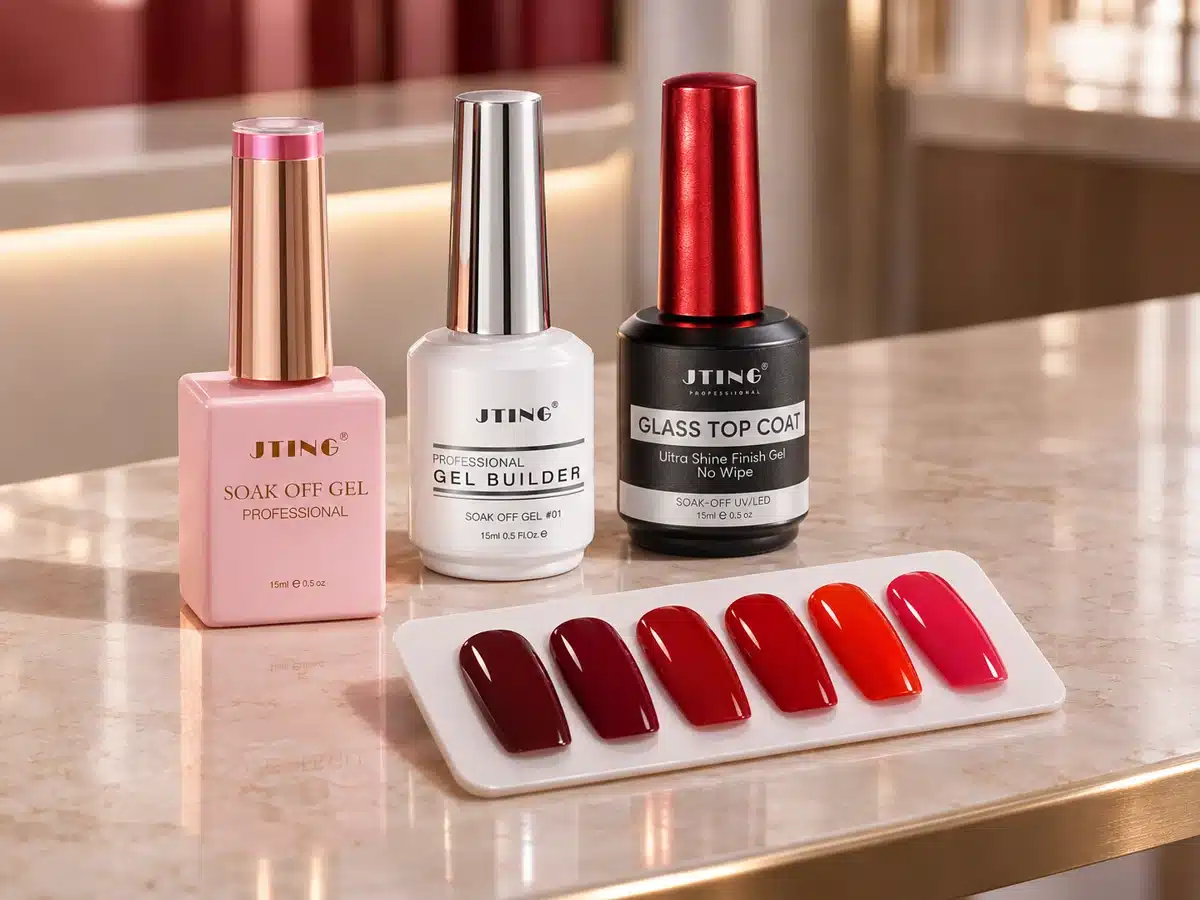
| Buyer Type | Recommended 10-to-12 Bottle Sample Kit Configuration | Primary Testing Goal |
|---|---|---|
| Salons & Multi-Location Chains | 1 Standard Base Coat, 2 Tinted Rubber Bases (Milky White, Sheer Blush), 1 Bottle Builder Gel, 4 Benchmark Solids (Jet Black, Pure White, Classic Red, Deep Burgundy), 1 Velvet Cat Eye, 1 Glass No-Wipe Top Coat, 1 Velvet Matte Top Coat | Check 2-coat coverage, low lamp warmth, 60-second cure, and 21-day client wear |
| Distributors & Wholesalers | 3 Functional Staples (Hard Base, Glass Top, Velvet Matte Top), 2 Rubber Bases, 1 Bottle Builder, 1 Poly Gel tube, 6 Core & Effect Shades, plus painted color chart and packaging samples | Verify INCI/SDS alignment, test high-turnover reorder staples, and inspect collection packaging |
| Private Label & E-Commerce Brands | Full functional stack (Base, Rubber Base, Bottle Builder, No-Wipe Top, Matte Top), 5 Benchmark & Hero Shades (Black, White, Burgundy, Milky Nude, Cat Eye/Reflective), plus 3–4 custom 15 ml bottle and brush options | Test formula performance alongside bottle light-blocking opacity, brush feel, and label fit |
Testing a coordinated 10-to-12-bottle kit side by side against your current supplier’s bottles in the same lamp gives your team an objective scorecard within one week of delivery, and lets you move straight into shade selection and packaging layout with confidence.
34. Request HEMA-Free and TPO-Free Samples from JTING
When you are ready to test samples or plan a collection upgrade, send our team these five details so we can prepare the right bottles, INCI sheets, and quote for your project:
- Your business model: Private label brand, importer/distributor, wholesaler, e-commerce seller, or salon group.
- Target sales markets: European Union, Great Britain, United States, Middle East, Southeast Asia, or multi-region distribution.
- Product categories to include: Base and top coats, rubber bases, bottle builders, hard builders, poly gel, core color sets, cat eye, reflective, or nail art gels.
- Formula and compliance requirements: Standard HEMA-free, dual HEMA-free and TPO-free, Vegan/Cruelty-free, or custom shade and viscosity matching.
- Packaging and quantity plan: House-brand wholesale (from 100 pieces mixed) or custom private label (from 10 pieces per shade), preferred 15 ml bottle style, and target launch date.
Build a sample set around your next collection. Use the form below to tell JTING which products you want to test and where you plan to sell them. We’ll recommend samples and shade charts for your range and outline the documentation available for the selected products.