A holiday nail collection needs more than red, green and a bottle of sparkle. Salon buyers need designs their teams can reproduce, distributors need products with clearly different roles, and private label brands need a color story that still makes sense after the decorations come down. The useful starting point is not the most elaborate reference picture. It is the relationship between the occasion, the desired finish and the professional service that will deliver it.
For businesses planning professional services, wholesale ranges, branded collections, online assortments or training materials, this guide connects Christmas gel nails and December 31 New Year's Eve nails with practical product selection. Use the design combinations to plan samples, compare physical swatches and develop a service menu appropriate to your customers, technicians and sales channels. Start with a coordinated palette, add effects with distinct purposes and choose a level of detail your professional team can reproduce.
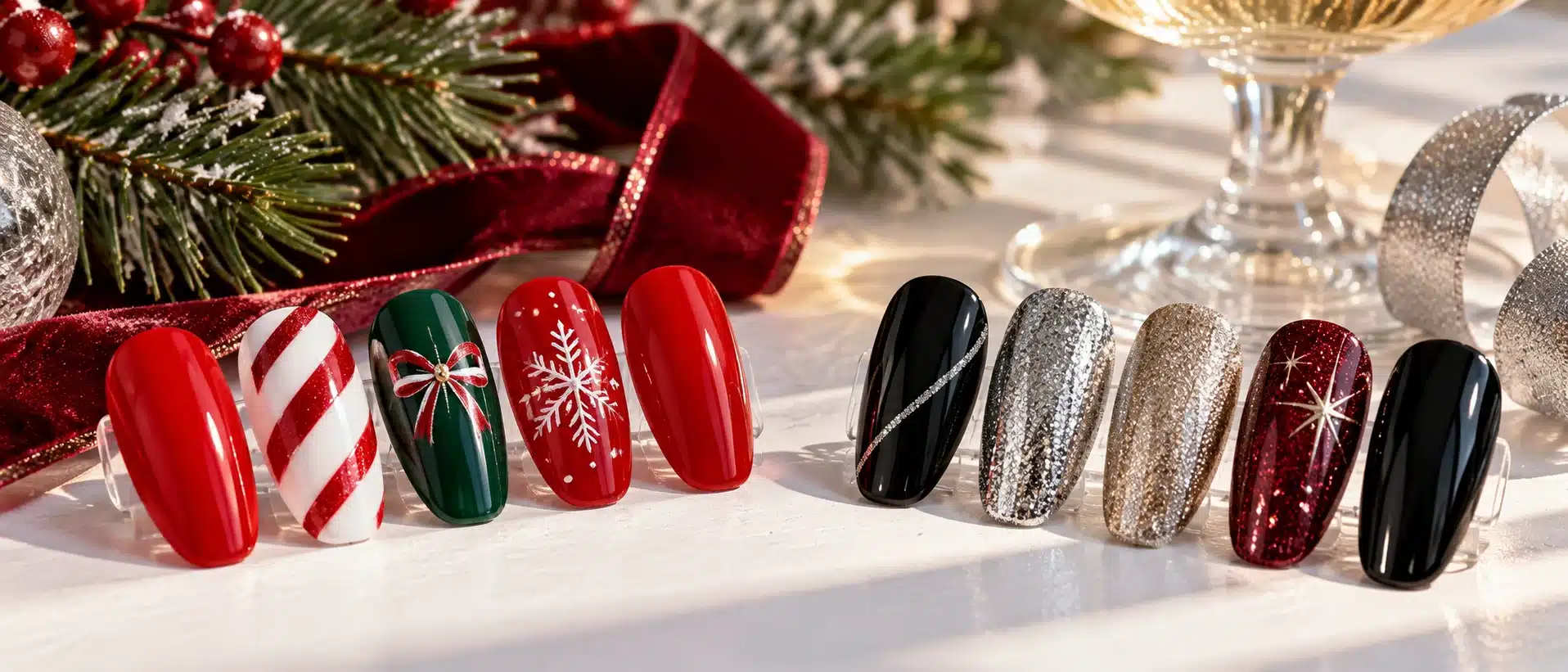
Christmas nail tips in red, green and white beside silver, champagne and dark New Year's Eve designs
01. Quick Answer: How Do You Choose Holiday Gel Nails?
Choose Christmas designs around recognizable color and motifs; choose New Year's Eve designs around light, contrast and the evening setting. For either occasion, select the base color first, the decorative material second and the compatible finishing system last. A glossy burgundy manicure with one painted ribbon and a black manicure with a reflective accent may share a service structure, but they communicate different occasions.
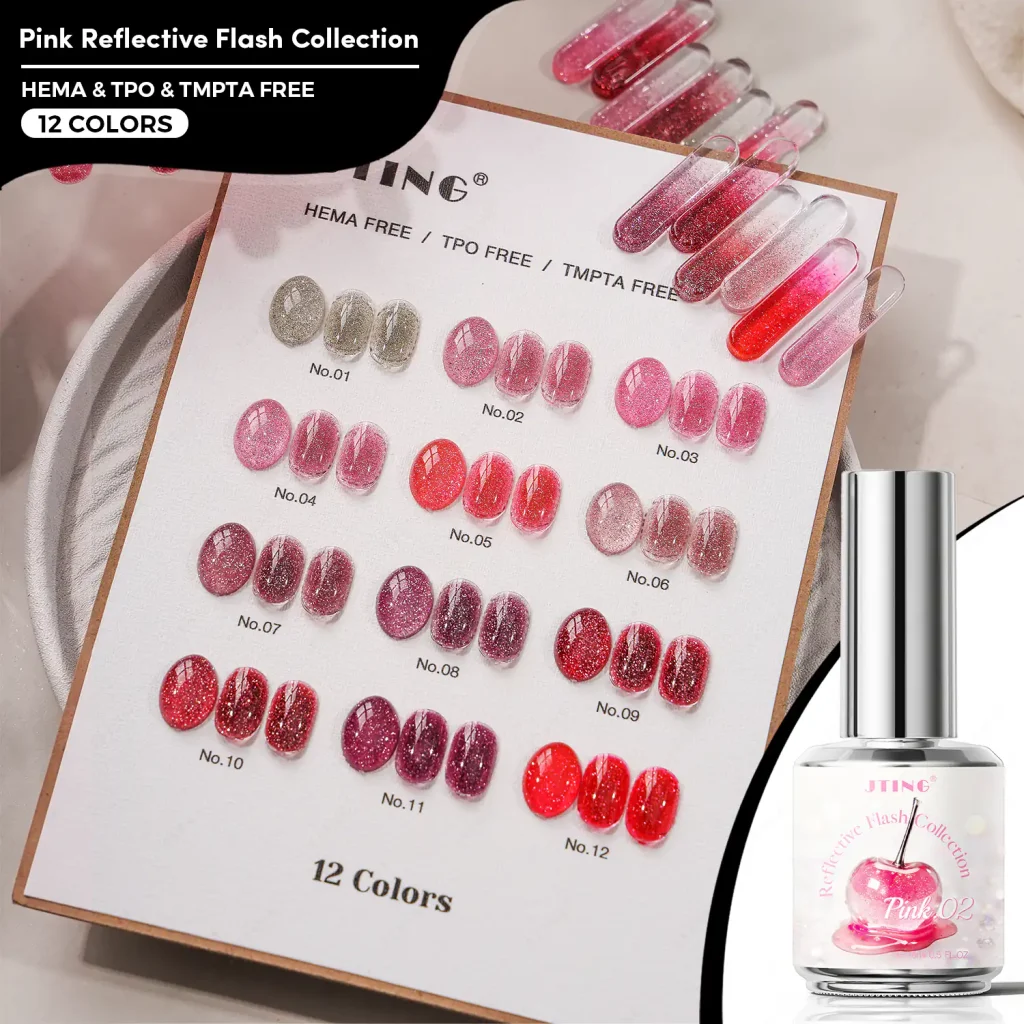
For a professional holiday assortment, assign every product a job: background coverage, sheer foundation, precise linework, sparkle or final surface finish. This prevents buying several similar effects while overlooking the white needed for clear snowflakes or the neutral base needed for restrained French designs. JTING's gel nail polish color collections bring together color ranges to shortlist for your holiday palette. Compare the selected shades and coverage on finished samples.
- For visible Christmas identity: pair a red or forest-green background with a white motif, a painted bow or a controlled gold-colored accent.
- For understated seasonal services: use a translucent neutral with a narrow festive tip, a tiny star or a limited sparkle gradient.
- For evening impact: compare ordinary glitter and reflective finishes under the lighting customers will encounter, rather than treating every sparkling gel as interchangeable.
- For repeatable salon delivery: offer a simple version and an illustrated upgrade using the same approved palette, with complexity determined by actual technician trials.
Before committing to a range, make one finished sample of each intended design, including its foundation and top coat. Review the result at normal viewing distance, not only through a close-up camera. A design can be attractive on a display tip yet lose its detail on a short natural nail. The buying decision should follow the usable service, not the bottle appearance alone.
02. Christmas vs. New Year's Eve Nails: Different Occasions, Different Priorities
Christmas nail designs can communicate the occasion through familiar symbols: candy stripes, decorated trees, wrapped gifts or snowflakes. New Year's Eve nails do not need literal calendar graphics to feel appropriate. A dark background, a crisp metallic-looking line or concentrated sparkle can create an evening direction without a seasonal illustration. Here, New Year's Eve means December 31, not Lunar New Year.
| Planning Question | Christmas Direction | New Year's Eve Direction |
|---|---|---|
| What Makes It Recognizable? | Festive colors, ribbon shapes, stripes and winter motifs. | Evening contrast, luminous accents and celebratory sparkle. |
| Where Can Detail Sit? | One illustrated feature nail beside coordinated solid colors. | A reflective accent, fine border or concentrated sparkling area. |
| What Should Samples Demonstrate? | Motif clarity, white coverage and readable color contrast. | Appearance in ambient light and under direct illumination. |
| What Can Continue Into January? | Burgundy, forest green, neutrals and motifs that are not explicitly Christmas-themed. | Dark solids, fine shimmer and restrained metallic-looking details. |
Plan for the Customer's Calendar
Ask whether the manicure is intended for a Christmas gathering, a workplace event, a December 31 party or several occasions. A salon serving clients with several events may need a versatile neutral-and-red option alongside more literal Christmas artwork. A salon supplier can support that choice by showing related designs side by side, rather than dividing its display into two unrelated collections.
One illustrative bridge is a deep wine base with a small champagne-colored line. Present it with a bow for Christmas or a clean geometric accent for New Year's Eve. Develop each version as a complete service sample with the appropriate preparation and layer sequence. For brands, the same approach separates reusable core colors from highly seasonal artwork in campaign materials.
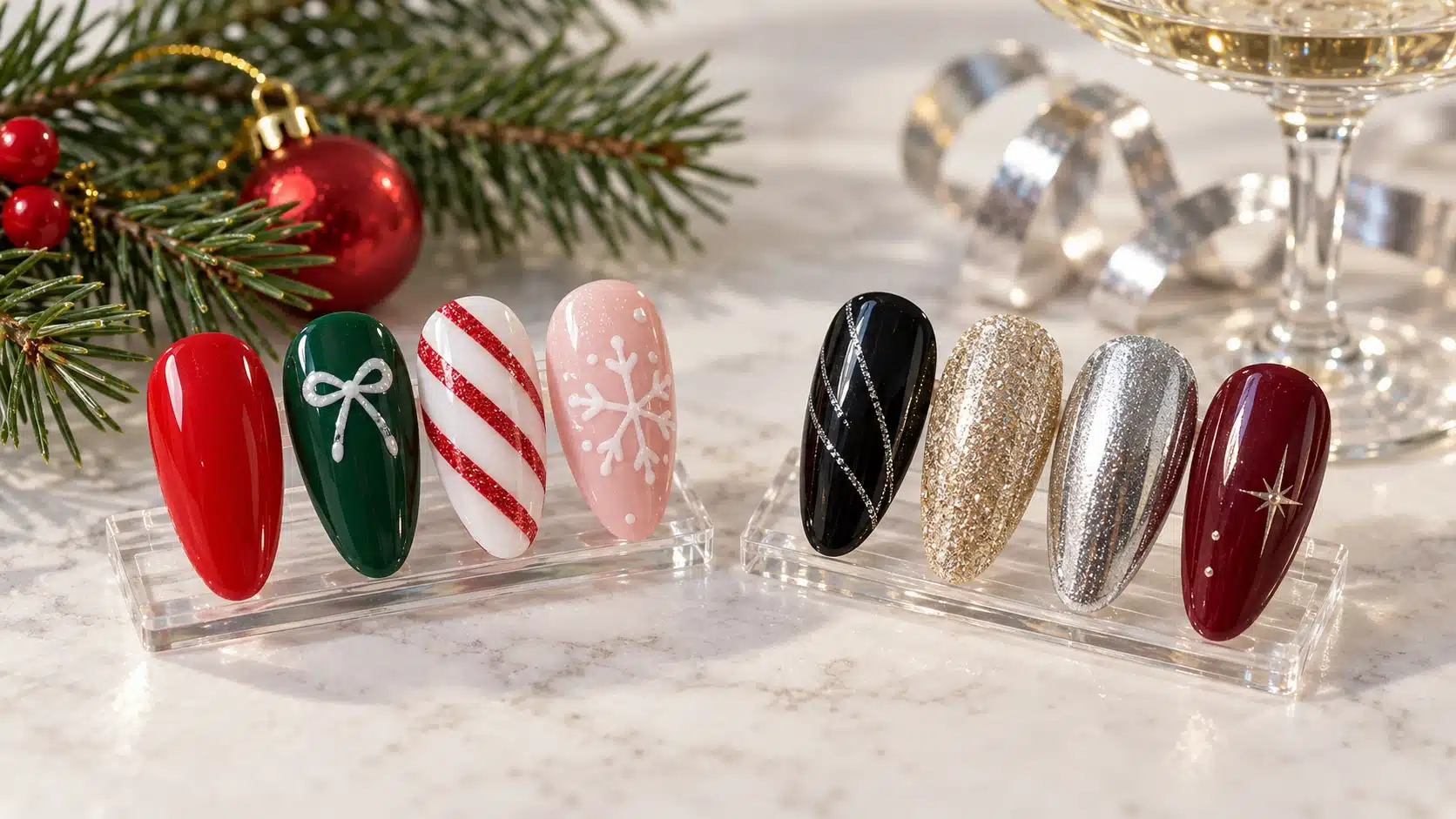
Christmas ribbon and candy stripe nail designs beside metallic and reflective New Year's Eve accents
03. Classic Red, Burgundy and Green Gel Nail Colors
A coordinated palette should contain useful differences, not simply several attractive reds. Start with the depth, opacity and undertone each design requires. Then assess the finished color over its intended foundation. A transparent wine shade and an opaque burgundy may look related in a bottle photograph but produce very different results in a French tip, a full-color service or a layered accent.
Reds and Greens: Separate the Background from the Detail
A clean red supports candy stripes and traditional gift motifs; a deeper red supports a quieter evening service. Forest green creates a different relationship with white than a bright green does. Compare these combinations on the same nail shape, with the same finish, to avoid confusing a lighting difference with a shade difference. For fine holly leaves or tiny tree branches, assess the art material separately: a full-coverage color gel is not automatically the best choice for a narrow, stable line.
Build the initial color board around finished combinations: red with white stripes, burgundy with a restrained accent, and green with a pale or metallic detail. Compare them side by side under the same light. Keep a second red only if its undertone, coverage or intended service adds a useful difference.
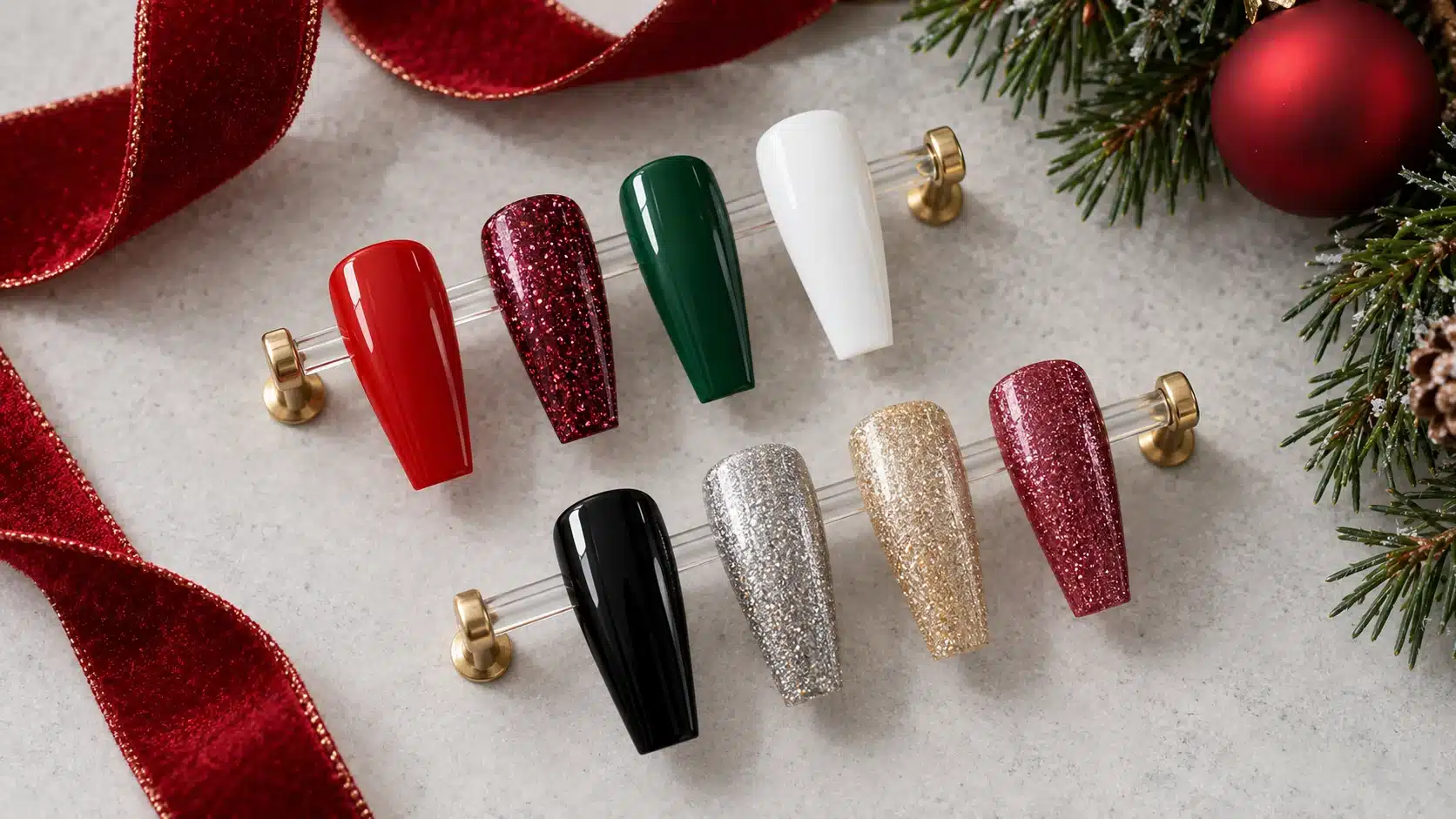
Long coffin nail swatches in red, green, white, black, silver and champagne for a holiday palette
04. Snowy Whites, Icy Colors and Neutral Foundations
Whites and Neutrals: Choose Coverage Deliberately
Opaque white can define snowflakes, snowy tips and candy stripes. A milky white or translucent nude serves another purpose: softening the overall manicure while leaving space around the artwork. Do not use those descriptions as interchangeable purchasing terms. Ask for physical comparisons showing coverage at the manufacturer's prescribed application thickness, and assess whether the foundation complements the customer's natural nail appearance.
For an icy direction, compare pale blue or cool silver accents with the selected white. A cool background and a warm cream-colored detail create a different result from two closely matched cool tones. Keep one finished motif in the comparison so the decision concerns legibility as well as color preference.
A translucent neutral also needs approval at the intended coverage. Review its warmth, visible natural-nail color and relationship to the decorative white. The foundation should support the design across the nail shapes in the menu, rather than looking right only on an opaque display tip.
05. Gold, Silver and Dark Colors for Evening Contrast
Gold, Silver and Dark Anchors: Specify the Visual Result
Gold-colored detail may mean fine glitter, a metallic painting material or another finish route. State whether the objective is scattered sparkle, an opaque painted line or a highly reflective surface. Similarly, compare silver beside the intended white and neutral tones before approval. Black, charcoal and midnight-blue directions can support New Year's Eve concepts, but the chosen dark color must still allow decorative edges and fine lines to remain readable.
For procurement, label each sample by its role: main color, supporting color, foundation or accent. Record the approved base and finish alongside it. An illustrative compact palette might combine a red, a deep green, an opaque white, a translucent neutral and a sparkling accent. Choose actual shades and quantities around the services you plan to offer. Expand only when an additional shade enables a distinct service rather than duplicating an existing look.
Choose the dark anchor beside the metal tone before adding extra colors. A cool silver against midnight blue can read differently from champagne against wine. Test whether the accent is visible at its actual size: a fine border may need clearer contrast than a full metallic nail. This comparison can eliminate unnecessary near-duplicate purchases.
06. Choose the Right Finish: Solid Color, Jelly, Cat Eye, Glitter or Chrome
Finish selection changes both the visual message and the materials needed to reproduce it. A glossy solid can give a painted motif a clear background. Fine glitter adds scattered points of light. A reflective formula should be evaluated under direct illumination as well as ordinary room light. None of these descriptions tells a buyer everything about opacity, particle distribution or application behavior.
| Finish or Material | Useful Design Role | What to Check on Samples |
|---|---|---|
| Solid Color Gel | Backgrounds, French tips and coordinated plain nails. | Coverage, edge control and appearance with the approved finish. |
| Fine Glitter Gel | Soft sparkle, gradients and small festive accents. | Particle visibility, transparency and whether the result obscures linework. |
| Jelly Color | Translucent foundations, tinted accents and selected layered designs. | How much underlying color remains visible after the complete application. |
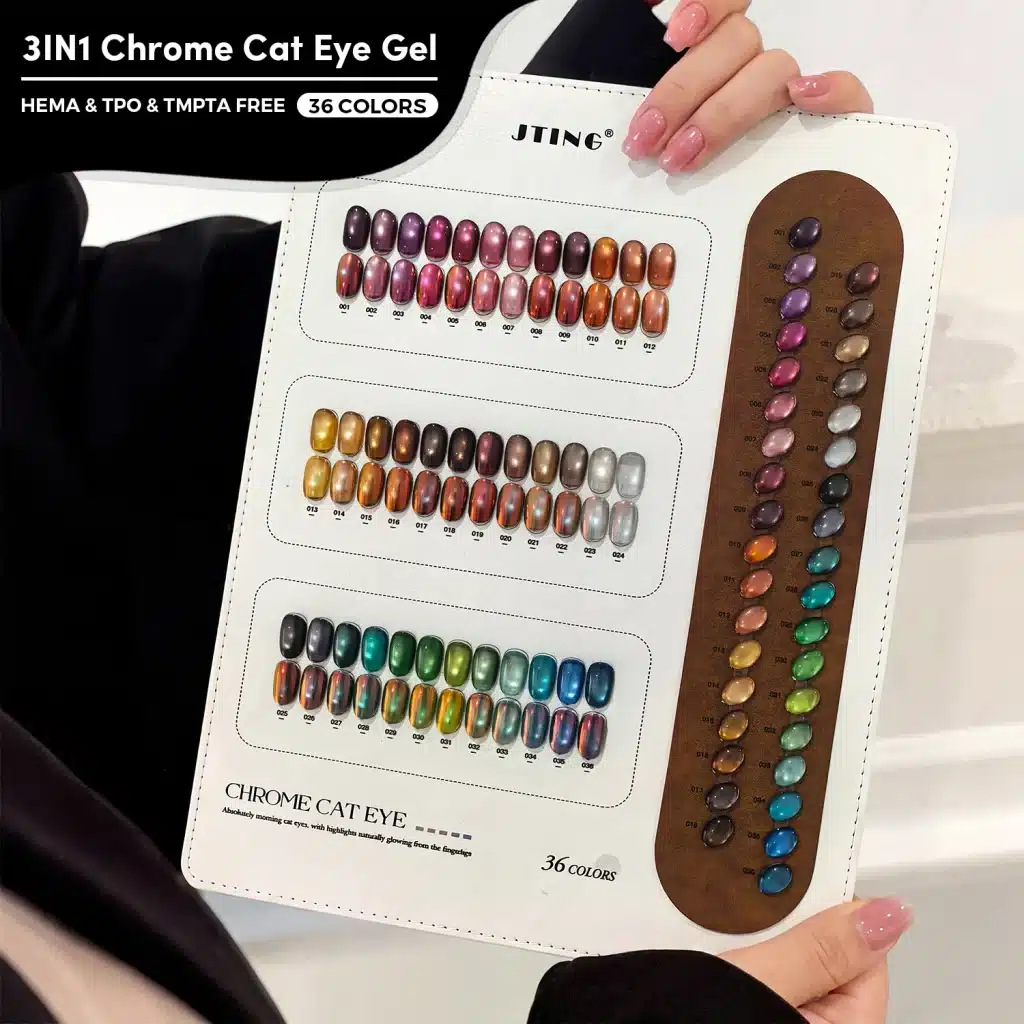
| Cat Eye Gel | Moving light, jewel-tone accents and soft luminous designs. | The required magnet, background and highlight on the intended nail shape. |
| Reflective Gel | Light-responsive accents for party-focused designs. | Ambient and direct-light appearance, surface texture and finishing requirements. |
| Chrome Effect | A mirror-like tip or metallic-looking accent through the selected application route. | Whether the result requires powder, a dedicated gel or a different detail material. |
| Liner or Painting Gel | Ribbons, candy stripes, snowflakes and narrow borders. | Line definition, pigment behavior and suitability for the intended technique. |
| Compatible Gloss or Matte Finish | A smooth glossy presentation or a deliberately muted surface. | Compatibility, detail visibility and the intended final appearance. |
Choose Detail Materials by the Mark They Need to Make
A bow outline needs controlled curves; a filled tree silhouette needs an even area of color. Compare liner gel for narrow decorative work, while checking the selected material's instructions and suitability for filled areas. Do not assume a material intended for linework is appropriate for thick decorative buildup. Select gloss or matte for the intended appearance, then follow the finishing product's specified application and curing steps.
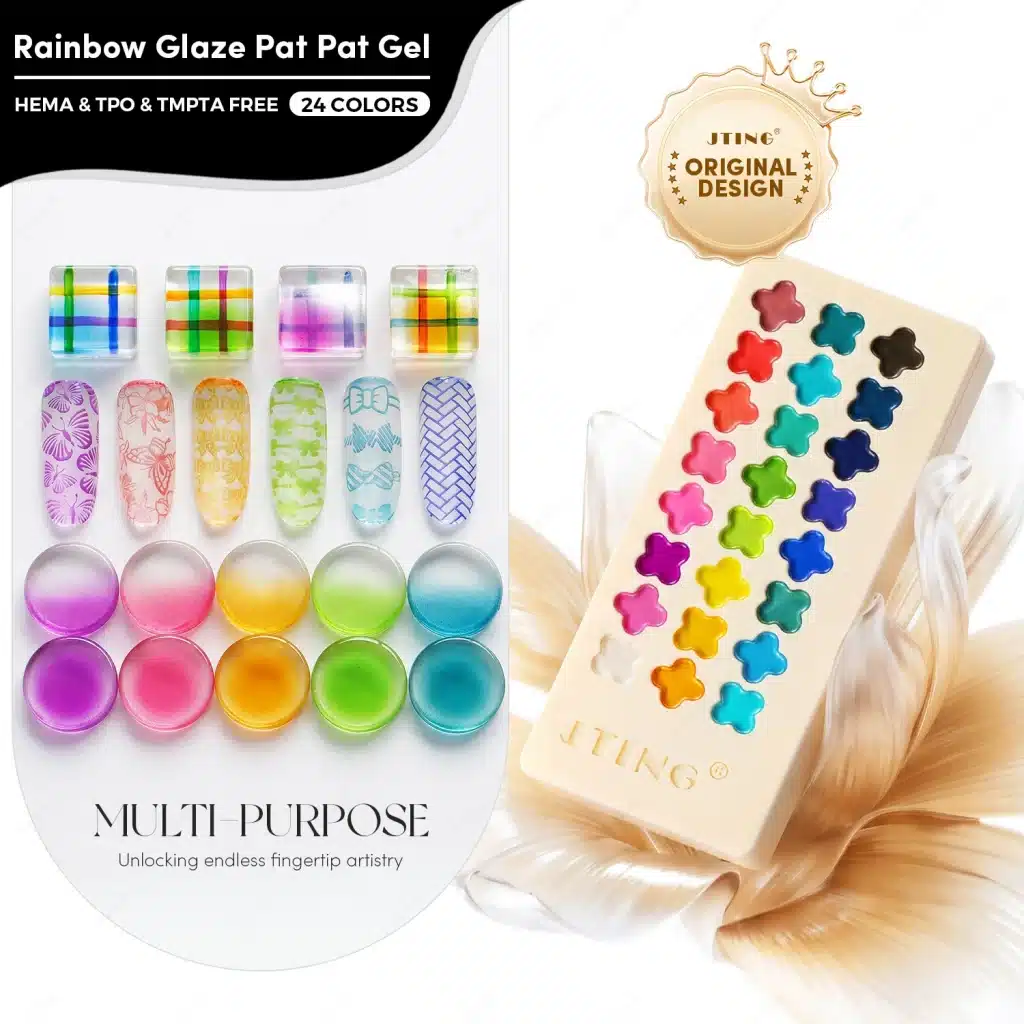
Translucency is another independent choice. A jelly base can support a delicate star or a colored glass-like accent, whereas an opaque base gives a white motif a more uniform background. The jelly gel nail polish guide explains that distinction. Choose clarity for the intended design rather than adding a sheer layer simply because a photograph looks dimensional.
Evaluate the complete professional system. Dense dark colors and particle-rich gels need the prescribed layer application and full curing, not thicker coats or arbitrary extra exposure. Keep uncured material away from skin, and follow the selected product instructions for foundation, decoration and finish. A finished sample should demonstrate an approved process as well as an appealing photograph.
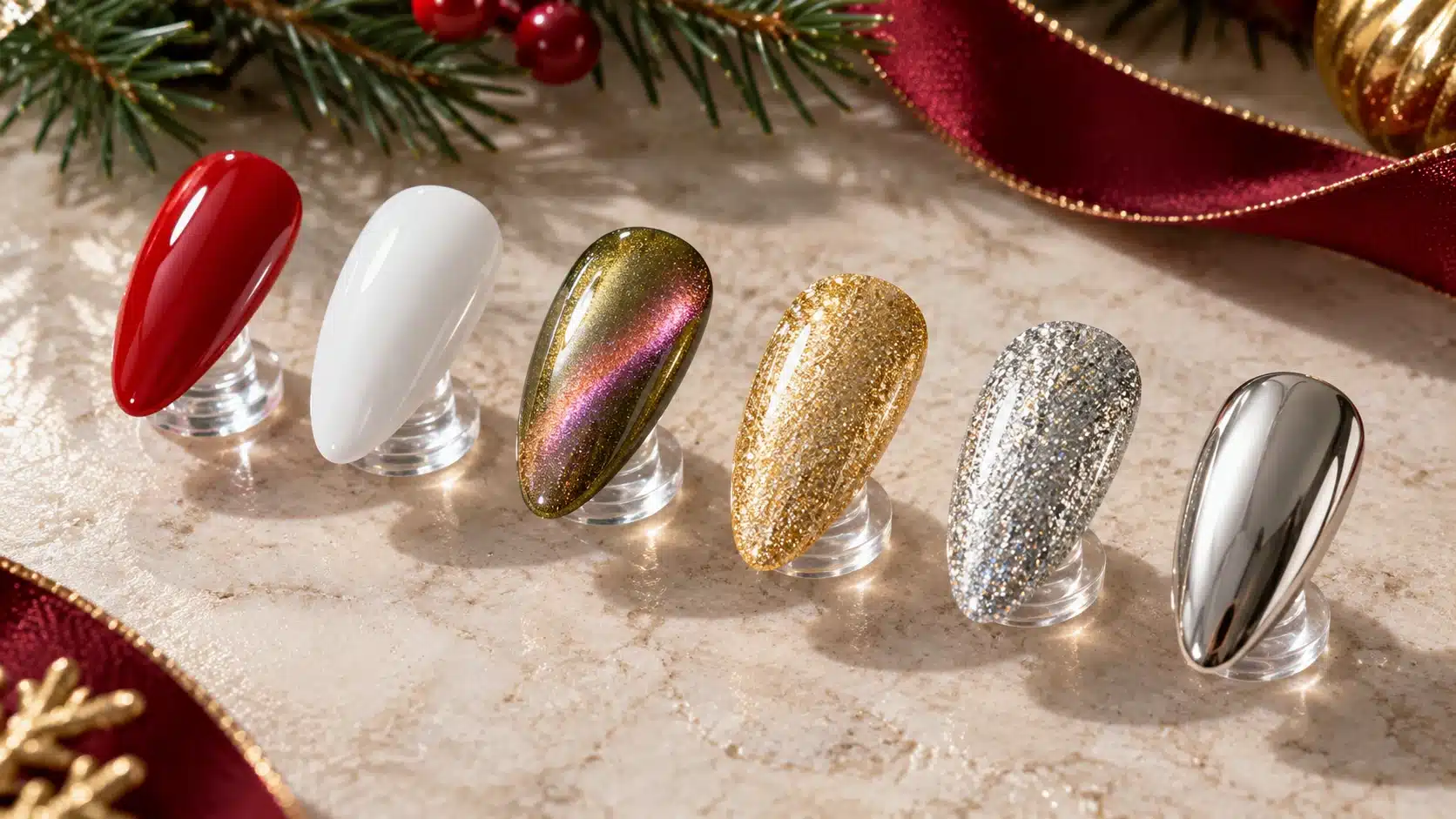
Solid color, magnetic, glitter, reflective and mirror-finish nail samples on a festive worktable
07. Conventional Glitter vs. Reflective Gel for Holiday Nails
Choose between a quiet sparkling texture and a stronger direct-light response before selecting the shade. The two finishes can look similar in promotional images, but customers may see a different result under everyday lighting. Ask what the customer should notice in ordinary light first, then decide whether a flash demonstration adds relevant information.
Compare Color and Sparkle under Both Lighting Conditions
A flash photograph can make an accent appear much brighter than it does during a consultation. Show both conditions when assessing reflective gel options, and keep the underlying shade visible in the sample record. This helps a distributor describe the finish accurately and lets a salon explain what the client will see in daylight, at dinner and in direct-light photography without promising identical results in every setting.
For a dedicated reflective collection, compare JTING's D16 24-color Reflective Disco Gel collection with your chosen solid-color palette. Review the individual shade in ambient light and under direct flash before selecting it for a party accent. This is a reflective collection, not a substitute for conventional glitter or magnetic styling.
For a sparkle fade, check how particles distribute across the transparent part of the sample. For a fuller accent, check whether the intended coverage can be achieved within the prescribed application. Neither role should depend on applying an oversized layer. Keep the ordinary-light swatch beside the proposed full-color partner so its undertone is visible.
Include both types only when the difference supports a separate service or customer need. Label their images consistently and show the same sample in each lighting view. This makes a reflective option a deliberate addition rather than a second bottle purchased because its photograph looked brighter.
08. Classic Christmas Motifs: Bows, Snowflakes, Trees and Holly
A useful Christmas design menu translates recognizable motifs into different levels of service. The following directions pair a visual idea with product choices and an adaptation. Approve each on the nail length and shape your customers actually request; enlarging a reference image does not create more working space on the nail.
Wrapped Gifts and Painted Bows
Combine a solid color base with intersecting ribbon lines and a flat painted bow. Red with a cream-colored ribbon reads differently from deep green with a gold-colored ribbon, so approve the whole pairing rather than each bottle separately. Keep the bow's crossing point clear and scale the loops to the available nail area. A short-nail version can use a single ribbon line and small bow near one side. Flat linework keeps this direction distinct from raised decorative services.
Snowflakes on a Winter Background
Choose a contrasting base and a white detail material capable of producing separated branches. A snowflake does not need to fill the nail: one readable motif often works better than several overlapping shapes. For a shorter service, use a simple central cross with restrained branching, surrounded by small dots only where space permits. For a quieter presentation, replace the dark background with a milky foundation and assess whether the white remains visible under the selected finish.
Christmas Trees and Bauble Accents
A tree can be a compact green silhouette, a series of clean branches or a narrow triangular outline. Select the material according to whether the design requires a filled shape or a fine mark. A small sparkling dot can suggest a bauble without introducing separate decorations. On short nails, keep the tree narrow and leave clear space around its edges. For a coordinated salon display, show the illustrated nail beside plain green and neutral nails, not several competing motifs.
Holly Leaves and Berry Details
Pair green leaf shapes and small red dots with a pale or translucent foundation. The color contrast creates the identity, so the leaves need not be botanically elaborate. Check that the red remains distinct beside the green and does not disappear into a dark background. A corner placement suits customers who want visible seasonal detail without full coverage. For smaller nails, simplify to two leaf shapes and a compact berry grouping rather than shrinking an intricate cluster until its edges merge.
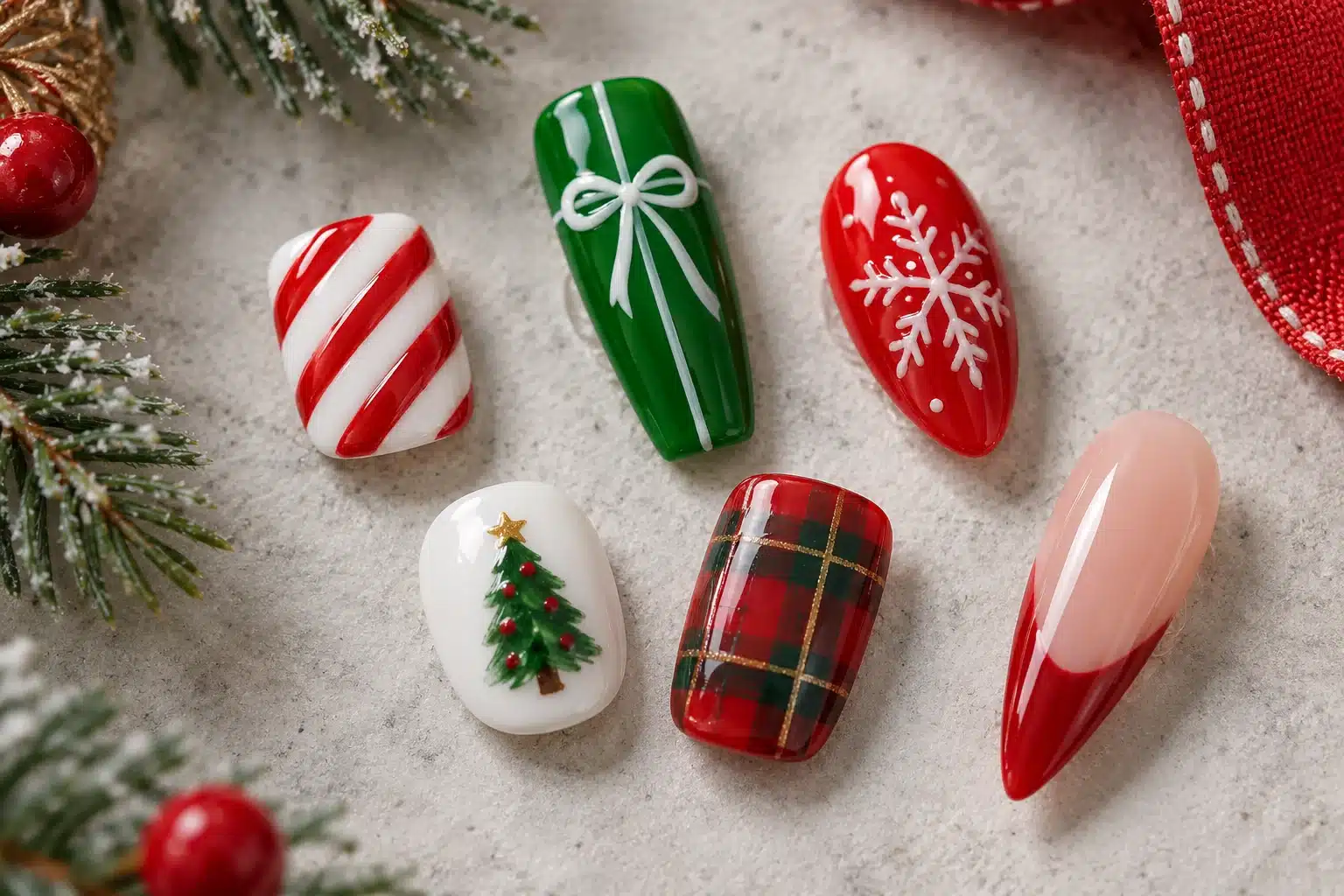
Christmas candy stripes, ribbon, snowflake, tree, plaid and red French designs on varied nail shapes
09. Candy Cane Stripes and Christmas Plaid Nails
Stripes and plaid share a small group of useful products but require different visual planning. Candy stripes rely on clear spacing and a consistent diagonal direction. Plaid combines wider bands with finer crossings, so the order of the marks matters as much as the palette. Approve both on the actual nail size before treating them as equally simple services.
For a seasonal linework selection, consider JTING's Christmas liner gel range with 36 color options. The range includes fine-shimmer effects; choose the actual shade and opacity for the motif. A sparkling ribbon and a crisp opaque snowflake need different visual characteristics, so use the color chart to shortlist and the finished design to confirm the choice.
Candy Cane Stripes
Use an opaque white background with controlled red diagonal lines, or reverse the relationship for a red-led design. Choose a linework material that holds a clean edge at the intended width. On short Christmas nails, a few clearly separated stripes are more legible than a tightly packed pattern. For an entry-level menu option, confine the stripes to one feature nail and repeat the red on the others. A narrow striped French tip offers a softer adaptation without losing the candy-cane reference.
Heritage Plaid
Build a plaid direction around a dominant background, wider contrasting bands and a limited number of fine crossing lines. Red, deep green and a pale accent create one possible Christmas interpretation; muted neutrals create a less literal version. Select a detail material with predictable line placement and test the sequence on display tips before adding the design to a menu. Short nails benefit from fewer crossings. Offer a single plaid accent if full-hand repetition exceeds the salon's planned service complexity.
Use a clean practice tip to compare the same brush loading across several strokes. If the line becomes wider at each crossing, revise the technique or material choice before increasing the number of colors. For a compact salon menu, one stripe accent and one plaid accent can provide useful alternatives while sharing the surrounding plain-color nails.
10. Christmas French Tips and Glitter Edges
Christmas French Tips
Replace the conventional white tip with red or green, then add a small contrasting line or a single festive detail. The foundation should complement the natural nail appearance, while the tip width should suit the available free edge. A shallow curve can keep a short nail visually balanced; a longer nail can accommodate a more pronounced tip without crowding the base. JTING's French manicure gel guide provides a related framework for planning the foundation, smile line and professional service.
Red Glitter with a Clean Solid Contrast
Red glitter nails can look coordinated without adding an illustrated character. Pair an approved red sparkle with a related solid, checking whether the two share compatible undertones in ordinary light. Select conventional glitter for the desired everyday appearance or evaluate a reflective route when direct-light response is part of the brief. Use the sparkling material as supplied and instructed; do not force greater density by loading an unusually thick layer. An accent nail or narrow tip adapts the concept to understated services.
When comparing these directions, separate motif difficulty from product count. A detailed plaid may use fewer colors than a simple mixed-color set but require more controlled brushwork. Photograph the approved version and record the materials used so that training, consultation and purchasing refer to the same design.
Keep a plain French reference beside the decorated version. This reveals whether the additional line or glitter improves the design or simply makes the edge heavier. On a short nail, consider a shallow colored tip or a narrow corner accent; on a longer nail, preserve enough neutral area to keep the French proportion recognizable. Evaluate the finish at the sidewalls as well as face-on.
11. Understated Holiday Nails: Four Low-Key Design Directions
Simple Christmas nails should feel intentional, not unfinished. Reduce the amount of decoration while preserving a clear relationship between foundation, accent and placement. These directions can serve customers who want seasonal detail for work or family events without a full illustrated manicure. They also help professional buyers assess which products remain useful outside December.
1. A Festive Micro-French
Use a translucent neutral foundation with a fine red, green or sparkling tip. Choose the foundation for its appearance on the intended nail, not solely from a color chart. The decorative material must create a continuous narrow edge without requiring excessive buildup. On very short nails, assess whether a tipped design is visually appropriate at all; a small side accent may be clearer. Keep a consistent tip proportion across the hand rather than forcing the same absolute width onto differently sized nails.
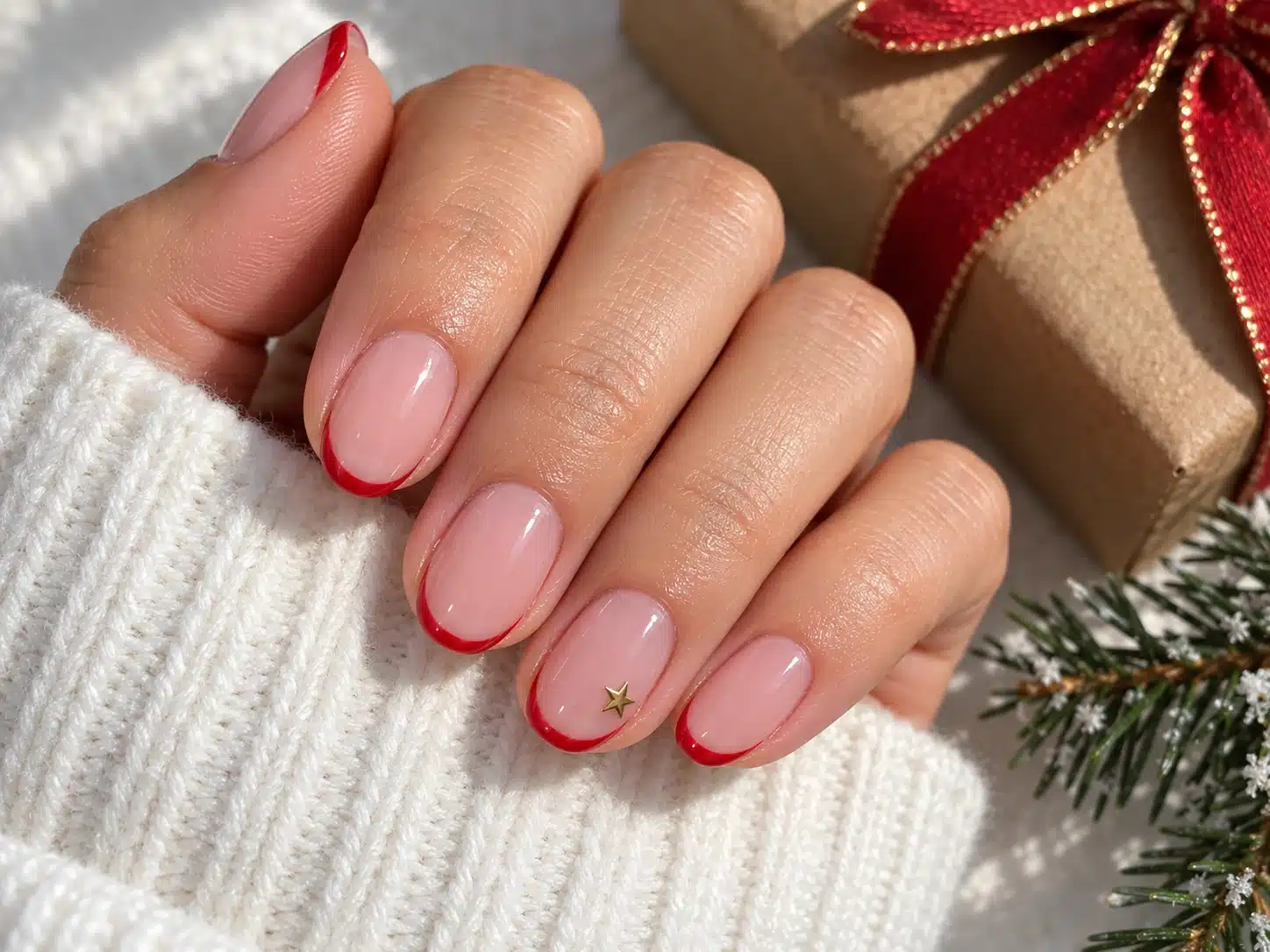
Short oval blush nails with narrow red French tips and a small gold star beside Christmas wrapping
2. One Small Star or Snowflake
Place one fine motif over a milky or nude-looking background and leave the remaining area clear. White creates a subtle relationship on a pale base, while a gold-colored detail creates a warmer accent. Check visibility at normal consultation distance before approving the subtle version. For a short appointment format, a simple star may be more reproducible than a branched snowflake. Make the motif an optional feature, allowing the same foundation shade to support both a plain service and an illustrated upgrade.
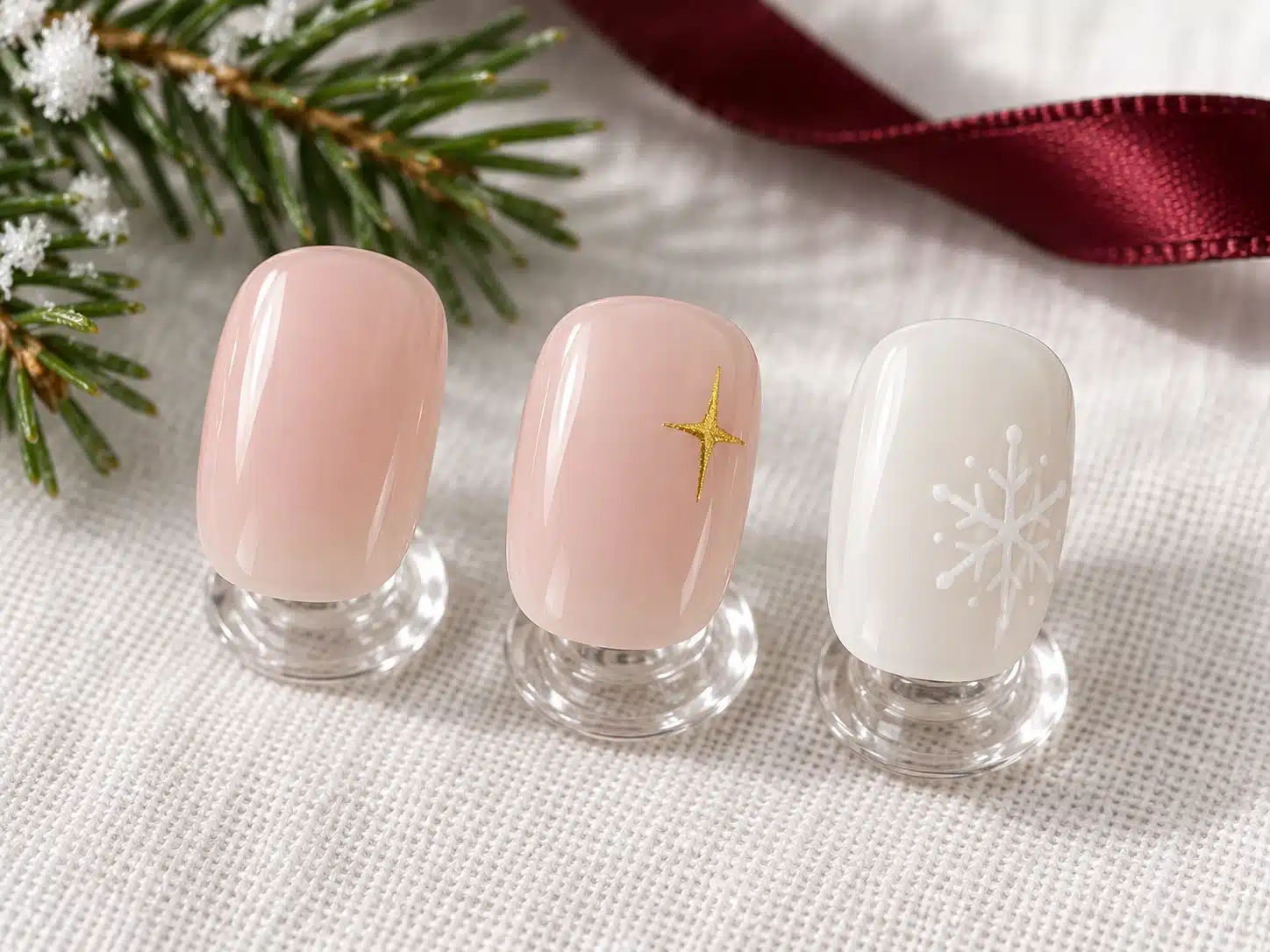
Short blush and milky-white nail samples with a small gold star and white snowflake
3. A Restrained Sparkle Fade
Concentrate fine sparkle near the tip and leave the foundation visible toward the cuticle area. Select a material whose transparency and particle distribution support that visual transition, following its application instructions. Large scattered particles and a fine shimmer will not create the same fade. For short nails, keep the concentrated area shallow so it does not become full coverage. Compare the finished sample in ambient light before deciding whether a reflective effect adds useful value to this deliberately quiet direction.
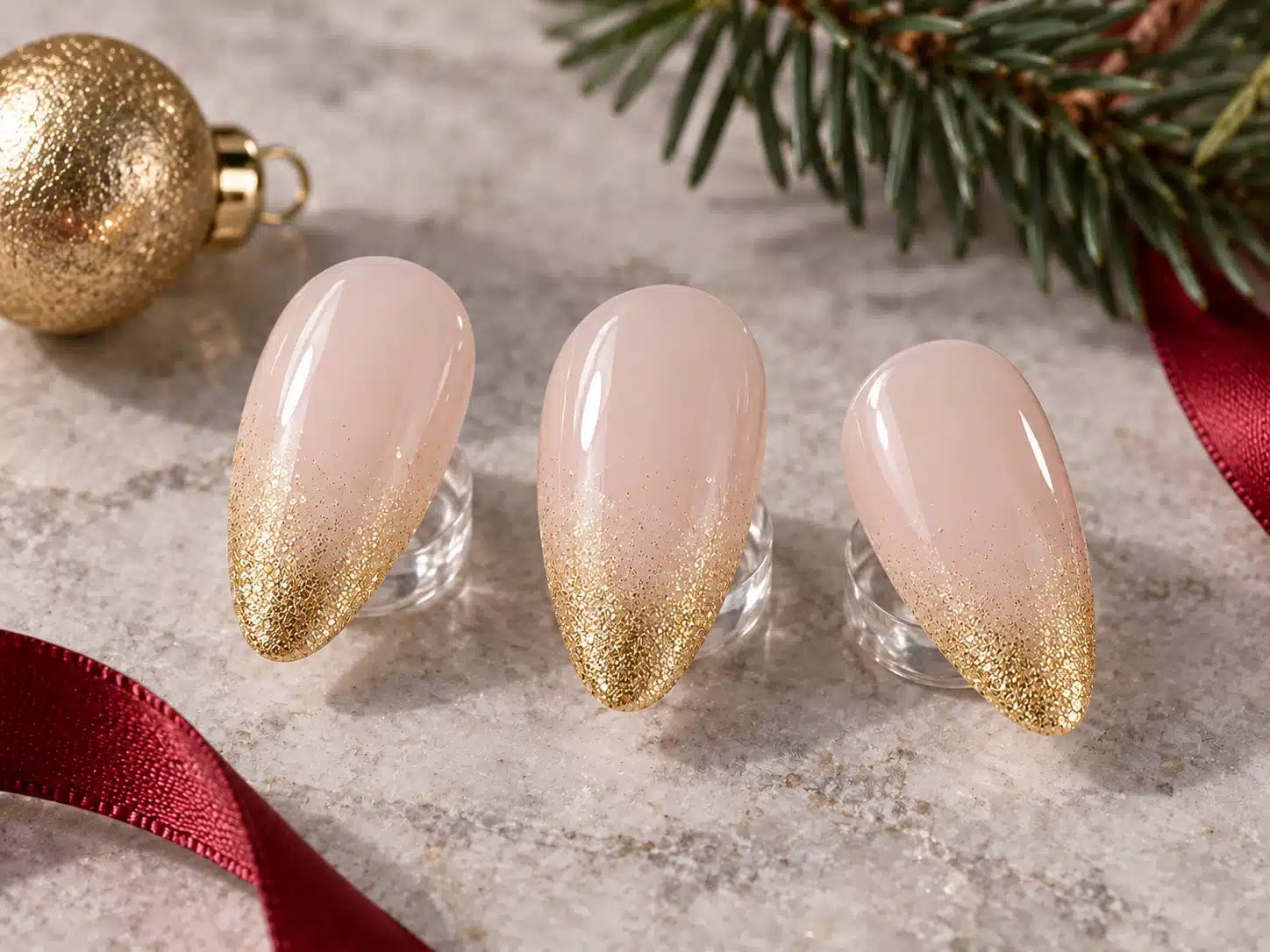
Almond blush nail samples with fine gold glitter fading from the tips toward a clear foundation
4. A Deep Solid with One Fine Accent
Choose a wine, forest-green or similarly deep color direction, then add a narrow line, a small corner detail or a minimal border on one nail. This keeps the color central while giving the service a seasonal cue. Use a contrasting detail material that stays readable without becoming the dominant feature. For a more general winter option, omit literal Christmas symbols. Buyers can then evaluate the base color for continued use after the holiday period rather than assigning the whole combination to a short campaign.
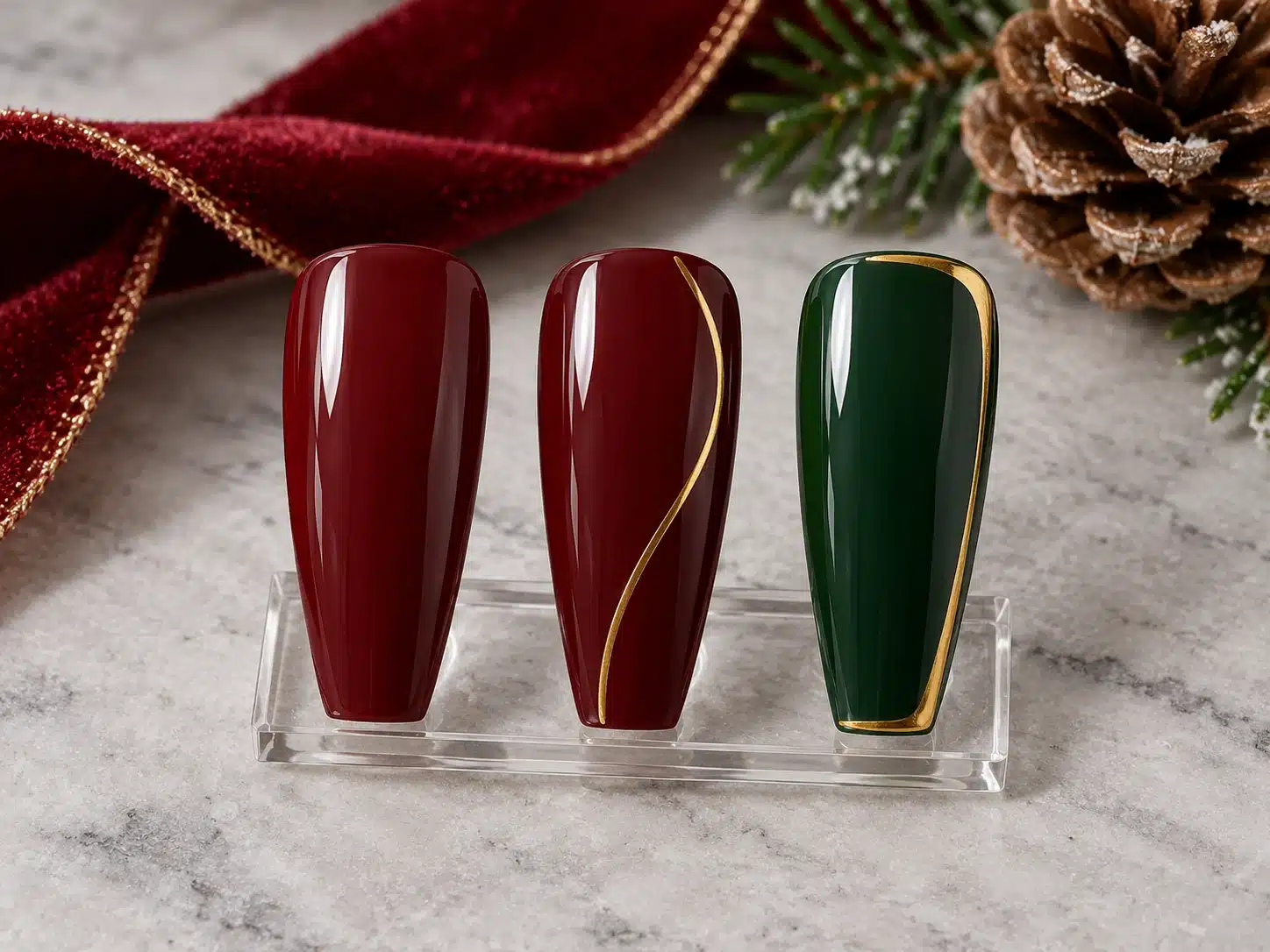
Wine and forest-green coffin nail samples with restrained gold lines and a corner border
For each understated option, show customers both the plain foundation and the decorated result. That comparison makes the service choice concrete and gives salon teams a common reference. Brands and distributors can use the same distinction when selecting samples: prioritize a reliable, versatile base palette, then add the specific art or sparkle materials needed to create genuinely different holiday looks.
12. New Year's Eve Nails: Metallic Shine and Party Effects
New Year's Eve gel nails can share a palette with Christmas without sharing its symbols. Remove the candy stripes or holly, retain the red, green or champagne, and change where the light sits. A metallic tip, a glitter accent or a moving magnetic highlight can make the same color family suitable for a different service. This is useful for buyers building a coordinated range rather than two collections with little connection.
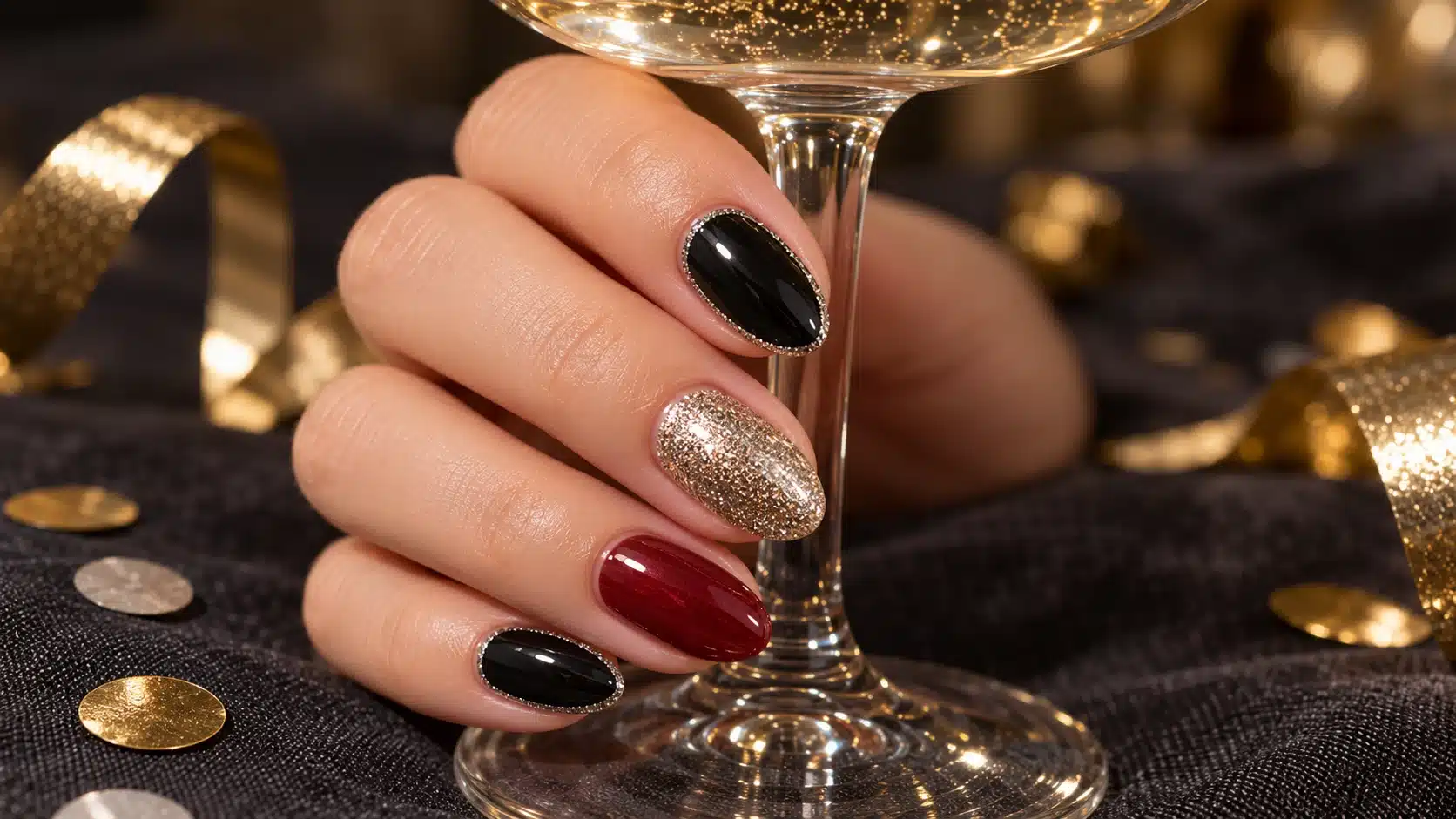
Black, champagne glitter and wine-colored party nails holding a champagne coupe
Four Party Directions with Different Product Requirements
Midnight with Silver Detail
Use an opaque black, deep blue or charcoal background with a narrow silver accent. Choose whether that accent should be a mirror-like surface, a metallic painted line or visible glitter. These require different materials and procedures. A thin silver outline can suit a restrained service; a full metallic accent nail creates a stronger contrast without adding detail to every finger.
Champagne Sparkle
Build the look around a warm pale metallic tone, then decide how much base color should remain visible. A sheer glitter overlay over nude looks different from a dense glitter color. For purchasing, compare coverage on a finished tip and note whether the displayed result needs a separate base shade. Keep champagne and cool silver distinct when planning the palette.
Ruby or Emerald Moving Light
A colored magnetic finish can carry the design without extra motifs. Use one clearly demonstrated light arrangement, then coordinate the other nails with a plain shade or a quieter version of the same color story. Approve the underlying color when the highlight moves away; a dramatic bright spot alone does not show the ordinary-light appearance a salon needs to demonstrate to its clients.
Stars and Fine Firework Lines
Small starbursts and radiating lines can suggest a celebration without spelling out a year. Plan their size around the actual nail area, leaving space between individual strokes. Use a suitable liner or painting gel for the chosen finish. A simpler version can place one star on an accent nail instead of compressing a complete firework display onto every finger.
For reflective finishes, show an ordinary-light view beside the direct-light presentation. Reflective glitter can become much more conspicuous in a flash photograph, while a client in diffuse indoor light may see a quieter finish. That change is part of the product description, not something to hide. Ordinary glitter, reflective glitter and magnetic particles should remain separate selection points even when one product combines them.
Choose the Metallic Route before Choosing the Color
A polished chrome effect is not interchangeable with a metallic painting gel or a silver glitter gel. Powder application relies on the appropriate surface and sealing procedure. A metallic drawing material is selected for the detail it can form. Glitter contributes separate bright particles. Decide which appearance is essential, then select its material route. The chrome nails guide explains those differences in more detail.
For fine metallic lines rather than a full powder-treated surface, JTING's gold and silver Mirror Liner Gel is a focused option to evaluate for star outlines, narrow borders and ribbon details. Compare line continuity and metallic appearance on the chosen background. A metallic liner and a chrome-powder system have different application routes; choose by the finished detail you need.
A useful sales sample pairs one expressive finish with a plain-color alternative under the same light. This lets a salon supplier explain the upgrade in terms of appearance and work required, rather than implying that more sparkle is always the better choice.
13. Holiday Cat Eye Nails: Color, Light and Accent Placement
Holiday cat eye nails do not need to be a separate formula category. A magnetic finish becomes seasonal through its color, placement and relationship with other details. For a Christmas service, a deep green accent can sit beside a small gold star. For a New Year's Eve party look, that same color family can be shown without the star and with a stronger light pattern. Plan the design change instead of buying near-identical effects under different holiday names.
Keep the Magnetic Effect Readable
Choose one main feature for each sample. A wide magnetic glow can be the focal point; a fine outline should support it rather than conceal the light. If a dense painted snowflake covers most of the magnetic surface, the buyer may no longer see a meaningful difference from an ordinary colored base. Move the detail to the side, simplify it or reserve it for a neighboring plain-color nail.
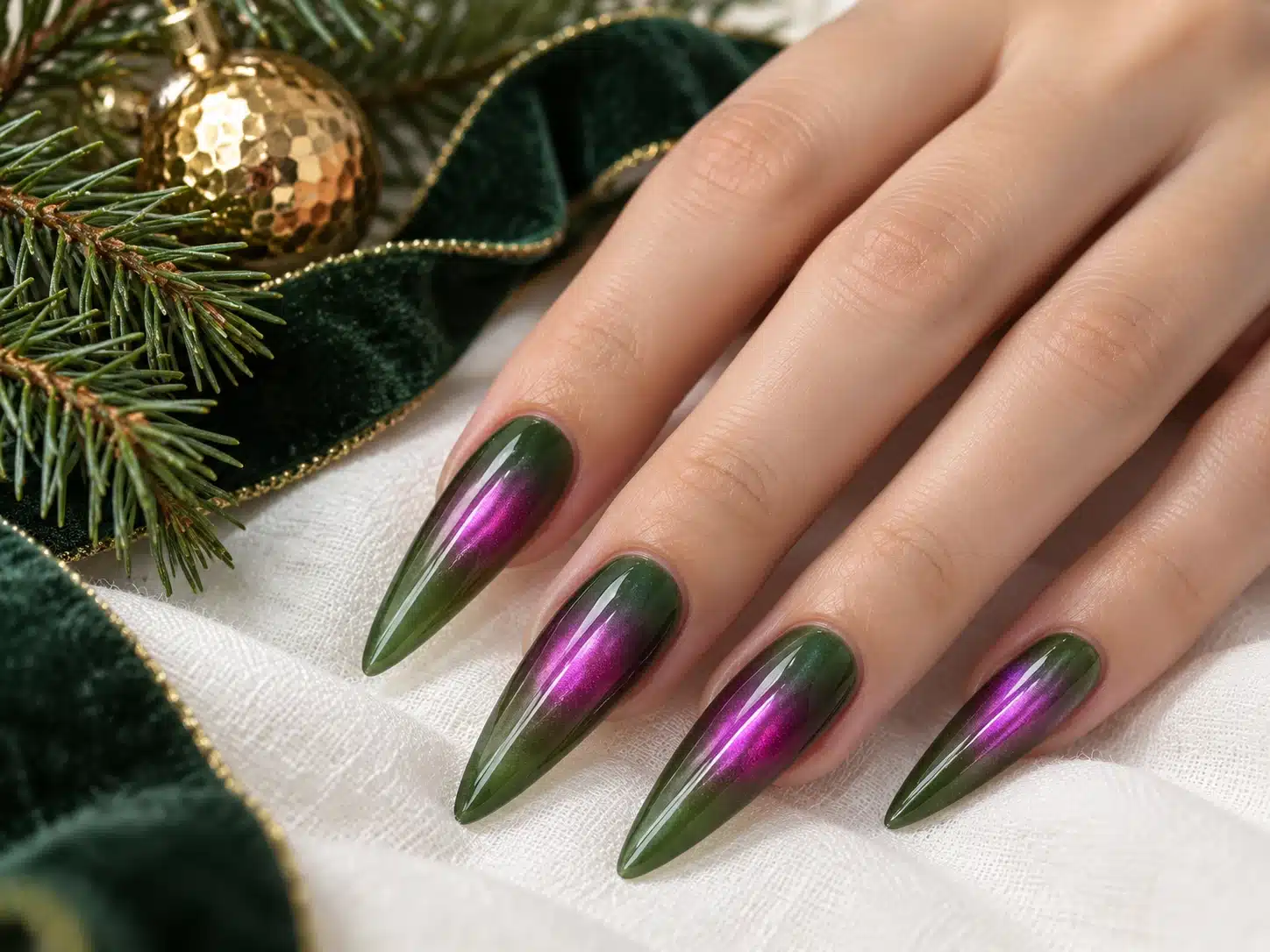
Long pointed olive-green Glass Aurora cat eye nails with pink-violet highlights in a Christmas setting
Different layers also change what remains visible. A translucent colored overlay can alter the tint, but it may soften the highlight. An opaque art product can block it locally. Compare the complete finish, including the selected top coat, instead of approving the magnetic stage and assuming the final design will look identical. The velvet and glass cat eye guide covers broad glows, colored depth and magnetic sample comparisons.
Two JTING Collections to Consider for Different Roles
The 16-color Glass Aurora Cat Eye collection is a starting point when the brief calls for colored depth and shifting magnetic highlights. Select the actual shade against the proposed holiday palette. Use the finished swatch to match the requested undertone, transparency and highlight on the chosen background.
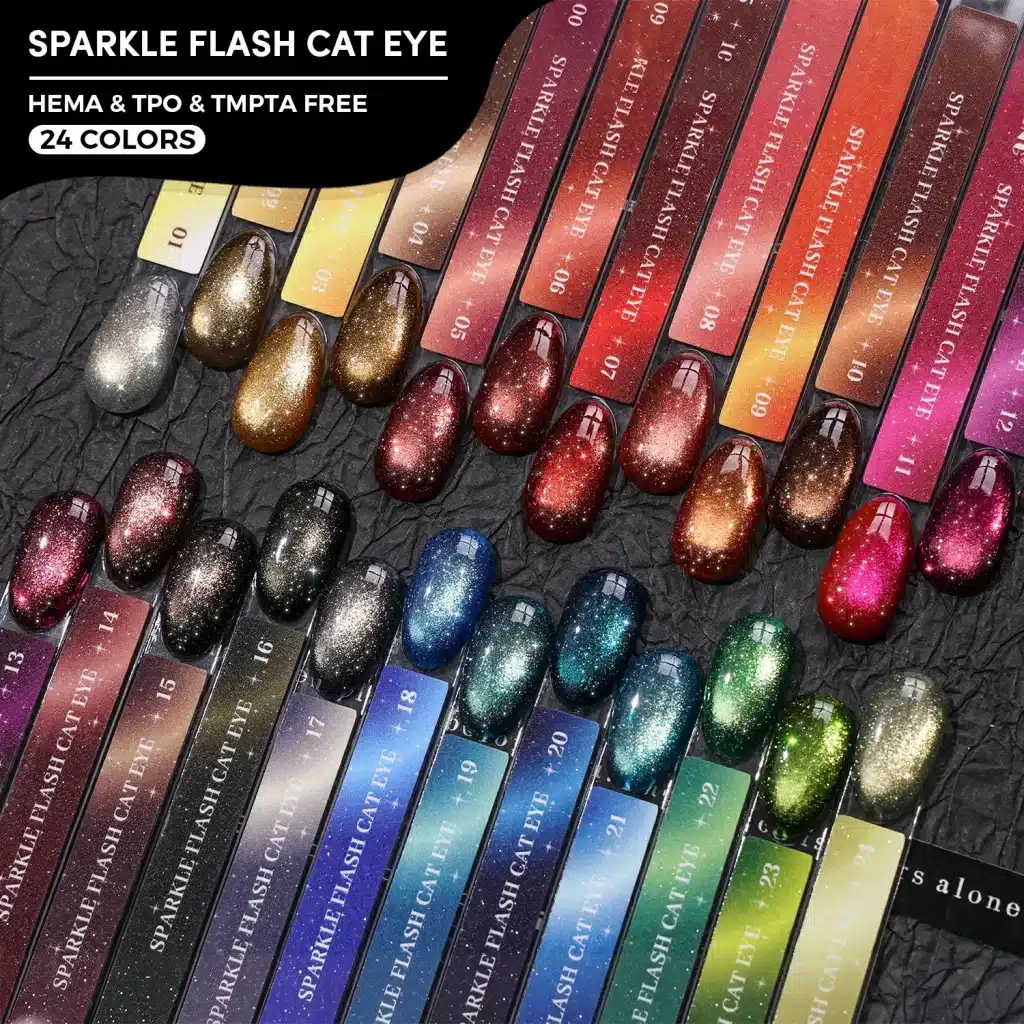
The 24-color Sparkle Flash Cat Eye collection offers a magnetic-plus-reflective direction for a more glitter-rich party comparison. Evaluate its ordinary-light appearance as well as the stronger direct-light sparkle. It serves a different role from a restrained fine-shimmer accent; the range does not need both unless the difference is useful to the customer.
Use One Effect across Several Design Levels
For a focused demonstration, show a magnetic full-color finish first, a fine-line accent second and a coordinated French design third. Each version should identify its additional materials. Magnetic French tips need enough painted area to reveal the effect at the intended length; a narrow line on a very short tip may not communicate the same movement as a full nail.
Record the magnet and layer sequence that produced the selected sample. Include a concise application record with the sample so the receiving team can identify the required tools and supporting layers. JTING's cat eye gel category can support broader product exploration after the desired visual role is clear.
14. Raised Details, Bows and Winter Textures
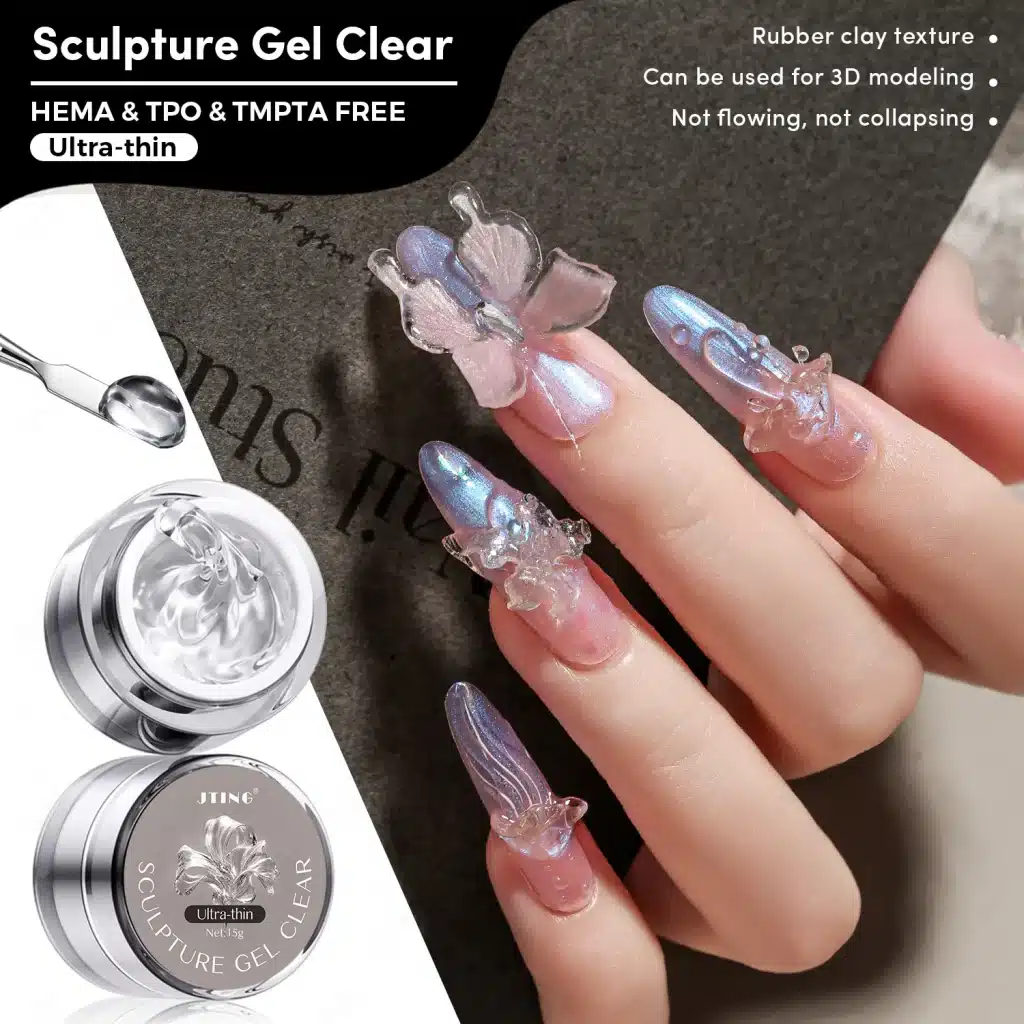
Raised details add a physical dimension that shimmer and chrome cannot provide. A sculpted bow, a low-relief ribbon or a knitted accent changes the silhouette of the finished nail as well as its color. That makes the product's shaping behavior, intended application and finishing procedure important selection criteria. A gel chosen for drawing a fine snowflake is not automatically the right material for building a dimensional bow.
Match the Material to the Detail
| Detail | Material Direction to Evaluate | Sample Check |
|---|---|---|
| Fine Raised Ribbon | A detail gel intended to hold the required line profile. | Does the line remain controlled without becoming an oversized ridge? |
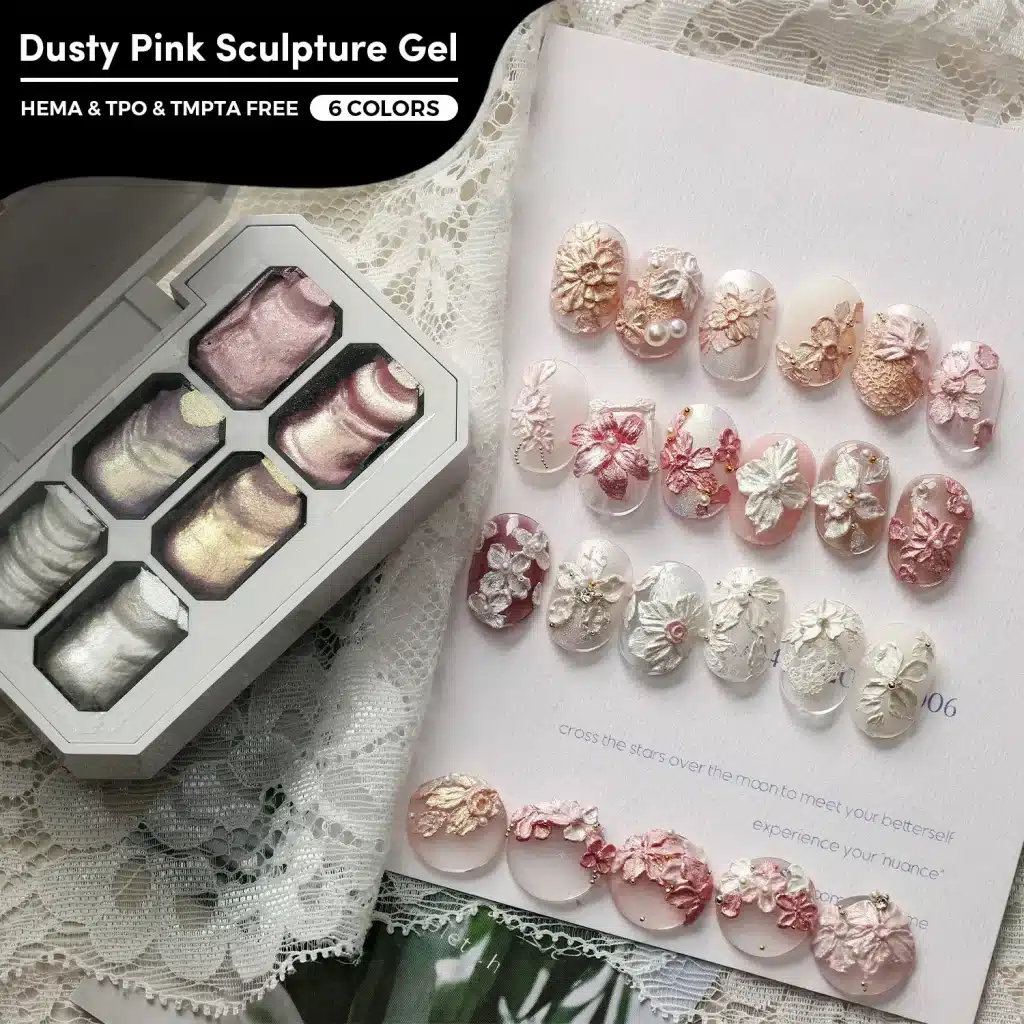
| Sculpted Bow | A sculpting material suited to the demonstrated dimensional work. | Are the loops, joins and edges manageable at the intended nail size? |
| Knitted Accent | A compatible relief technique and specified surface finish. | Can the repeat pattern be formed clearly without unnecessary bulk? |
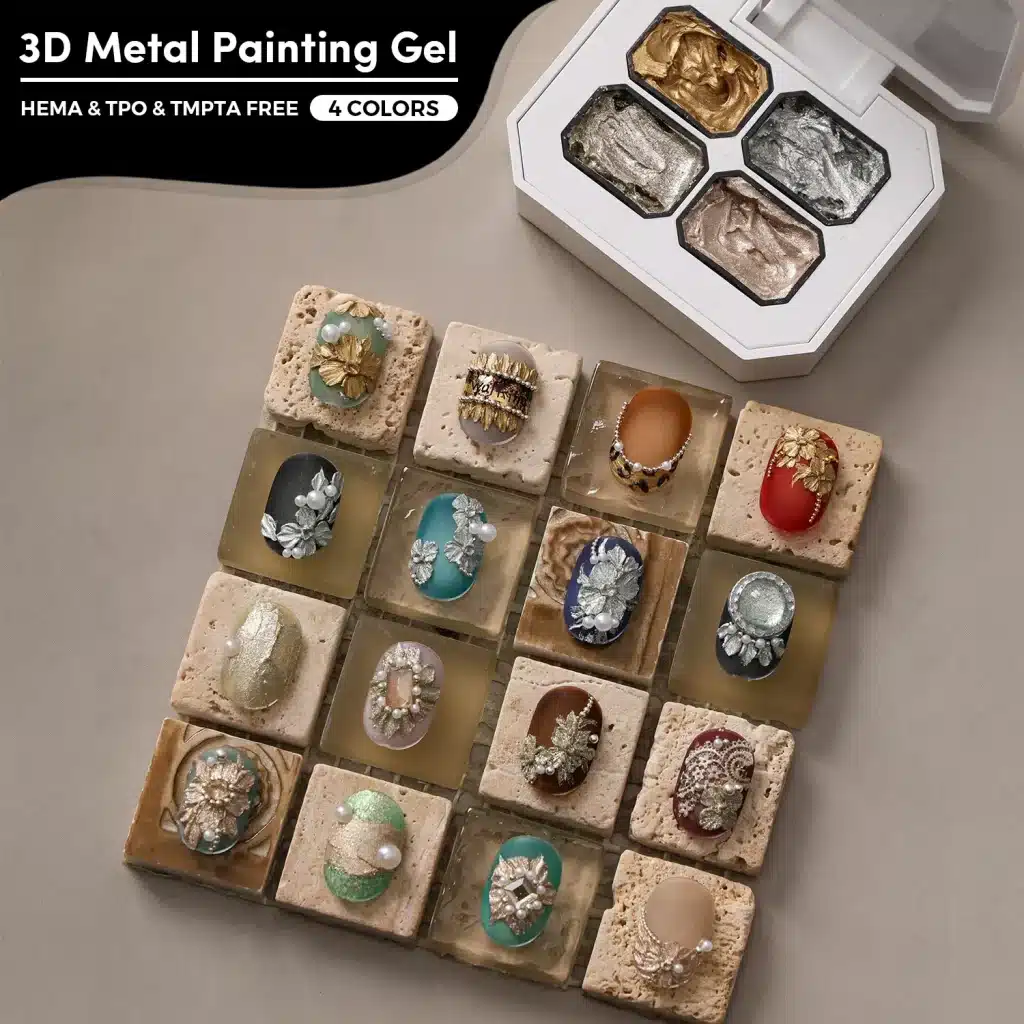
| Metallic Relief | A suitable metallic detail material or an approved powder-over-detail system. | Is the result metallic color, mirror-like shine or a powder-treated relief? |
| Separate Charm | An attachment product intended for the chosen decoration and system. | Are the contact area, placement and attachment instructions clear? |
For 3D Christmas nails, start with a restrained accent that leaves the underlying color visible. One small bow on a nude or wine-colored nail can communicate the theme without requiring every nail to carry raised decoration. A flat painted bow can serve as a lower-profile alternative. Choose a sculpting material for the raised version and a suitable liner or painting material for the flat version.
Review Profile, Edges and Finishing
Inspect a raised sample from the side, not only from above. Look at the height, the free-edge position and whether corners project where they may catch during ordinary hand movements. The appropriate profile depends on the service and the decoration. Do not solve a weak shape by repeatedly adding large amounts of gel; use the selected material within its instructions and complete every specified curing stage.
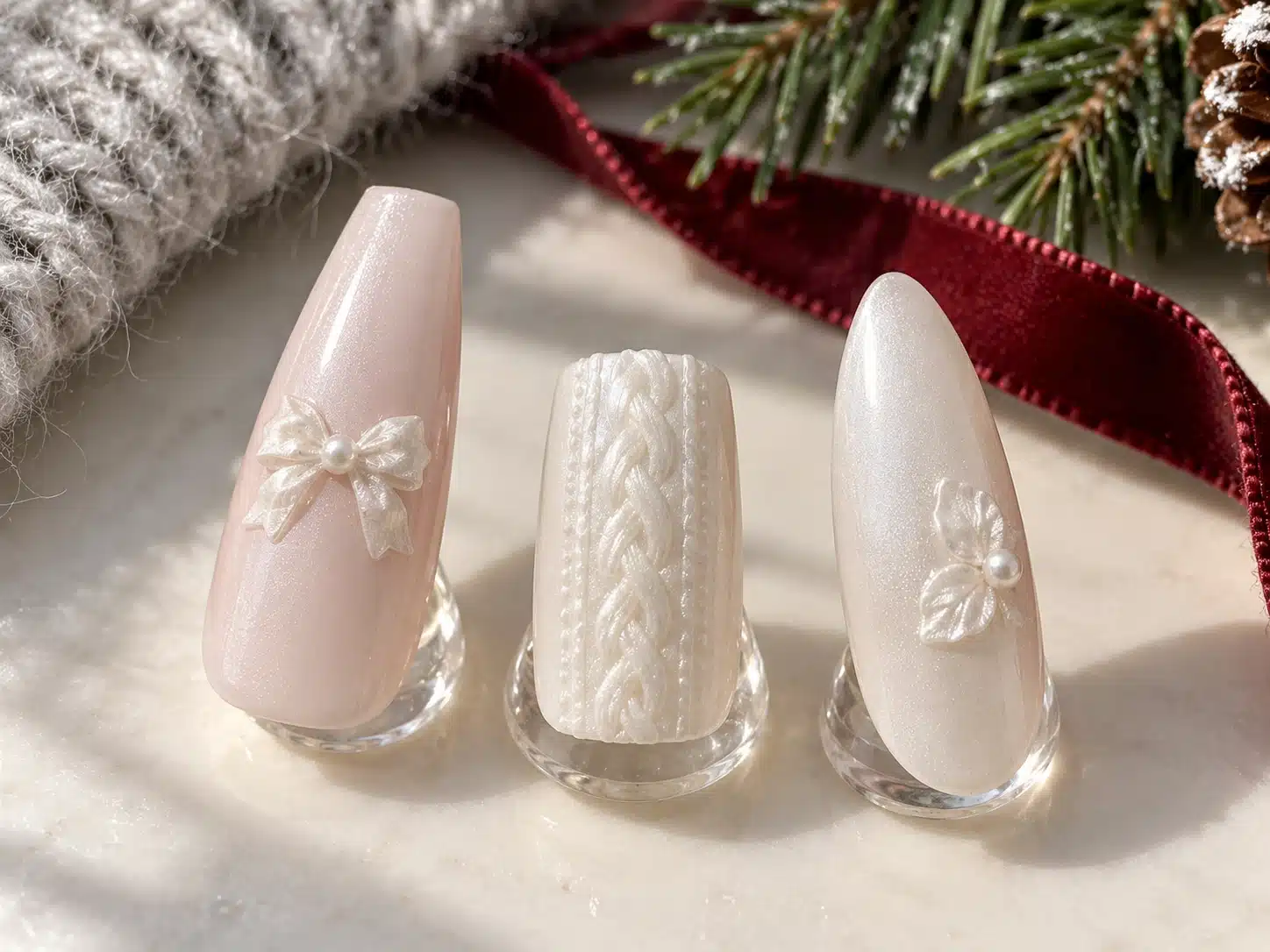
Pearly bow, knitted relief and sculpted flower details on winter nail samples
Finishing can change the design. A top coat may soften fine ridges or collect between raised lines, while a matte surface changes the appearance of nearby shimmer. Confirm whether the chosen detail needs a finishing layer and which areas it should cover. Do not assume that a no-wipe surface automatically answers every durability or compatibility question.
The 3D nail art gel guide gives a broader comparison of relief and sculpting materials. In the holiday assortment, the practical priority is a clearly demonstrated detail that the intended professional can repeat, photograph and explain to clients.
15. Short Christmas Nails: Clear Detail in a Smaller Space
Short Christmas nails need design editing, not merely a smaller copy of a long reference. A long almond display has room for a full ribbon, a broad French tip and several decorative elements. On a short rounded nail, those elements compete for the same small area. Decide which feature carries the idea, then remove the rest before choosing additional products.
Three Ways to Simplify without Losing the Theme
Reduce the number of motifs. One snowflake, star or ribbon can be more legible than several overlapping icons. Place the detail where the available area supports its outline. If the motif only reads in an enlarged photograph, it may be too complicated for the intended display or service.
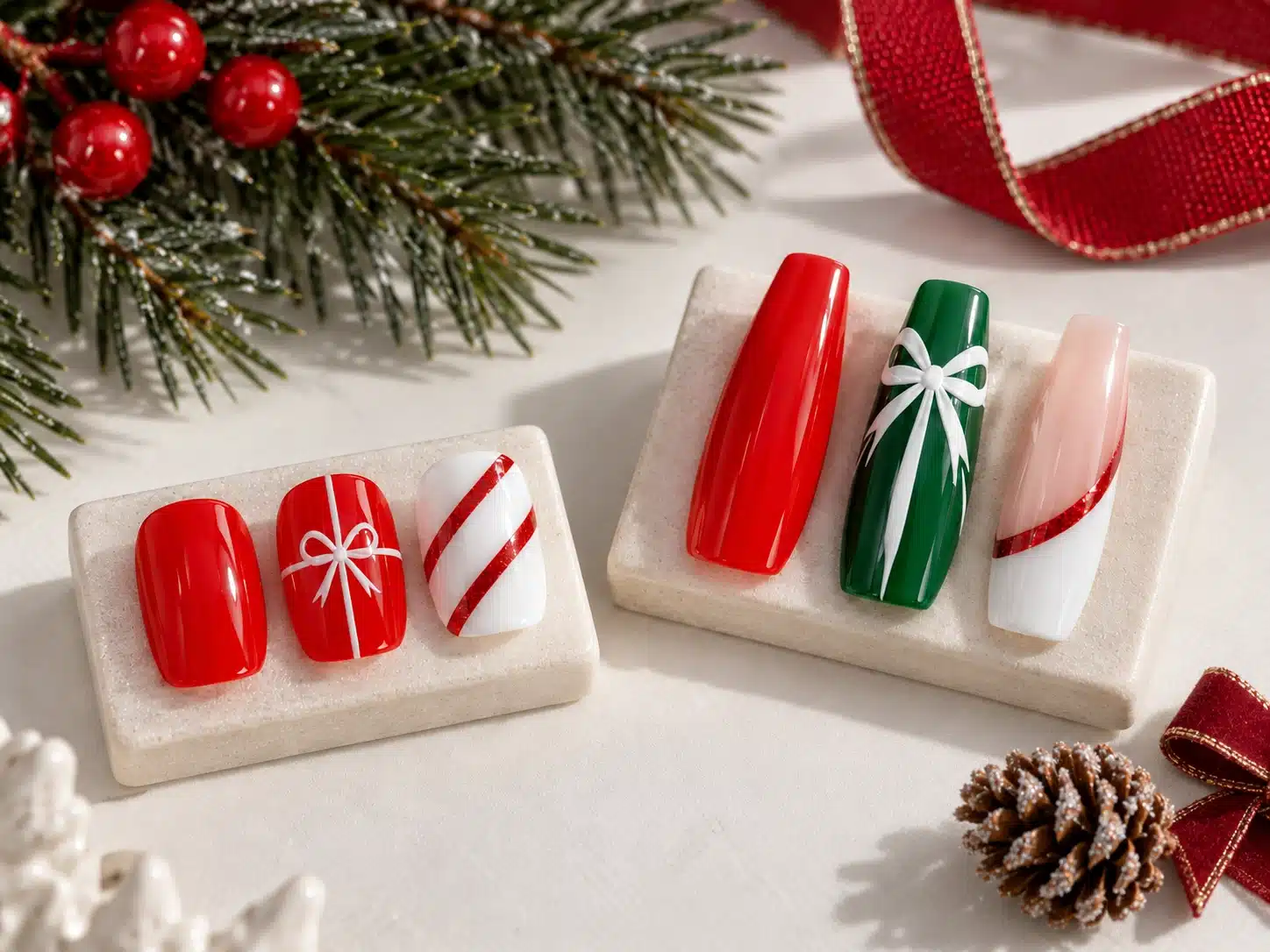
Short squoval and long coffin nail samples with coordinated red, green and white holiday designs
Use color as the holiday signal. A deep red finish with a narrow gold accent needs less illustrated detail than a full festive scene. On short nails, keep the chosen red visible instead of covering it with dense glitter and multiple outlines. This also makes the shade easier to compare in a buying review.
Separate the jobs across the set. Combine a simple color, one effect nail and one motif rather than applying all three to every nail. The design can still feel coordinated through repeated undertones and a consistent accent color. Record the products for each role so a technician does not have to infer the combination from a photograph.
16. Medium and Long Holiday Nails: Balance, Scale and Profile
Use Length to Add Space, Not Automatic Complexity
Longer nails can support a larger visual rhythm, but they do not require more layers or taller details. Use the extra area to give stars, lines or a magnetic highlight room to breathe. Check that the design remains balanced from the cuticle area to the free edge. The structural service underneath must be appropriate for the selected length; decorative color gel is not a substitute for that structure.
A wide French tip can make a short nail look visually crowded, while a very thin tip on a long display may disappear. Approve the smile-line proportion on the actual sample shape instead of setting one universal width. A colored or glitter French design should keep the boundary clear and the base shade readable.
For a wholesale chart, include the nail shapes your customers actually use. A mix of long campaign imagery and one short service sample is more informative than approving every shade on oversized display tips alone. Keep any shape comparison honest: do not label different products or different layer sequences as though only the length changed.
For an extended shape, review both a full-hand view and an individual nail. The hand view shows how accents repeat; the close view shows whether the artwork follows the curve. A large snowflake on every nail may compete with the color story, whereas one larger feature can leave the remaining nails visually quieter. Plan that balance before adding more decorative products.
17. Match Each Design to the Right Gel Products
A reference design becomes a useful buying brief when every visible feature has a corresponding product role. Separate the main color, optical effect, drawing material, dimensional detail and finishing system. Several roles may be supplied by one appropriate product, but that should be demonstrated rather than assumed from its name. The table below helps build a shortlist without requiring every business to stock every effect.
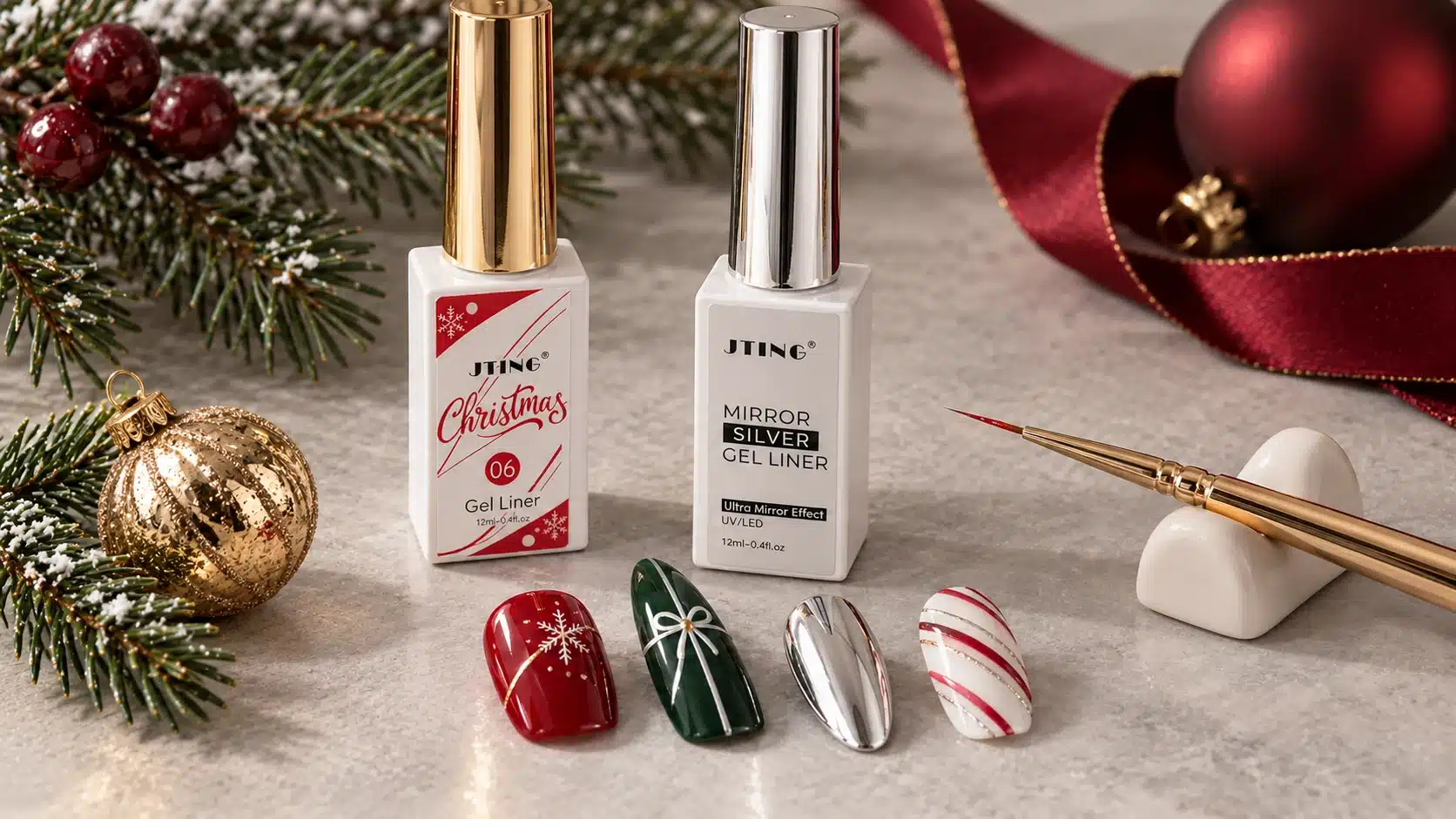
JTING Christmas liner and Mirror Silver Gel Liner bottles beside festive nail-art samples
| Design Goal | Main Product Role | Additional Products If Required | What to Confirm |
|---|---|---|---|
| Red-and-White Candy Stripes | A suitable red or white color foundation. | A controlled drawing material in the contrasting color and the specified finish. | Line definition, background coverage and the complete curing sequence. |
| Green with Gold Stars | Deep green gel nail polish. | A gold detail material suited to painting the chosen star size. | Whether the detail is metallic paint, glitter or a separate powder application. |
| Snowflake Accent | A pale, nude, blue or dark color selected for contrast. | A fine-detail white liner or painting gel. | Visibility at the intended nail size and separation between fine strokes. |
| Glitter French Tips | A coordinated sheer or covered foundation. | A suitable glitter color and any material needed to establish a crisp boundary. | Coverage at the tip without a thick, uneven edge. |
| Jewel-Tone Cat Eye | The selected colored magnetic gel. | The demonstrated magnet, required background and finishing layer. | Underlying color, moving highlight and repeatable positioning. |
| Reflective Party Accent | A reflective gel appropriate to the desired coverage. | A background color only where the approved look requires it. | Ordinary-light appearance and direct-light sparkle on the same sample. |
| Mirror-Like Silver Tip | A compatible chrome-powder system or another demonstrated mirror-effect route. | The prescribed foundation, application surface and seal. | The actual material route; metallic paint alone should not be promised as identical. |
| Raised Bow or Knit Detail | A sculpting or relief product suited to the detail. | A compatible color foundation and specified finish. | Side profile, clear joins and instructions for the complete detail. |
Buy for the Role, Not Only the Shade Name
A white drawing material is selected for controlled lines, not simply because a white color bottle already exists in the catalog. A sheer-looking pink foundation should be evaluated for the intended coverage, not selected by the word nude alone. Likewise, a gold glitter that suits a party accent may be unsuitable for a fine painted star. Sample the actual application that the product must perform.
JTING's painting gel category can help identify detail materials, while the foundation and finish belong to the selected top coat and base coat system. Include the required foundation and finish in the product specification so buyers can order the complete combination.
Before adding a product to the shortlist, ask whether it fills a missing role or duplicates a material already approved. A focused selection is easier to demonstrate and replenish. If one candidate needs an additional product to match the reference, include that requirement in the comparison rather than treating the bottle prices as equivalent offers.
Prioritize Products within Your Buying Budget
Allocate the budget by the services or customer orders the range must support, not by buying an equal quantity of every attractive shade. Use the priorities below to decide which product roles need funding first, then confirm the actual assortment and quotation.
| Priority | Product Roles | When to Allocate Budget |
|---|---|---|
| Core Service Materials | Usable base and top coats, selected background colors and the detail material needed for the planned motifs. | First cover gaps that prevent the team or account from delivering the advertised design. Existing suitable stock can fill these roles. |
| Effect Upgrade | One clearly differentiated magnetic or reflective direction, with its required supporting products. | Add when a sample demonstrates a distinct service or resale opportunity, rather than duplicating an effect already stocked. |
| Specialist Design Extension | Relief materials, a dedicated chrome route or additional artwork colors. | Allocate after confirming professional application capability, demand and the additional steps or equipment required. |
Compare the cost of completing the intended assortment: products, required accessories, packaging and the applicable freight and import costs. Keep some purchasing flexibility for replenishing frequently used foundations or colors. A lower bottle price is not necessarily a lower assortment cost if it requires extra materials or quantities beyond expected use.
18. Holiday Gel Application: Sequence and Troubleshooting
A holiday reference often combines products with different application requirements. Plan the order before building the display: prepare the foundation, complete the required color stages, shape any magnetic effect while its designated layer is workable, add compatible detail at the specified stage and finish as instructed. This is a planning sequence, not a substitute for each product's complete directions.
Keep Dark Color and Dense Sparkle Controlled
Deep red, dark green and glitter-rich materials can conceal an uneven application in a dramatic photograph. Inspect the surface and edges before judging the result. Use the specified layer thickness instead of pursuing opacity with one heavy coat. Additional material changes the coating that must be cured and can reduce control near the sidewalls.
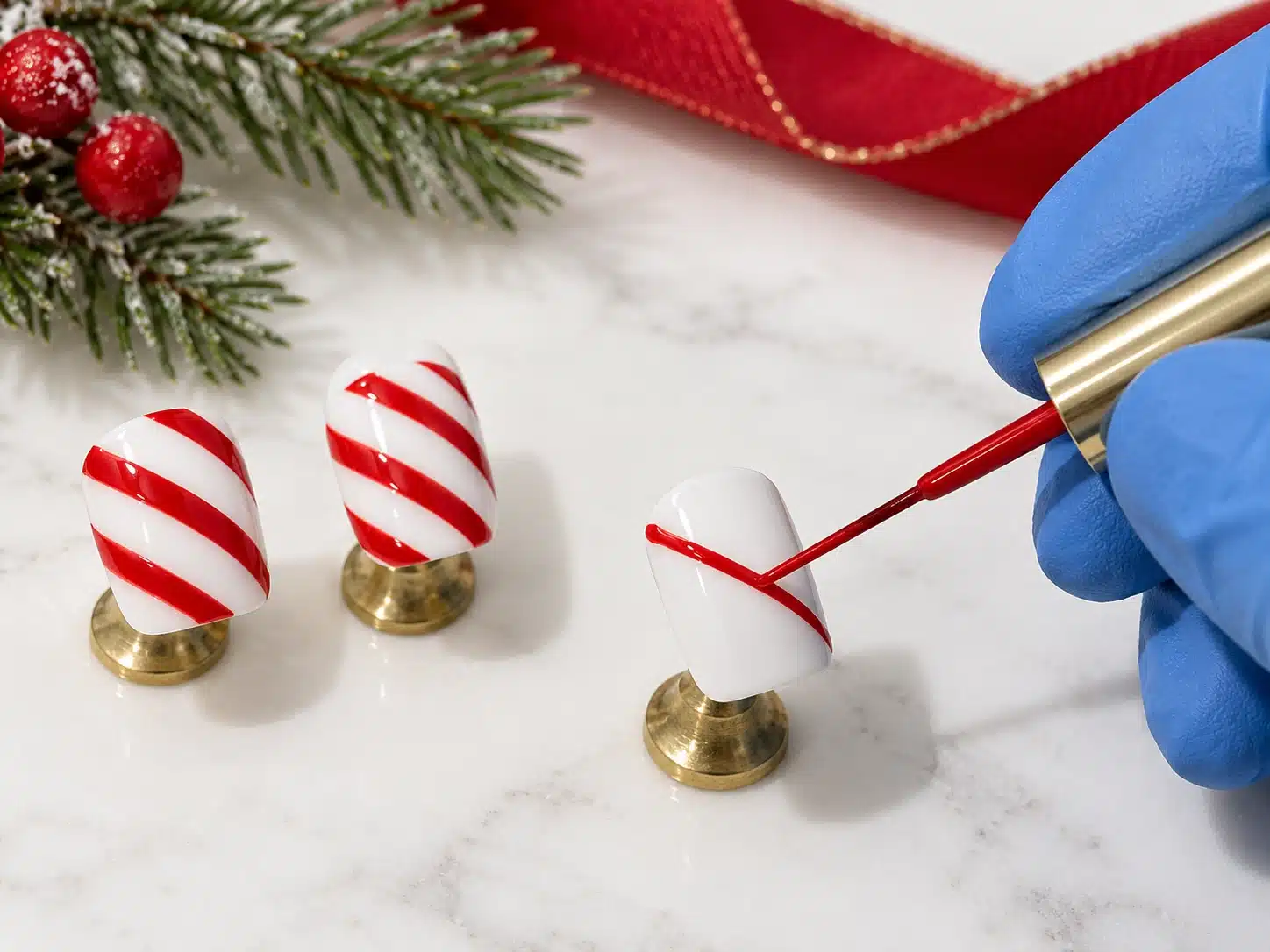
Gloved technician using a fine liner brush to paint a red stripe on a white practice nail
If the result wrinkles, remains soft or changes unexpectedly, stop using that application as the approval sample. Review the selected formula, compatible lamp, application amount and complete instructions together. Do not cover a questionable layer with more art or treat extra exposure as a universal fix. The gel nail polish curing guide explains product-focused checks.
| Problem | First Check | Useful Next Comparison |
|---|---|---|
| Fine Lines Spread | Drawing material, underlying surface and amount on the brush. | The same motif on the specified prepared surface with controlled loading. |
| Glitter Tip Looks Bulky | Coverage, material distribution and tip boundary. | A sample that reaches the desired appearance within the product's application limits. |
| Magnetic Glow Disappears | Pattern before curing, overlay opacity and final lighting. | The approved magnetic stage beside the complete finished system. |
| Chrome Detail Looks Patchy | The powder's prescribed application surface and sealing procedure. | A repeat using the specified compatible system, not a random top-coat substitution. |
| Raised Pattern Loses Definition | Material suitability, profile and finishing coverage. | A simpler low-relief sample with the approved material and curing stages. |
| Finish Changes the Design | Gloss or matte selection and coating distribution around details. | Separate labeled samples of the permitted finish options. |
19. Choose the Base, Top Coat and Mixed-Finish Sequence
Distinguish the adhesion base coat from a background color. They have different jobs even when the finished photograph shows only one colored surface. Identify the prescribed foundation, any colored background and the finishing route for each display design so the complete system can be supplied and taught.
Approve Gloss and Matte as Separate Design Choices
For mixed finishes, establish which areas receive gloss, matte or any dedicated treatment. The word velvet describes a magnetic appearance, not a requirement to use a matte top coat. A matte knitted accent and glossy neighboring color can be attractive, but they still need a deliberate, compatible sequence. The gel top coat guide covers finish selection.
Retain the complete layer record with the final sample. That record should travel with training and sales material, so a buyer knows what is needed to reproduce the displayed service. Keep uncured material away from skin and reserve application trials for appropriately trained professionals. A clear, controlled process supports the design better than a complicated sample whose corrections cannot be explained.
For a mixed-finish set, label which nail or area receives each finish and keep a finished reference. A glossy edge beside a matte knitted accent may need a different working sequence from an all-gloss design. Confirm the steps for the selected materials instead of adding a second finish by habit. Include any additional supporting product in the cost and ordering record.
21. Compare Holiday Service Time and Material Costs
Price from Observed Work, Not the Photograph Alone
Rehearse each proposed service with the actual materials before setting its appointment allowance. Record preparation requirements, decorative steps, corrections and removal considerations. Build pricing from the salon's labor, consumables and overhead rather than copying another business's holiday supplement. Magnetic styling may be visually dramatic without detailed painting, but positioning still needs a reliable method and an agreed visual reference.
Offer a simpler alternative for every elaborate display: a painted bow can become a fine ribbon line; a full textured set can become one suitable accent; a multicolor composition can become a single festive shade. Keep the visual relationship clear without promising that different routes produce identical results. A shorter version should genuinely reduce work, not merely remove decoration while retaining the same complicated preparation.
Separate hands-on work from required curing stages in the trial record. Track the materials used for the whole design, including a background or finishing product that is easy to overlook. Compare a simpler and a more detailed version over the same service scope. Estimate service cost as labor cost plus gel and decoration use, disposable supplies and allocated overhead. Calculate labor from the measured appointment time and your business's hourly cost. If bottle-use data are not yet available, record consumption during trials instead of assuming a fixed number of sets per bottle. Use the same service scope when comparing a plain-color option with a decorated upgrade.
22. Evaluate Samples and Photograph the Actual Finish
Approve a holiday product for the service it must perform. A beautiful bottle photograph cannot establish coverage, brush control, magnetic response or suitability for a specific design. Request samples with a defined evaluation purpose: for example, comparing a fine French red with a full-color red, or checking whether a magnetic effect remains legible on short nails.
Make Comparisons Reproducible
Use comparable display tips and record the substrate, foundation, application method, finish and the selected system's curing instructions. Label each sample with its product reference and evaluation date. Where a dark underlayer is part of the intended look, distinguish that swatch from the same material shown without it. Otherwise, a buyer may approve an effect that the salon cannot reproduce from the supplied color alone.
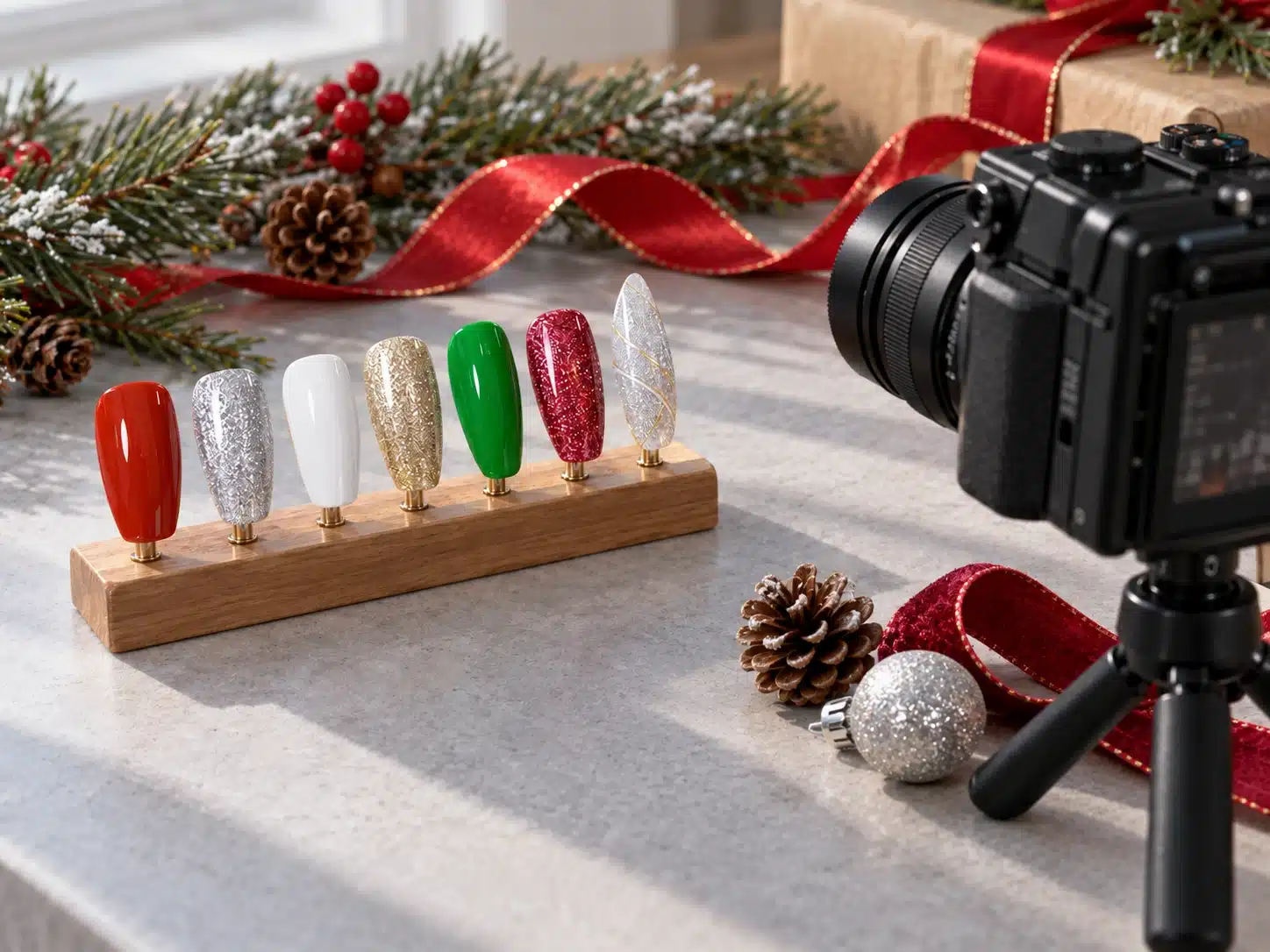
Camera directed toward holiday gel nail swatches on a festive sample review desk
Assess workable application, not just the final still image. Note brush loading, edge control, leveling behavior and whether the intended detail stays defined during application. For magnetic samples, record the magnet arrangement and the appearance before curing. For reflective materials, compare ordinary illumination with direct flash. Do not interpret sparkle in a flash photograph as proof of the same brightness in a softly lit room.
Review the Full Product Combination
Evaluate the selected foundation and finish alongside the decorative material, using compatible products and their instructions. A matte finish, glossy finish or chrome route can change the approved appearance. Keep the finished sample as the reference for future production discussions. If a trial reveals wrinkling, poor cure or inconsistent application, pause approval and investigate the system rather than hiding the result with another layer.
Separate visual approval from broader performance approval. A display tip can establish an agreed color direction and effect, but it does not establish a wear-duration claim or demonstrate performance on every nail condition. Agree appropriate professional evaluation criteria before making customer-facing promises. When several people assess samples, ask them to record observations independently before deciding which differences matter commercially.
Photograph Color, Movement and Nail Scale
Create a consistent photograph in neutral lighting, a close view showing the finish and a short movement clip for directional effects. Keep camera settings and backgrounds comparable where practical. Include a recognizable view of nail length and shape so a fine accent is not mistaken for a broad decorative band. Label flash images clearly and avoid filters that materially change the shade.
JTING can support product photography and product videos. Agree the required views, packaging version and approved physical reference before production of those assets. Identify concept packaging separately and connect approved images to the correct product and shade references. This gives sales teams a consistent visual record for inquiries and repeat orders.
23. Approve, Revise or Hold a Holiday Product Sample
End the sample review with a decision and a specific reason. A general score such as good or premium leaves too much room for interpretation. Separate visual acceptance, application suitability and unresolved order information so one appealing finish does not conceal a missing requirement.
- Approve: the shade has a distinct role, the finished design matches the agreed reference and a trained operator can reproduce it using the documented system. Confirm the remaining order and packaging details before production.
- Revise: the product direction is useful but one observable feature needs adjustment. State whether the issue is undertone, coverage, line definition or effect placement, and retain the current sample for the next comparison.
- Hold: the candidate duplicates another shade, requires an unexplained supporting layer or lacks essential application information. Resolve that point before assigning it a place in the launch.
Keep the accepted physical sample, product identification, layer record and approval date together. If the composition of a display changes, review the changed combination rather than assuming the earlier approval covers it. A change to the top coat, brush or background color may affect application or appearance even when the main color name remains unchanged.
24. Choose Holiday Assortments for Your Business Model
A holiday assortment should match the way your business uses and sells products. Salons plan services, distributors build ranges for professional accounts, and private label brands coordinate products with their identity. Online sellers need clear saleable configurations, while educators need materials that support demonstrations and practice. Use the relevant priorities below to shape your selection.
For Salons: Buy around Appointments
A salon assortment should support the menu its team can confidently deliver. Select core shades with distinct roles, then add effects that extend those shades into different services. A burgundy used for full color and fine detailing may be more useful than several similar reds with no clear distinction. Check that the actual formula works for each proposed technique rather than assuming all color products perform like painting gel.
Consider variation across technicians and client preferences. Keep a restrained option for short nails and a more expressive party option, but avoid purchasing an unfamiliar effect solely because it photographs well. Review product consumption after rehearsals. Shared finishes may need replenishment even when a seasonal accent color still has substantial stock.
For Distributors: Make the Range Easy to Explain
A distributor should distinguish color, effect and application route clearly enough for account managers to explain them without improvisation. Separate ordinary glitter, reflective sparkle and magnetic light; their names should not imply interchangeable behavior. Provide product references, approved swatches and compatible system information with each proposed group. This makes ordering more precise than a broad collection name such as holiday sparkle.
Build a core range for repeat professional demand and treat experimental effects as a separate commercial decision. Ask salon accounts which services they plan to offer and where existing stock overlaps. Evaluate individual shade replenishment, carton identification and the practicality of replacing a missing component. A complete display is less useful when accounts cannot identify which item they need to reorder.
For Private Label Brands: Design a Recognizable Collection
Define the brand's visual territory before selecting packaging: understated winter neutrals, classic festive color or expressive evening effects are different propositions. Use coordinated shade naming and product descriptions that distinguish appearance from technique. If a collection includes several technologies, explain their different uses rather than forcing every product under one ambiguous finish claim.
For businesses developing their own range, JTING's private label brand solutions provide a relevant starting point. Specify which elements need customization: the shade direction, bottle and brush combination, label, box or collection presentation. A brand launch does not automatically require an exclusive formula; decide whether differentiation should come from color coordination, product performance direction or presentation before expanding development work.
For E-Commerce and Marketplace Sellers: Make the Offer Clear
Define the exact contents of each saleable product or set before preparing listings: shades, bottle capacity, packaging and any included accessories. Keep the product references consistent across the listing, color chart, carton and order specification. For reflective and magnetic finishes, distinguish ambient-light views, direct-flash images and movement demonstrations so buyers can understand the actual effect.
Plan photography around the approved configuration rather than a concept box or an unrelated swatch. If supporting products or tools are required but not included, identify them clearly. Compare assortment depth, packing requirements and replenishment plans against your channel's expected orders before committing to a large seasonal range.
For Nail Academies and Educators: Buy around the Lesson Plan
Separate core practice materials from advanced festive effects. A lesson on candy stripes needs a clear background, a suitable linework material and the matching application system; relief work or magnetic styling introduces additional product and demonstration requirements. Select materials that let an instructor explain one technique at a time before combining effects.
Trial the lesson with the actual product and brush combination. Record the quantities needed for demonstrations and supervised practice, distinguish shared supporting products from learner materials and keep the demonstrated sequence available to instructors. Agree repeat-order references so later classes can use the intended products rather than an unexplained substitute.
Across all channels, distinguish reusable core products from season-specific artwork and packaging. Assess how a burgundy or champagne effect fits later services alongside its holiday role, using your own account demand and stock records to set quantities.
Build a Holiday Range from Usable Existing Stock
A seasonal launch does not have to start with a completely new assortment. Existing reds, neutrals and effects may already cover most of the design brief. Review their condition and suitability before assigning a new purchasing budget.
- Audit usable stock: record the product reference, available quantity, batch and shelf-life information, storage condition and compatible system. Separate reserved or unsuitable stock from quantities available for the campaign.
- Match stock to finished designs: assign each item a role in the proposed menu or resale range. Make a complete sample when the combination is new; a familiar color does not establish compatibility with a new art material.
- Identify the actual gaps: distinguish missing shades from missing capabilities, such as an opaque white line, controlled metallic detail or a direct-flash effect. Check whether one suitable addition supports several designs.
- Buy for the gap and replenishment window: account for usable stock, expected consumption or orders, minimum quantities and the time needed to replenish. A new effect should not absorb the budget needed to keep core services available.
For example, a salon with usable red, nude and gloss products may need only a suitable detail material to develop a restrained ribbon design. A distributor can build a coordinated offer from current products with accurate references. Private label brands should confirm approved packaging and product identity before regrouping existing items; changing the campaign presentation does not make the formula new.
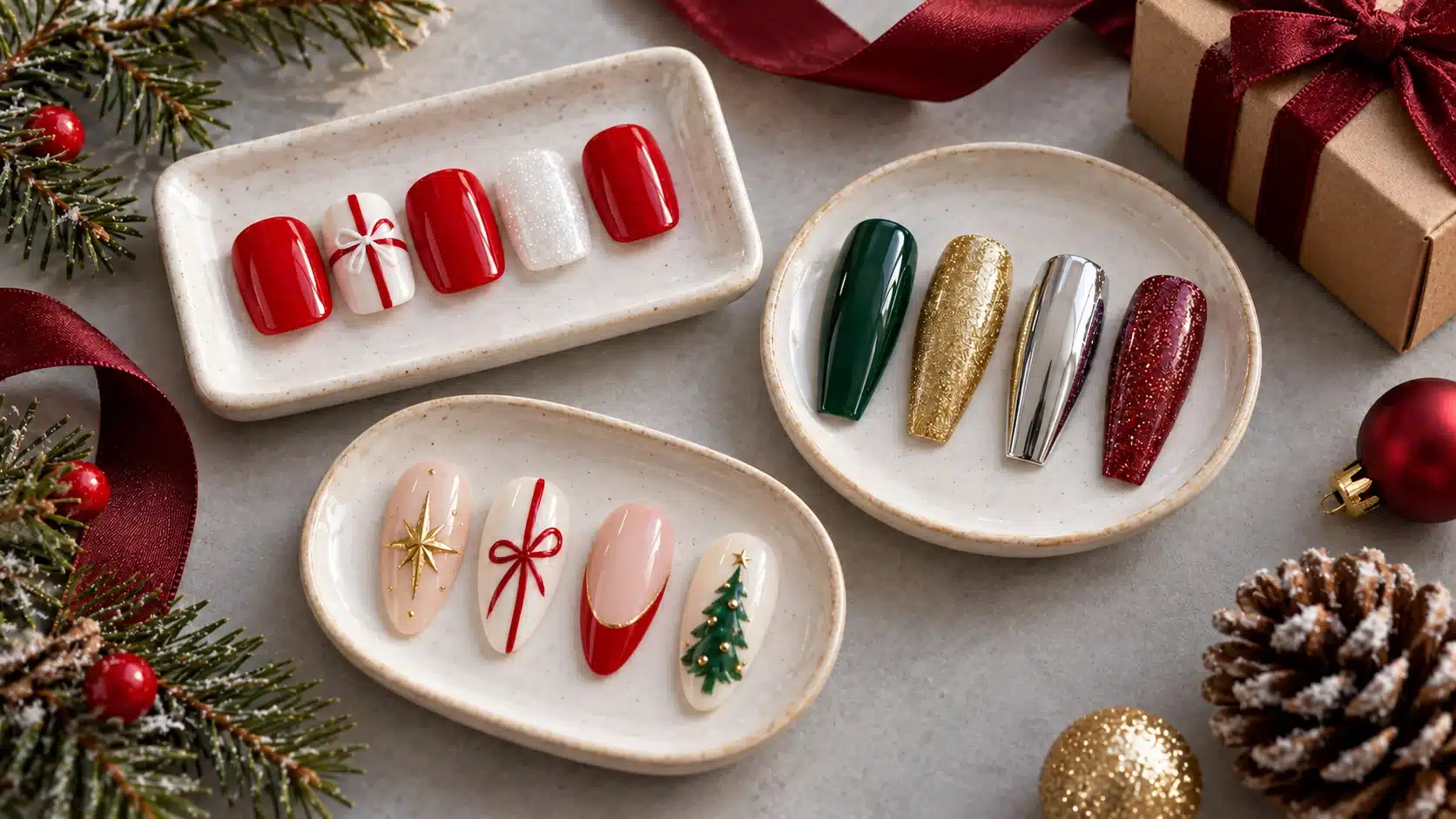
Holiday nail samples in varied shapes grouped on trays beside Christmas gifts, pine cones and ribbon
25. Schedule Holiday Sampling, Production and Delivery
Work backward from when products must be available for training, photography, account selling and service delivery, not only from December 25 or December 31. A commercial launch needs usable stock before customers choose their appointments or place their own orders. Discuss the required availability date with the supplier before committing to a promotion.
Separate Development, Approval, Production and Transport
For JTING, standard samples typically take 7-10 business days. Custom color or exclusive formula development typically takes 2-4 weeks. Bulk production after sample and packaging approval typically takes 15-20 days. Allow for each applicable stage and confirm transport separately; these timings do not establish a holiday arrival date. Final timing depends on product type, sample quantities, revisions, color count, packaging complexity, order scale and documentation requirements.
Ask for an order-specific schedule that identifies approval points and separately addresses transport and destination arrangements. Do not calculate an arrival date by adding only the production period to the purchase date. If the available window is tight, discuss a simpler product or packaging scope and confirm feasibility before changing public launch plans. Simplification can reduce decisions, but does not establish stock availability or reserve production capacity.
26. Seasonal Packaging, Replenishment and Approved Substitutions
A holiday collection can use a permanent brand identity with selected seasonal details, or a more distinctive coordinated package. Decide what needs to change before sampling. JTING supports bottle, brush, box and label choices around the selected gel products; the useful question is how each choice supports application, identification and the way the range will be sold.
Bottles and Caps: Keep the Brand Recognizable
Compare custom gel nail polish bottles and caps by silhouette, color, surface finish and logo presentation. An existing style can be customized, while a new bottle or cap design involves a separate development scope. Consider whether a coordinated permanent bottle with seasonal artwork would serve the range better than a Christmas-specific package. Review the selected combination in hand, including closure fit, formula compatibility and the space needed for product information.
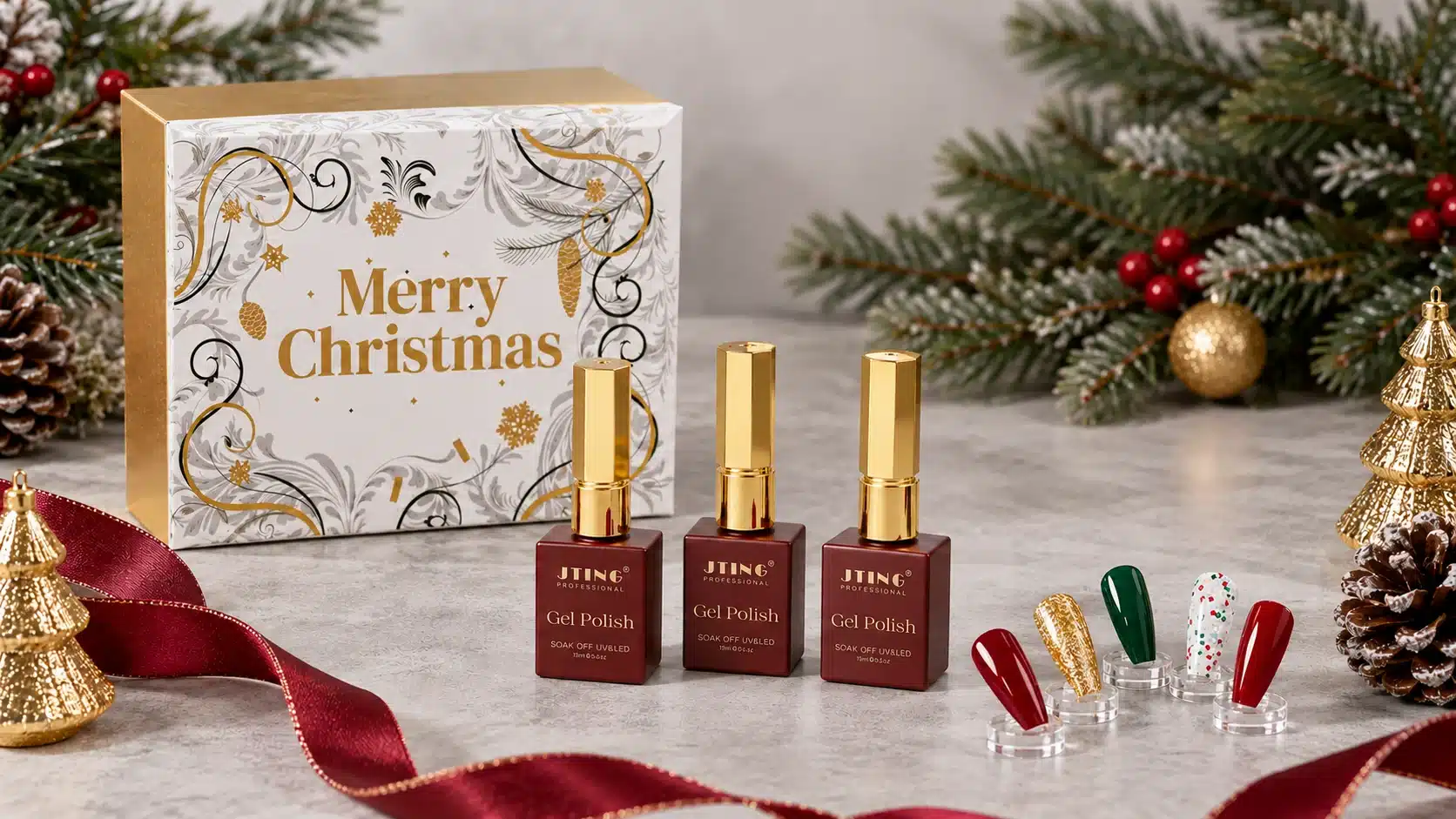
JTING wine-red gel nail polish bottles with gold caps beside a white-and-gold Merry Christmas box
Brushes: Match the Applicator to the Product
Choose brush options for the selected gel products around the intended work: full-color application and fine decorative lines need different handling. Start with a suitable existing brush and discuss changes to shape, dimensions or feel where the brief requires them. Brush selection and customization are coordinated as part of the JTING product order. Review pickup, release and bottle-and-cap fit with the actual formula before confirming the configuration.
Boxes: Plan the Contents before the Structure
For custom gel nail polish boxes, define the bottle count, dimensions, presentation and insert requirements before finalizing festive graphics. Compare existing box options with project-specific development, and confirm which structure and components will be sampled for your order. Check access, component fit and the intended packing arrangement on a physical sample. Confirm box-specific quantities, development costs and schedules rather than applying the finished gel product's starting MOQ to every packaging choice.
Labels and Stickers: Adapt the Design to Your Range
JTING's custom labels and stickers can start with an existing design adapted to your logo and product information, or a layout adjusted to your brief. Coordinate shade identification and collection graphics while keeping instructions and required market information legible at printed size. Label design and supply are coordinated with the corresponding JTING product or customization order.
Approve the bottle, brush, label and box as one configuration, with the same product references used in photography and ordering. Check quantities, artwork and the approval sequence before committing to a launch date. The private label gel nail polish guide provides the wider context for coordinating product development and branding.
Plan Reorders at the Component Level
Track use and orders by shade, effect and supporting product, not only by collection. Set an internal review point while there is still time to discuss replenishment. Confirm whether a repeat order requires the same packaging components and what approvals apply to it. Do not assume a reorder is immediately available because the first batch has already been produced.
If the original product cannot meet the required replenishment window, compare a physical alternative with the account or technician. Agree any change to formula, shade or finish and update the product description before supply. Keep the original and replacement references distinct in the order record.
27. Frequently Asked Questions about Professional Holiday Gel Nail Buying
How Should a Buyer Separate Christmas and New Year's Eve Products?
Separate the design brief before separating stock. Christmas services may emphasize recognizable festive colors or motifs, while December 31 services may emphasize evening light and party finishes. Some products can serve both. Identify each product's practical role and assess overlap instead of buying two unrelated ranges simply because the occasions have different names.
How Many Shades Should a Holiday Collection Include?
Choose the shade count from the planned designs and product roles, not a fixed seasonal number. A compact starting palette can include a red, deep green, opaque white, translucent neutral and one selected effect, with compatible base and top coats planned separately. This is an illustrative selection, not a standard JTING kit. Add shades when they enable a distinct service or resale offer; set order quantities separately using expected demand, usable stock, MOQ and replenishment timing.
What Should a Salon Choose for Short Christmas Nails?
Evaluate proportions on a short display tip: slim French edges, small painted accents, full-color finishes and controlled magnetic light are useful directions to sample. Keep the decorative area appropriate to the available surface. A design photographed on long nails should be adapted and approved, not presented as an identical short-nail result.
Can One Red Product Handle Both Full Color and Fine Artwork?
Only if its application characteristics suit both tasks. Test brush control, coverage and line definition with the intended tools. A product that levels well across a nail may not retain the fine edges needed for a ribbon motif. Specify a suitable liner or painting gel when the chosen color formula does not support the artwork.
Are Reflective Gel and Cat Eye Gel Interchangeable?
No. Reflective sparkle and magnetic light are different effects, although a particular product may combine them. Ask which behavior the selected product actually provides, review ordinary-light and flash views, and test any magnetic styling before curing. Do not describe an entire category as magnetic or reflective based on one combined-effect sample.
Does Every Metallic Gel Create a Mirror Chrome Finish?
No. Chrome powder, chrome-effect gel and metallic painting gel represent different routes and may produce different appearances. Confirm the intended result, compatible foundation and finishing procedure for the specific material. Approve the complete sample rather than using the word metallic as evidence that a mirror finish will be achievable.
Should Raised Holiday Decoration Appear on Every Nail?
Not necessarily. Selected accents can communicate the theme while keeping the service appropriate to the client's daily use and preferred profile. Use material intended for the proposed detail and follow its application and curing requirements. Decorative gel is not automatically a structural builder or an adhesive for separate embellishments.
What Should Be Included in a Sample Request?
Include the selling channel, destination market, intended designs, reference shades, preferred finishes and the application system you need to evaluate. Explain whether the goal is shade matching, magnetic appearance, fine artwork or packaging approval. Distinguish essential requirements from preferences so the sample selection answers a purchasing question rather than becoming an unfocused assortment.
Can Photographs Replace Physical Shade Approval?
Photographs are useful for shortlisting, but lighting, camera settings and screens affect appearance. Approve a physical sample for an important shade or finish decision, then use consistent photographs to communicate that approved reference. For directional effects, include movement; for reflective sparkle, distinguish a flash demonstration from an ordinary-light view.
Are All JTING Products HEMA-Free?
All JTING products are HEMA-free. This does not mean allergy-free, Di-HEMA-free or automatically suitable for every person or destination market. Confirm other requested formula attributes and relevant product documentation separately. Professional application still requires the selected system's instructions, appropriate skin-contact precautions and full curing; HEMA-free is not a substitute for correct use.
What Is JTING's Minimum Order Quantity?
JTING supports private label gel nail polish orders starting from 10 pieces per shade. House-brand mixed-color orders can start from 100 pieces. MOQ may vary by product type, packaging style, formula request, and customization level. Confirm the requirements for your actual assortment rather than treating the starting figures as universal terms for every configuration.
When Should Buyers Begin Holiday Order Discussions?
Begin early enough to accommodate selection, sampling, revisions, packaging approval, production and transport before your required selling date. Ask for a project-specific schedule rather than a universal calendar cutoff. Identify whether the project uses an existing formula and packaging or needs new development, then request a schedule for that scope.
Can a Brand Customize Packaging without Developing an Exclusive Formula?
JTING supports labels, logos and packaging boxes as well as bottle, cap and brush options. Discuss a suitable product selection and the branding scope separately from exclusive formula development. Confirm the actual configuration, artwork, quantities and approvals; packaging customization should not be presented as evidence of a unique formula or exclusive color rights.
Which Documents Should an Importer Request?
Specify the destination market and product selection first. Depending on the product and destination market, JTING can support documentation such as SDS/MSDS, INCI information, COA and customs documentation. Have the responsible business and compliance personnel confirm what applies to the order. A general document list is not blanket approval for every SKU or market.
Can Holiday Shades Be Reordered Individually?
Discuss individual shade replenishment when defining the initial assortment, including applicable minimums, packaging components and approval requirements. Do not assume that buying a collection guarantees immediate access to every replacement item. Track individual demand early and agree any proposed substitute against a physical reference before offering it under a service or product description.
How Can Buyers Reduce Unsold Seasonal Packaging?
Consider a permanent bottle identity with an approved seasonal outer presentation, or keep holiday references in campaign materials rather than every product name. Match the decision to your sales channel, brand presentation and packaging requirements. This can create more options after December, but it does not guarantee sell-through or remove the need for careful purchasing.
28. Turn Your Holiday Nail Ideas into a Product Brief
A productive inquiry describes what the range must do, who will use it and when it needs to enter your business. You do not need a finished collection design to begin, but clear priorities help distinguish a suitable product selection from unnecessary development.
- Business and channel: identify your business model, such as salon operations, professional distribution, a private label brand, e-commerce or nail education, and name the destination market.
- Design direction: share reference colors and the intended Christmas or December 31 look, distinguishing essential effects from optional decorative details.
- Product roles: describe full-color services, French work, magnetic styling, reflective accents or suitable raised artwork, rather than listing appearance words alone.
- Commercial scope: provide the proposed assortment, estimated quantities and whether the requirement is a first launch, range extension or replenishment order.
- Presentation: explain bottle, label and box preferences, existing artwork and whether the imagery shows an approved configuration or an initial concept.
- Evaluation and timing: state what samples must demonstrate, required documentation and your intended launch or stock-availability date.
JTING can support custom gel colors and coordinated shade collections, packaging mockups, sampling, approval and bulk production. Keep the first discussion focused on the decisions that matter most: the physical finish, service suitability, branding scope and feasible order sequence. Where requirements conflict, such as a highly customized presentation and a narrow launch window, ask for the trade-offs before committing.
Send JTING your holiday gel nail polish brief to discuss product selection, sample evaluation and an order-specific plan. Include any existing products you intend to retain so the proposal can focus on genuine assortment gaps, approved combinations and the needs of your professional business.